
Two pointers (pattern)
easy 14 minTwo pointers walks one list with two indexes instead of one.
Video lesson · Chapter 1 of 16
The sorted two-sum challenge
The two pointer pattern, fully visual
3:26Reel

How it works
Step through the idea, or press Play.
Spot the shape. Sorted input, a pair or window to find, or a list to compact in place
Understand it
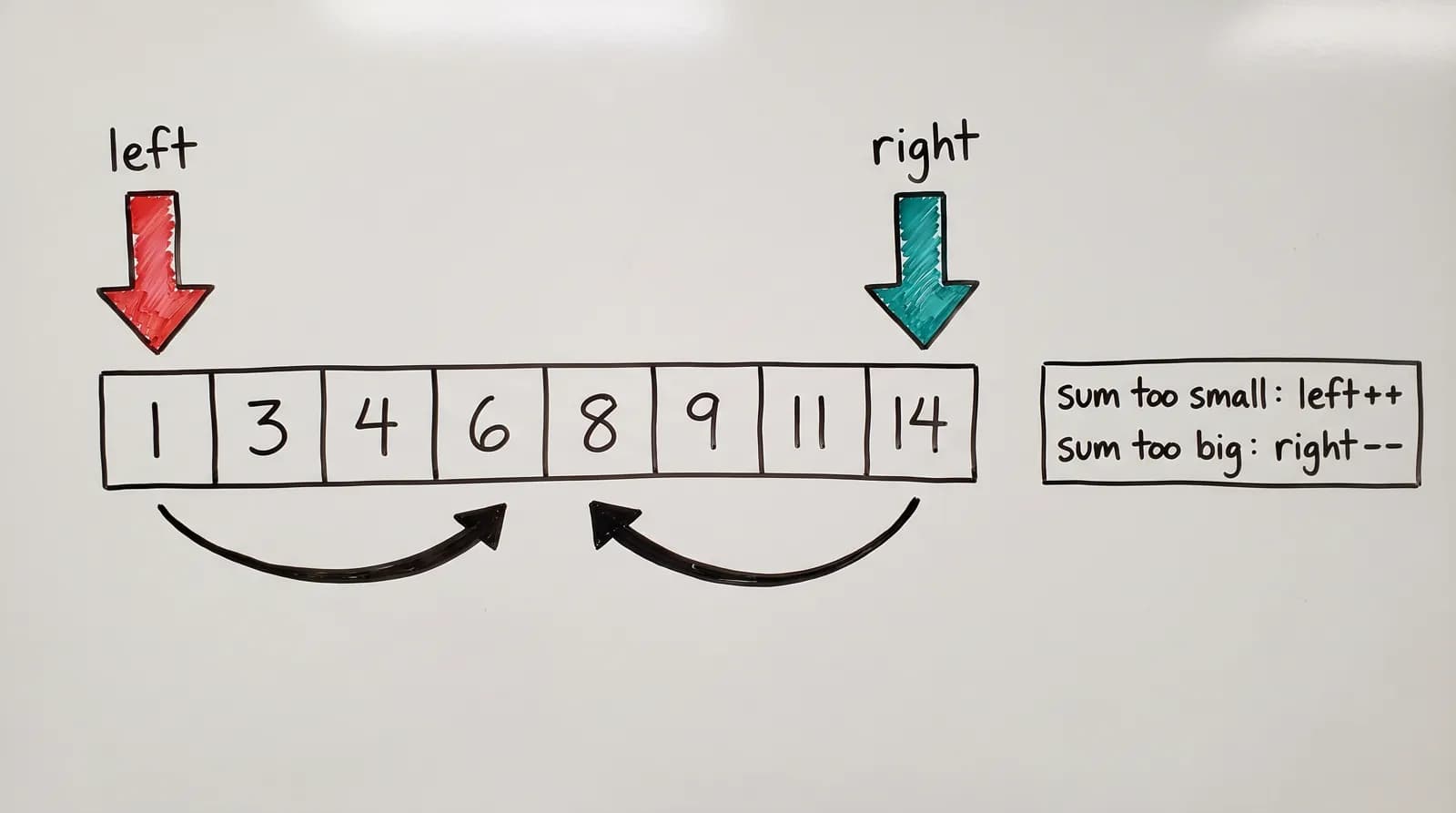
The brute-force way to find a pair in a list checks every pair: two nested loops, about n²/2 comparisons. Two pointers gets the same answer in one pass by using structure in the input, usually that it is sorted, to rule out many pairs at once.
Shape 1
Opposite ends
Put left at index 0 and right at the last index. In a sorted list, if nums[left] + nums[right] is too small, no pair that uses nums[left] can work, because every other partner is smaller than nums[right]. So left moves up. If the sum is too big, right moves down for the mirror reason. Stop when they meet.
- 1Check
left < rightIf they have met, there is no pair - 2Add the two ends
nums[left] + nums[right] - 3Compare with the targetEqual: done. Too small:
left += 1. Too big:right -= 1
left, right = 0, len(nums) - 1while left < right: total = nums[left] + nums[right] if total == target: ... # found a pair elif total < target: left += 1 # need a bigger sum else: right -= 1 # need a smaller sumShape 2
Slow and fast (reader and writer)
Both start at 0. fast visits every item; slow marks where the next kept item goes. When the item under fast should be kept, copy it to slow and advance slow. At the end, the first slow positions hold the answer. The same idea with steps of one and two finds the middle of a linked list or detects a cycle.
slow = 0for fast in range(len(nums)): if keep(nums[fast]): nums[slow] = nums[fast] slow += 1# nums[:slow] is the answer; slow is its lengthkeep(...) is the only problem-specific part.Why it works
O(n) time, O(1) space
Every loop iteration moves at least one index, and no index ever moves back. Opposite ends can do at most n − 1 moves before the indexes meet. Slow/fast does exactly n moves of fast. No nested loop, no extra list, so O(n) time and O(1) extra space.
Common bugs
Do
- Loop while
left < rightwhen the two indexes must be different. - Sort first (O(n log n)) or use a hash set when the list is not sorted.
- Move exactly one index after a mismatch.
- Handle the empty and one-item lists before you start.
- In slow/fast, return the new length and compare with the last kept value,
nums[slow - 1].
Don't
- Use
left <= rightfor a pair: the two indexes can land on the same item. - Run the opposite-ends scan on an unsorted list: the move rule depends on order.
- Move both indexes after a mismatch, which can skip the answer.
- Forget that
len(nums) - 1is −1 or 0 for those tiny lists. - Return the list instead of the new length, or compare with the wrong neighbour.
Key points
- Two indexes over one list turn an O(n²) pair search into one O(n) pass with O(1) extra memory.
- Opposite ends needs order: a small sum moves
leftup, a big sum movesrightdown. - Slow/fast compacts in place:
fastreads everything,slowwrites what you keep. - Indexes only move forward (or inward), never back. That is why it is linear.
- State the invariant, then check
left < right, sortedness and the tiny lists.