
Design an elevator system
medium 90 minModel a bank of several cars that answer hall calls and car calls.
Video lesson · Chapter 1 of 6
Make a prediction
Elevator system LLD in 90 seconds
1:26Reel coming soon
Theory
Read or listen first. About 2 min.
What it is
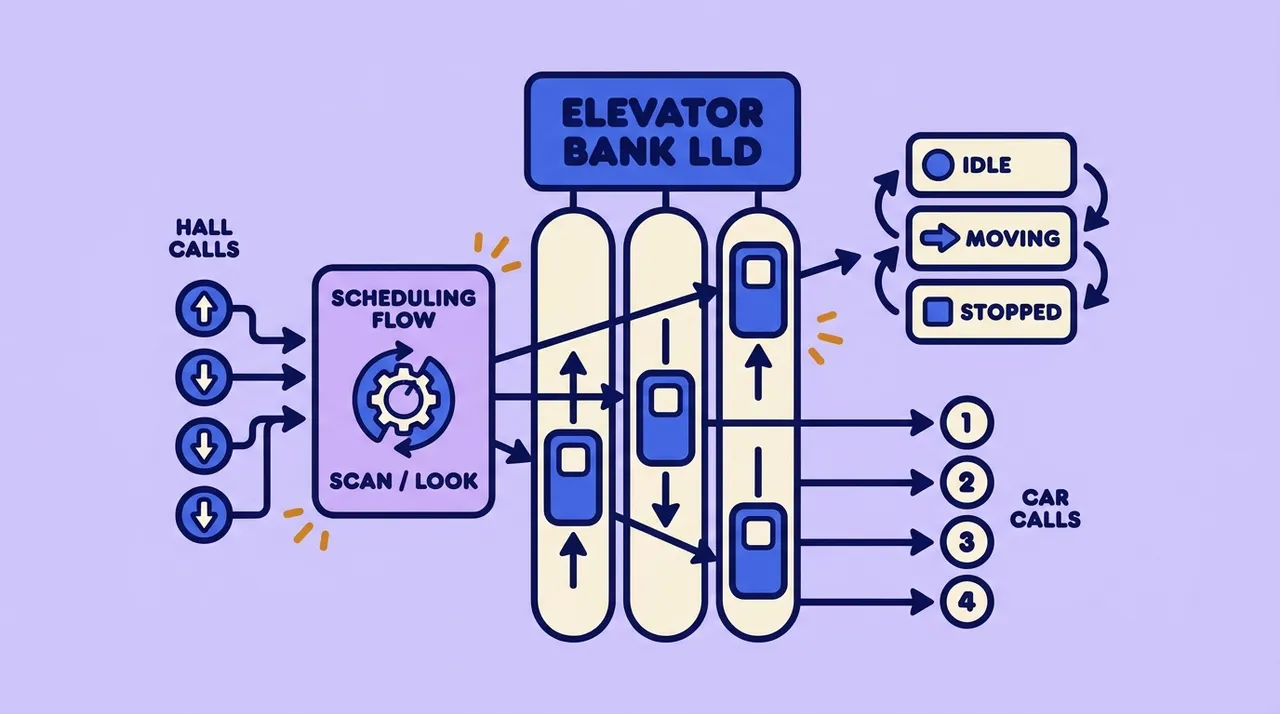
An elevator system in a low-level design round is the control software of one or more cars. It turns presses into promises (this car will come), promises into an order of stops, and the order into single steps of a motor and a door.
Underneath it are two classic problems. Choosing a car is assignment: match work to workers. Ordering stops is one-dimensional routing: visit points on a line with little travel and without forgetting anyone.
The answer is small: a bank, a car, a call and one rule. The difficulty is in what a stop means. A button inside is served whenever the car passes; a call from a floor only in its direction.
Why it exists
Everybody has waited for a lift and been angry at it. That makes it a good exercise: each person has requirements without reading a document.
It separates people who model nouns (floor, button, panel) from people who model decisions. The nouns are many and empty. The decisions are few and hard.
It has honest safety in it. Software with a motor must say what happens when it is wrong, and which rules it does not guard alone.
A short history
1852
Elisha Otis introduces the safety elevator: if the cable breaks, the car does not fall. Otis shows it in New York in 1854.
1857
On 23 March the first such passenger elevator is installed in a store at 488 Broadway, New York.
1880
Werner von Siemens builds the first electric elevator in Germany.
1961
Leo Port in Sydney proposes and patents destination dispatch. Relays are not ready for it; microprocessors make it possible from the late 1970s.
1968
The first volume of Donald Knuth's The Art of Computer Programming simulates the elevator of a mathematics building. It is the earliest published treatment of the elevator algorithm.
Words to know
- Hall call
- A press on a floor: floor and direction.
- Car call
- A press inside a car: a target floor. Also cabin call.
- Bank
- A group of cars that share hall buttons.
- Dispatcher
- The rule that chooses a car for a hall call.
- SCAN
- Sweep to the end of the shaft, then back. The elevator algorithm.
- LOOK
- Like SCAN, but turn at the last stop ahead.
- Dwell
- How long doors stay open.
- Interlock
- A condition that makes a dangerous action impossible.
- Nudging
- Closing slowly with a buzzer after several obstacles.
- Destination dispatch
- People enter the target in the lobby and are sent to a car.
The solution, twice
Reach the regular design first. Then go where a FAANG interviewer digs.
Solve it like an interview
New to it? Start with Approach. Revising? Go straight to the mock.
- 1ApproachWhat this question tests, where it gets hard, and how to spend the time.
- 2ScopeAsk what changes the design, then commit to a short list.
- 3API and dataThe contract first, then the data that serves it.
- 4DesignStart with the smallest system that works. Change it only when something breaks.
- 5Deep divesCompare the options before you open them, then say which you would pick.
- 6Explain your choicesAnswer first. Then compare your reasoning.
- 7By levelThe same question is judged differently for mid, senior and staff.
- 8MockAnswer against the clock, then score yourself.
How it works
Step through the idea, or press Play.
Hall call. A person on a floor asks for up or down; the dispatcher assigns the most suitable car
Understand it
Start here
The lighthouse with two buckets
A lighthouse keeper lifts oil, bread and letters with two buckets, each on its own rope. There are five levels and one bell on each. Watch three things: who decides which bucket comes, who decides where it stops, and why the direction of a call must not be forgotten.
Two decisions, choose and drive. Keep them in two classes and the rest of this problem becomes small.
What an interviewer looks for here
Two kinds of call
A hall call has a direction, a car call has a target. Mixing them is the most common mistake.
Choose and drive apart
Which car comes is a rule that changes. How a car moves is mechanics that does not.
A clear turn rule
Go on while there is work ahead, then turn. Nobody waits forever.
Doors are not decoration
The car never moves with open doors. Say where this rule lives.
Questions
Six questions, and what each answer changes
| Ask | If the answer is | Then |
|---|---|---|
| How many floors and cars? | 10 floors, 2 cars | Simple loops are fast enough. Say so |
| Up and down buttons, or a target in the lobby? | Up and down | Hall calls with a direction. A target in the lobby is another design, see the Destination dispatch page |
| Is there a weight limit? | Not today | A car always takes everybody. Name the place where a limit would go |
| Emergencies? | Fire alarm | A mode that overrides stops. Later, not in the first code |
| Doors blocked by people? | A timer is enough | A count of ticks. With sensors, Door becomes a class |
| One thread or many? | A simulation | step() moves the world by one tick. Real buttons come from other threads: FAANG page 1 |
One trip, from the button to the empty car
Two calls
Hall call and car call
| Hall call | Car call | |
|---|---|---|
| Pressed | On a floor, outside | Inside a car |
| Carries | Floor and direction | Target floor only |
| Who serves it? | Any car: the dispatcher chooses | This car, nobody else |
| Direction | Must be said | Follows from where the car is |
| Can be moved to another car? | Yes, until it is served | Never: the person is inside |
| In the code | HallCall(5, DOWN) | car.press(1), a number in a set |
Should this car open here?
Design, first try
The design most people draw first
The design to avoid: a class for every noun, and the direction is lost
1/4A global building
getInstance(10, 2) the first time, getInstance(40, 8) the second time, and the second answer is the first building. The arguments are ignored in silence.
owns (dies together)usesimplementshas (lives on)extends (is a)
class Elevator: def __init__(self, floor): self.floor, self.up_stops, self.down_stops = floor, set(), set() def add_stop(self, floor): # the direction of the call is not even a parameter if floor > self.floor: self.up_stops.add(floor) elif floor < self.floor: self.down_stops.add(floor) def go_up(self): self.floor += 1 if self.floor in self.up_stops: self.up_stops.remove(self.floor) print("doors open at", self.floor)lift = Elevator(1)lift.add_stop(9) # somebody inside wants 9lift.add_stop(5) # on floor 5 somebody pressed DOWNfor _ in range(8): lift.go_up()lift.add_stop(9) # pressed again while standing at 9print(lift.up_stops, lift.down_stops)Design, better
The design to reach
The design to reach: one bank, independent cars, one rule for choosing
1/5Start with the car
A car has a floor, a direction and stops. It has two kinds of stop, because they mean different things: a button inside (cabin) and a call from a floor (hall).
owns (dies together)usesimplementsdepends onhas (lives on)
What each class owns
| Class | Knows | Does | Does not know |
|---|---|---|---|
Bank | Cars, floors, who promised what | Checks buttons, assigns, switches lamps | How a car moves |
Car | Its floor, direction, stops, door timer | One tick, estimates its own arrival | Other cars, lamps |
Dispatcher | Nothing between calls | Picks one car for one call | Doors, stops, people |
HallCall | Floor and direction | Nothing: a value | Which car will come |
Order
FCFS, SCAN and LOOK
Ten people press ten buttons. In which order should one car visit the floors? The question is older than most computers, and it is the same question a disk arm has. The elevator algorithm (SCAN) was named after lifts, not the other way round.
| Rule | Turns | Floors travelled for 10 random stops out of 20 floors | Trouble |
|---|---|---|---|
| First come, first served | Whenever the next call is the other way | 69.8 | Runs past people who wait |
| SCAN | At the top and bottom of the building | 26.1 | Goes to floors nobody asked for |
| LOOK | At the last stop ahead | 24.7 | Must look ahead, one line of code |
| Nearest stop first | Whenever the nearest is the other way | Often short | Starves far floors: a busy middle keeps it |
Car at 5, going up, with calls at 8, 3 and 7
States
The life of a car
Three states, and no arrow from moving to moving with open doors
The life of a hall call
The other decision
Which car should come?
How does the dispatcher compare two cars?
BreaksDistance
- How
abs(car.floor - call.floor)- Limit
- A car one floor away that is leaving in the other direction wins, and comes back after a full tour.
- Choose when
- One car, or a first sketch.
WorksDistance plus a penalty
- How
- Add 100 if the car would have to turn.
- Limit
- It does not see stops. A car 7 floors away with 6 stops on the way beats an idle car at distance 8, although it needs 26 ticks against 9.
- Choose when
- A fair answer for the first 30 minutes. Say what it ignores.
StrongAsk the car how long it would take
- How
- Copy the car, add the call, run
step()on the copy until the call is served, count. - Limit
- More work: at most a few hundred small steps per car. And it knows only what is known now.
- Choose when
- Here. The estimate can never disagree with the real movement, because it is the movement.
The third option is worth a pause. A formula for the arrival time must know every rule of the car: turning, doors, promises. Write it and you have the rules twice. Running the real rules on a copy keeps them in one place.
Summary
The whole topic in one minute.
A bank remembers which car promised which call. A dispatcher chooses, a car drives. The car holds cabin floors and hall calls apart, goes on while there is a stop ahead, then turns, and opens for the other direction only where it turns.
One tick does one thing: open, wait or move. The wait comes before the move, and that line is the interlock. Estimates run on a copy of the car. Modes come before stops, threads talk through one inbox.
- Hall call: floor and direction. Car call: floor only. Keep them apart inside the car.
- A dispatcher chooses, a car drives, a bank remembers promises and lamps.
- LOOK: go on while there is a stop ahead, then turn. Never go to floors nobody asked for.
- A car opens for its own direction, and for the other one only where it turns.
- Moving and open doors exclude each other in one place of the code.
- State is derived from direction and door timer, so it cannot disagree with them.
Sources
- Wikipedia: Elevator algorithm
- Wikipedia: LOOK algorithm
- Wikipedia: Elevator
- Wikipedia: Destination dispatch
- Linux kernel: Deadline IO scheduler tunables
- PostgreSQL: synchronize_seqscans
- Open-RMF: lift messages
- Elevator Saga: documentation
- US Access Board: guide to elevators
- Java SE 21 API: TreeSet
- Java SE 21 API: ConcurrentSkipListSet
- Java SE 21 API: CountDownLatch