
Design a parking lot
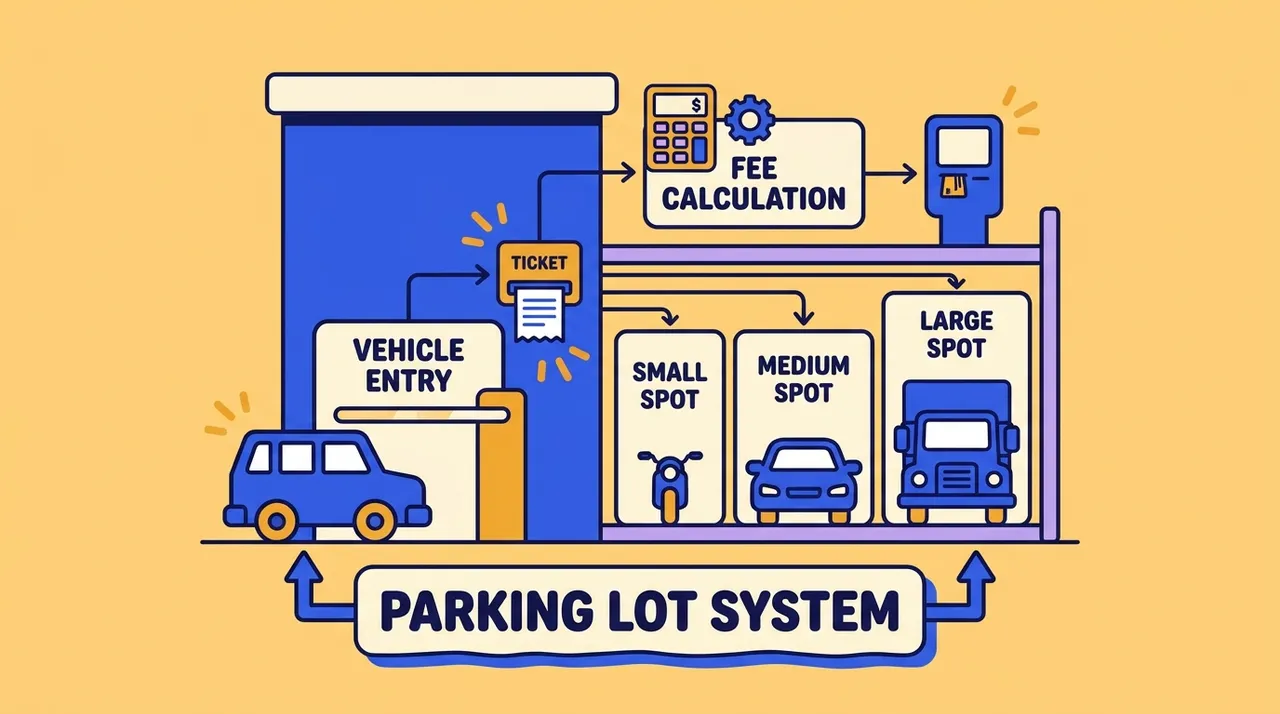
medium 90 minModel a car park with several levels as classes: vehicles, spaces of different sizes, tickets and a replaceable price rule.
Video lesson · Chapter 1 of 6
Make a prediction
Parking lot LLD in 90 seconds
1:28Reel coming soon
Theory
Read or listen first. About 2 min.
What it is
A parking lot in a low-level design round is the software at the gates of a car park. It decides which vehicle gets which space, remembers it on a ticket, and at the end turns the time into a price.
Underneath it is a resource allocator: typed things in limited number, a rule who fits where, a claim, a release and a bill. Meeting rooms, hotel rooms, seats and database connections have the same shape.
The answer is small: one coordinator with two verbs, one owner of free spaces, a few records, and one interface for prices. The skill is to see why it is enough.
Why it exists
It is a popular exercise because everybody knows car parks. No time is lost on explaining the domain, so the conversation is about objects from the first minute.
It hides three real difficulties in a friendly picture: classes that differ only in data, prices that change, and two people who want one thing at the same moment. Each appears in systems you will build.
It also shows judgement. The problem can grow without end, with booking, charging, cameras and passes. Choosing what to leave out, and saying so, is part of the answer.
A short history
1901
The earliest known multi-storey car park opens in Denman Street, London: seven floors, space for 100 vehicles.
1935
The first parking meter is installed in Oklahoma City on 16 July. Time becomes a price, coin by coin.
1970
Compare and swap becomes part of the IBM System/370 architecture: change a value only if it is still the expected one, in one instruction.
1994
The book Design Patterns describes Strategy and Observer, the two patterns people reach for here.
2004
Java 5 brings the concurrency utilities of JSR 166: locks, semaphores, atomic values and concurrent collections.
2017
San Francisco's transport agency adopts demand-responsive parking prices on 5 December: a real tariff that changes by place and time.
Words to know
- Space or spot
- One place for one vehicle, with a size. In code often
Spot. - Smallest size
- The least size a vehicle fits. Larger ones fit too.
- Fallback
- Using the next larger size when the best one is out.
- Pool or free list
- The collection of what is free. Being in it is being free.
- Claim
- Find and take in one step.
- Check then act
- Two steps with a gap. Also called time of check to time of use.
- Ticket
- The unchanging record of one stay: vehicle, space, moment.
- Started hour
- An hour that has begun counts as a whole one.
- Idempotent
- Doing it twice has the same result as doing it once.
- Invariant
- A sentence that is true after every operation, such as free plus taken is total.
The solution, twice
Reach the regular design first. Then go where a FAANG interviewer digs.
Solve it like an interview
New to it? Start with Approach. Revising? Go straight to the mock.
- 1ApproachWhat this question tests, where it gets hard, and how to spend the time.
- 2ScopeAsk what changes the design, then commit to a short list.
- 3API and dataThe contract first, then the data that serves it.
- 4DesignStart with the smallest system that works. Change it only when something breaks.
- 5Deep divesCompare the options before you open them, then say which you would pick.
- 6Explain your choicesAnswer first. Then compare your reasoning.
- 7By levelThe same question is judged differently for mid, senior and staff.
- 8MockAnswer against the clock, then score yourself.
How it works
Step through the idea, or press Play.
Vehicle arrives. The smallest free space that fits is claimed, and a ticket is made
Understand it
Start here
A day at Sandy Point
Before any class, look at the thing itself. This small car park by the sea has five spaces: one small (S1), three medium (M1, M2, M3) and one large (L1). Watch what must be remembered, what must be decided, and who decides it.
Two verbs, enter and leave. Everything else on this page is about doing these two well when many people do them at once.
What an interviewer looks for here
Do they ask?
Sizes, vehicles, prices, number of gates. Each answer changes a class.
Do they give each class one job?
The lot orders the work, the pool owns spaces, the ticket remembers, the policy prices.
Do they resist extra classes?
Vehicle types that differ by one field are an enum. A level that is only a number stays a number.
Is one space sold once?
Finding and taking a space is one step. This is the point most answers miss.
How to spend the round
Questions
Five questions, and what each answer changes
| Ask | If the answer is | Then |
|---|---|---|
| How many levels, how many spaces of each size? Can the layout change while it runs? | Fixed, known at the start | A list of Spot records passed to the constructor |
| Which vehicles? May a small one use a larger space? | Motorcycle, car, bus; yes; a large one never uses a smaller one | An enum with the smallest size, and a fallback upwards |
| How is the fee calculated? Per started hour, flat, by size, by time of day? Is there a minimum? | Several rules, changing | A Pricing interface, injected |
| One entrance or many? | Many | Many threads: claim must be one atomic step |
| Is payment, a sign, or booking in scope? | Payment by someone else's machine | A one-method interface; the rest is an extension |
Fit
Who fits where
| Vehicle | Small | Medium | Large | Spaces |
|---|---|---|---|---|
| Motorcycle | yes, first choice | if no small is free | if no medium either | 1 |
| Car | no | yes, first choice | if no medium is free | 1 |
| Bus or truck | no | no | yes | 1 large here; 5 in a row is an extension |
spot.size >= vehicle.minSize, tried from the smallest. Some interviewers say compact instead of medium. The rule stays.Finding a space for a motorcycle
Design, first try
The design most people draw first
Every noun becomes a class, every difference a subclass, and the lot does the rest. It works on the whiteboard. Then the second gate opens, the tariff changes, and the electric spaces arrive.
The design to avoid: one class that knows all, and a tree for every noun
1/4The class that does everything
Spaces, prices, cards, printing and the sign in one class. A new tariff, a new card machine and a new sign all change the same file. It is also a Singleton, so two tests share one lot.
usesowns (dies together)has (lives on)extends (is a)
class ParkingLot: # everything in one class def park(self, plate, kind): for spot in self.spots: # looks at every space, every time if spot["free"] and self.fits(kind, spot["size"]): spot["free"] = False # a second gate may be here too self.entry[plate] = datetime.now() return spot["id"] def fee(self, plate, kind): hours = (datetime.now() - self.entry[plate]).seconds / 3600 if kind == "car": return hours * 2.0 # floating-point money elif kind == "bus": return hours * 5.0 elif kind == "motorcycle": # the next rule goes here, and here return hours * 1.0.seconds, which silently drops whole days.Design, better
The design to reach
The design to reach: one coordinator, one owner of free spaces, plain records
1/6Start from the two verbs
The requirements have two sentences with a verb: a vehicle enters, a vehicle leaves. They become the two methods of one coordinator, ParkingLot. Everything a gate needs is there.
owns (dies together)usesimplementshas (lives on)
ticket = lot.enter(Vehicle("RED-1", VehicleType.CAR)) # claims a space, or Nonereceipt = lot.leave(ticket.id) # prices, charges, freeslot = ParkingLot(spots, DailyCap(HourlyPricing(rates), 2000), payments, clock)# ^ a new rule is a new object passed in, not a new branchRoles
What each class owns
| Class | Knows | Does | Does not know |
|---|---|---|---|
ParkingLot | Active tickets, plates inside, one lock | Orders the steps of enter and leave | Which space is best, how much it costs |
SpotPool | Free spaces by size | Claims and releases | Vehicles, tickets, money |
Spot | Its id, level and size | Nothing: a record | Whether it is free, who is in it |
Vehicle | Plate and type | Nothing: a record | Where it is parked |
Ticket | Vehicle, space, entry time | Nothing: an unchanging receipt | Prices |
Pricing | Rates | Turns a ticket and a time into cents | Spaces, cards |
Payments | Somebody else's machine | Charges once per key | Parking |
States
The life of a space and of a ticket
A space
A ticket
The hard part
Two drivers, one space
Two gates, one free space, the same second. Nobody does anything stupid. Each clerk looks, sees a free space and prints a ticket. The mistake is that looking and taking are two steps.
The fix is not a faster clerk or a second look. It is one thing that only one hand can hold.
The same second, without a lock
The same second, with one atomic claim
How do you stop two gates from giving out one space?
BreaksCheck, then take
- How
if spot.isFree(): spot.park(car)from each gate.- Limit
- Both gates can pass the check before either takes. Tests with one thread never see it.
- Choose when
- Only with a single thread, and even then it is a habit to lose.
WorksOne lock around find and take
- How
- One lock in the lot, held for the few microseconds of a claim. No payment, no printing inside.
- Limit
- All gates queue for it. With a handful of gates the queue is nearly always empty.
- Choose when
- The right first answer. Say the numbers: a car every few seconds against microseconds.
StrongMake taking the check
- How
- An atomic removal from a free queue, a compare and set on the space, or one conditional update in the database. Whoever wins owns it.
- Limit
- Covers one space. Two spaces at once, or a space and a plate, still need a lock or a transaction.
- Choose when
- Many gates, several processes, or a database. Name the one you use and what the loser sees.
Money
Prices as rules, money as whole cents
Strategy is the pattern here: one interface, several rules, chosen from outside. The lot asks for a price and does not care how it was made. That is the open/closed principle at work: open for a new rule, closed for changes in ParkingLot.
| Stay in M1 (200 cents an hour) | Started hours | Hourly | Hourly, at most 2000 a day | Event flat rate |
|---|---|---|---|---|
| 0 minutes | 1 (the minimum) | 200 | 200 | 1500 |
| 60 minutes | 1 | 200 | 200 | 1500 |
| 61 minutes | 2 | 400 | 400 | 1500 |
| 130 minutes | 3 | 600 | 600 | 1500 |
| 11 hours | 11 | 2200 | 2000 | 1500 |
Started hours without floating point
Do
- Use enums with data for types that differ by one field
- Put pricing behind an interface
- Keep free spaces grouped by size
- Make find and take one step
- Store money as whole cents and time as an instant
- Pass the clock in
- Agree on the requirements before writing code
Do not
- Build
Car extends VehicleandCompactSpot extends Spotfor one field - Let an
ifchain on vehicle type grow in the fee method - Scan every space for every arrival
- Check in one step and take in another
- Use floating-point money
- Call the system clock deep inside
- Start coding and rewrite when trucks appear
Is it a class at all?
Summary
The whole topic in one minute.
Two verbs, enter and leave. One owner of free spaces, grouped by size, where finding is taking. Tickets, vehicles and spaces are records. Prices are a rule that is passed in, in whole cents.
Check plate, claim and store under one short lock. At the exit take the ticket out, charge without a lock, put it back on failure, and release last. Reject classes that hold nothing, and say so.
- Ask first: levels, sizes, vehicles, prices, gates, and what is out of scope.
- One job per class: the lot orders the work, the pool owns free spaces, tickets are unchanging records, pricing is a rule.
- Enums for differences in data. Subclasses only for differences in behaviour.
- Being in the free queue is being free. Taking a space is the check.
- Charge before you release. Never hold the lock while you wait for a card.
- Whole cents, instants in UTC, an injected clock, no Singleton.
Sources
- Wikipedia: Strategy pattern
- Java SE 21 API: ConcurrentLinkedDeque
- Java SE 21 API: Semaphore
- Java SE 21 API: ReentrantLock
- PostgreSQL: SELECT, the locking clause
- HikariCP source: ConcurrentBag
- Linux memory manager: physical page allocation
- Stripe: idempotent requests
- Stripe: currencies and minor units
- Redis: SET
- SFMTA: demand-responsive parking pricing
- Python: zoneinfo
- OpenJDK: jcstress
- Wikipedia: Multistorey car park
- Wikipedia: Parking meter