
SOLID in one page
medium 45 minFive principles for classes that can be changed without fear: single responsibility, open/closed, Liskov substitution, interface segregation and dependency inversion.
Watch lesson5:16
Chapter mnemonic
Five SOLID design questions
One job. Bolt on extras. Swap a part. Pack small kits. Fit a standard socket.
A replacement part fits, but it breaks behavior the caller relies on. Which SOLID principle is at stake?
Liskov substitution. A subtype must honor the behavioral contract of its supertype.
Remember it
The few things worth knowing cold, and how to make them stick.
Memory hook
Who asks, what is added, can I trust it, what do I need, who owns it?
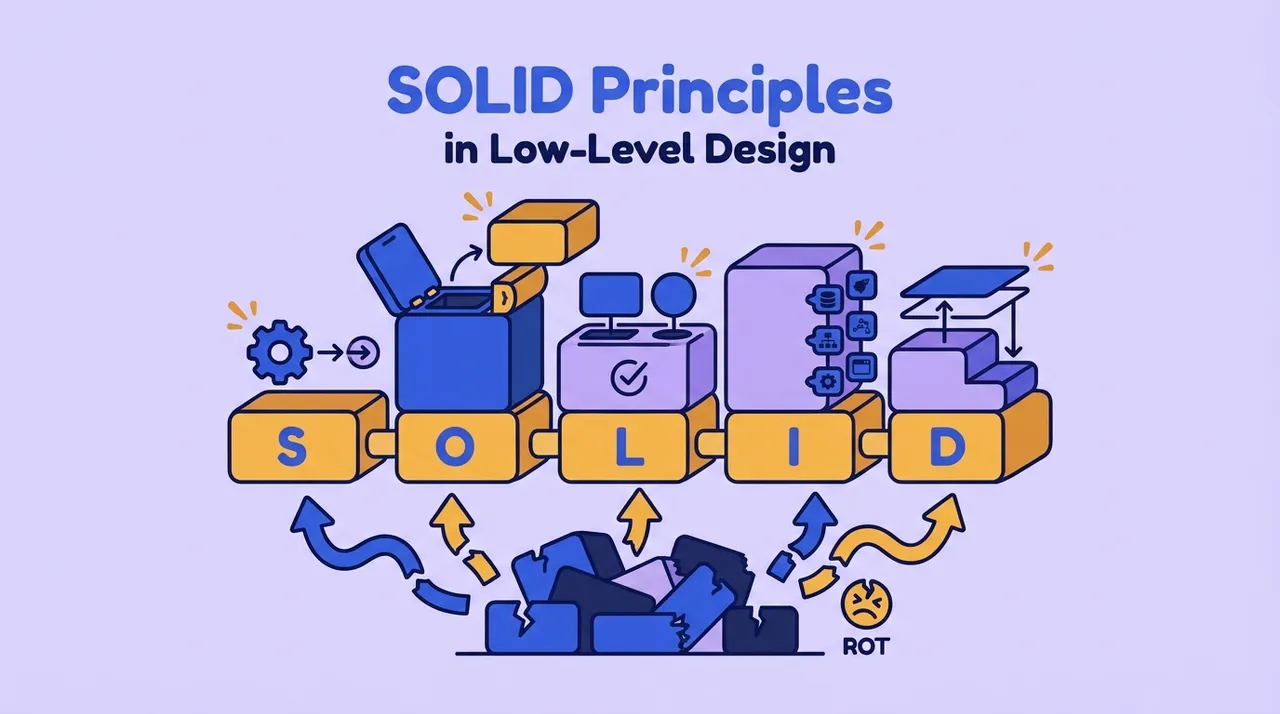
A marble run on a board with holes. S: one piece, one job. O: hang one more. L: what goes in must come out. I: one peg if you need one. D: the board owns the holes, not the funnel.
Cheat sheet
- S
- one group of people may ask for a change
- O
- new kind = new code, on a chosen axis
- L
- never ask for more, never give less, no surprise
- I
- a caller sees only what it uses
- D
- the rule owns the port, the detail implements it
- Chain
- S and I cut, D turns arrows, O gains, L keeps
- DI
- handing things in: a technique, not the principle
- Order
- the next wish decides
- Stop
- one kind, one owner, closed set
Spot it when you see
- A class named Manager
- The same switch again
- isinstance in the core
- An empty or raising method
- new inside a rule
- A test that needs a server
Tricks that stick
- Five words: Split, Open, Like (a subtype acts like its parent), Interfaces, Direction.
- One hand, five fingers: each does one job, and you grip only when they work together.
- For L ask: would a caller notice the swap?
Do not forget
- All five at once
- An interface per class
- Contracts owned by the detail
- Injection taken for inversion
- Promises only in the signature
- Reciting letters instead of pointing at lines