
Bad deploy & rollback
medium 6 minA rollback restores a known-good serving configuration.
Video lesson · Chapter 1 of 4
A bad release behind a healthy average
Theory
Read or listen first. About 1 min.
What it is
A rollback restores a known-good serving configuration. Its safety depends on everything the new version touched, including durable records, message formats and clients that already changed. A flag rollback can be faster when it isolates the faulty behavior and both paths still read the same data.
Why it exists
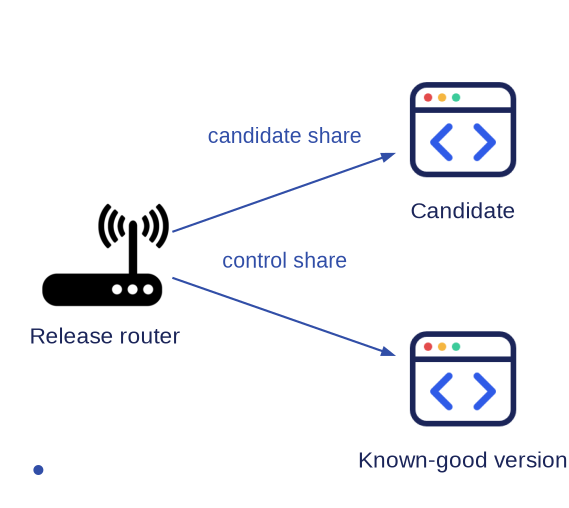
A release fails only on older mobile clients. Scope the cohort by client and release, stop expansion and choose a reversible action. Before switching binaries, confirm the old reader accepts records written by the new writer. Afterward, verify the same failing client journey and any background queue that may need to drain.
If older clients also fail on the control, inspect shared dependencies or a client-side release before rolling back healthy servers.
A bad release behind a healthy average
How it works
Step through the idea, or press Play.
Baseline. The baseline handles older clients.
Understand it
Worked incident
A bad release behind a healthy average
| Observation | Candidate failures per 1000 (failures) | Interpretation |
|---|---|---|
| Baseline | 2 | The baseline handles older clients. |
| Incident | 48 | The candidate fails a formerly supported payload. |
| After intervention | 3 | Withdraw exposure using the compatible path and recheck older clients alongside the rest of traffic. |
Choose the next investigation
Summary
The whole topic in one minute.
Code can be rolled back faster than data. An old reader may fail on records already produced by the candidate.
If older clients also fail on the control, inspect shared dependencies or a client-side release before rolling back healthy servers.