
Database internals on the critical path
hard 7 minMany storage engines persist a description of a change before relying on the changed data pages.
Video lesson · Chapter 1 of 4
Commits stall while reads remain fast
Theory
Read or listen first. About 2 min.
What it is
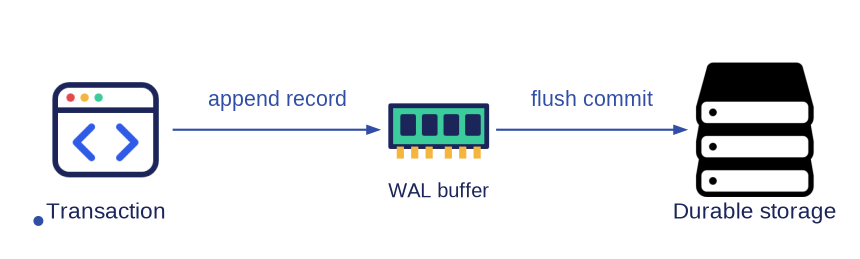
Many storage engines persist a description of a change before relying on the changed data pages. With synchronous commit settings, acknowledgment waits for the configured durability condition. Group commit can amortize a flush over several transactions. Cached reads may remain fast while durable writes queue behind slow flushes.
Why it exists
An order service shows slow commits but normal indexed lookups. Split transaction time into lock wait, execution and commit. Correlate commit delay with WAL flush latency and competing device I/O. Disabling durability changes what a successful order means. Prefer reducing contention or batching compatible work while keeping the agreed acknowledgment guarantee.
If the application waits before commit starts, measure row locks, pool leases or query execution before changing storage.
Commits stall while reads remain fast
Inside this chapter
- B-tree indexes and range reads
- Balanced-tree indexes keep keys ordered and support selective lookups and ranges. PostgreSQL’s default B-tree is an implementation choice. SQL itself does not prescribe an index structure.
- LSM Trees (Write-optimized, Cassandra/RocksDB)
- An LSM engine buffers writes, flushes immutable runs and merges them over time. Compaction backlog can raise read amplification and eventually constrain writes.
- Write-Ahead Logs (WAL) and durability
- Write-ahead logging requires log records to reach the necessary durability boundary before related data-page changes can safely stand on their own. Recovery replays the log.
- Bloom Filters for read efficiency
- A Bloom filter can skip a run when a key is definitely absent under the filter’s assumptions. A positive result still requires checking the actual data.
- MVCC (Multi-Version Concurrency Control)
- MVCC stores or reconstructs multiple versions so a reader can view its snapshot. Old transactions can delay version reclamation and increase storage pressure.
- Index Types: B+Tree, Hash, GIN, GiST
- Ordered, hash, inverted and generalized indexes support different predicates and operators. Inspect the query plan and workload before accepting index storage and write costs.
- Connection Pooling (PgBouncer, ProxySQL)
- A connection pool multiplexes clients onto a bounded backend set. Pool mode influences session state. Count lease waiting separately from SQL execution time.
How it works
Step through the idea, or press Play.
Modify state. A transaction generates a log record describing a change.
Understand it
Worked incident
Commits stall while reads remain fast
| Observation | Commit flush p95 (ms) | Interpretation |
|---|---|---|
| Baseline | 3 | WAL flushes complete promptly. |
| Incident | 84 | A competing sequential job stretches sync latency. |
| After intervention | 5 | Isolate or pace the competing work and verify commit acknowledgment under the same durability setting. |
Choose the next investigation
Summary
The whole topic in one minute.
Acknowledging earlier can expose successful recent transactions to loss in a crash. Latency and durability describe different promises.
If the application waits before commit starts, measure row locks, pool leases or query execution before changing storage.