
Running and learning from an incident
medium 7 minIncident response separates decision ownership, execution and communication so responders can work in parallel without undoing one another.
Video lesson · Chapter 1 of 4
Three responders change the same system
Theory
Read or listen first. About 2 min.
What it is
Incident response separates decision ownership, execution and communication so responders can work in parallel without undoing one another. A shared state document records user impact, known facts, hypotheses, actions and owners. It should distinguish a dependency recovering from the customer journey actually returning to normal.
Why it exists
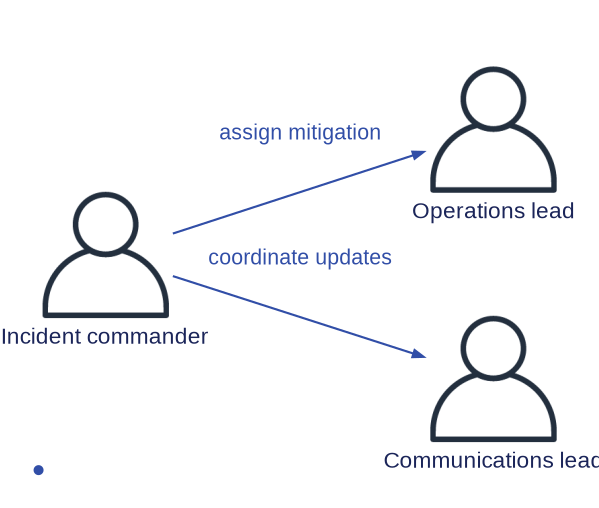
During a partial outage three teams change capacity at once. Symptoms shift and nobody can attribute the improvement. Establish a commander, assign one operations owner for each action and publish a timed customer update. After recovery, reconstruct contributing conditions and assign preventive work with a verification date. A postmortem’s value depends on those changes being completed.
If operator actions are already coordinated but updates are stale, assign communications ownership and schedule the next verifiable update.
Three responders change the same system
Inside this chapter
- SLIs (Service Level Indicators)
- An SLI measures an outcome over eligible events, such as successful checkouts divided by attempts. Define exclusions and measurement location so the number represents the user experience.
- SLOs (Service Level Objectives)
- An SLO sets a target for an indicator over a window. A 99.9 percent request objective allows one bad eligible request per thousand over that window.
- SLAs (Service Level Agreements)
- An SLA is a service agreement with defined measurement rules and consequences. An internal SLO can be stricter and can use a different decision process.
- Error Budgets and release freezing
- An error budget is the allowed bad fraction times the eligible population. A release policy can slow risky changes when budget burns too fast while permitting repairs.
- Blameless Post-Mortems and Root Cause Analysis (RCA)
- A postmortem reconstructs conditions, decisions and consequences using the evidence available at the time. Assign corrective actions an owner and a way to verify risk reduction.
- On-Call Practices and Escalation Policies
- On-call coverage needs a reachable owner, escalation timing and handoff. Repeated unactionable pages are a signal to change alerts, capacity or operational ownership.
- Runbooks and Playbooks
- A runbook specifies actions for a known situation and should include validation and reversal. A playbook guides investigation when the exact cause is uncertain.
- Incident Communication and Status Pages
- Status updates state confirmed impact, mitigation and the next update time. An explicit communications lead allows operators to concentrate on restoring service.
- Capacity Planning and Forecasting
- Forecast demand with seasonality, service time and failure headroom. Validate the limiting resource under a realistic mix and estimate capacity while one failure domain is unavailable.
How it works
Step through the idea, or press Play.
Detect impact. A page identifies increased checkout errors and gives the first scope estimate.
Understand it
Worked incident
Three responders change the same system
| Observation | Uncoordinated changes per interval (changes) | Interpretation |
|---|---|---|
| Baseline | 0 | One operator coordinates each reversible action. |
| Incident | 3 | Independent teams make three overlapping changes and lose causal evidence. |
| After intervention | 0 | Centralize decisions and log outcomes. Close the incident only after checking user impact and backlog. |
Choose the next investigation
Summary
The whole topic in one minute.
Stakeholders can act on verified impact and a next checkpoint. False certainty can send responders toward the wrong system.
If operator actions are already coordinated but updates are stale, assign communications ownership and schedule the next verifiable update.