
Delivering a packet across local and routed links
medium 7 minAn Ethernet frame reaches the next hop on a local segment.
Video lesson · Chapter 1 of 4
Small messages pass and large ones stall
Theory
Read or listen first. About 2 min.
What it is
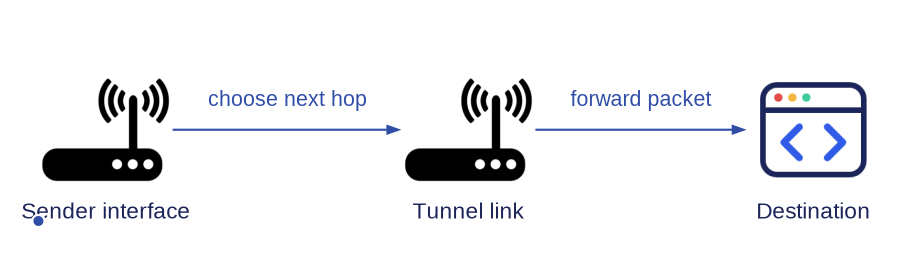
An Ethernet frame reaches the next hop on a local segment. A router removes that link envelope, chooses a route for the IP destination and forwards a new frame. Each link limits frame size. A tunnel adds headers, so the maximum useful payload on the inner path may be smaller than the sender expects.
Why it exists
After a tunnel change, small requests succeed while full-size responses stall. Compare packets at two controlled sizes on the same route and inspect path MTU reporting. Ordinary reachability checks can miss the threshold entirely. IPv6 routers do not fragment forwarded packets. The sender needs usable packet-too-big feedback or another way to discover a safe size.
If equally small and large requests fail, an MTU explanation is weaker. Check host reachability, route choice and application availability.
Small messages pass and large ones stall
Inside this chapter
- Ethernet Frames and MAC Addresses
- An Ethernet source and destination identify the local-hop endpoints. After a router forwards a packet the next link usually has a different frame while the IP destination remains the remote endpoint.
- ARP (Address Resolution Protocol) and the ARP Table
- ARP resolves an on-link IPv4 address to a link-layer address, often the gateway’s. IPv6 uses Neighbor Discovery. Inspect reachability at the correct hop.
- MTU (Maximum Transmission Unit) and MSS (Max Segment Size)
- MTU bounds the network packet a link can carry. TCP MSS describes segment payload and excludes headers. Tunnels can reduce usable payload without changing application message size.
- Packet Fragmentation drawbacks
- Fragments require reassembly and losing a fragment can prevent delivery of the whole datagram. IPv4 and IPv6 handle fragmentation differently. Diagnose path MTU before changing application retries.
- ICMP Internals: How ping and traceroute work (TTL Expiry)
- ICMP can report reachability or forwarding failures. Traceroute uses expiration at successive hop limits. Missing diagnostic replies can reflect filtering or rate limits as well as path failure.
- IP Routing Table and route selection
- Routes choose a next hop using rules that can include prefix length and policy. Examine the source, destination and namespace that the failing request actually uses.
- NAT mechanics: SNAT, DNAT, Masquerade
- Address translation rewrites endpoint addresses and possibly ports. Stateful mappings age out. A return packet must traverse a path that can apply the corresponding translation.
- VLAN Tagging (802.1Q)
- VLAN tags distinguish logical link-layer segments on a shared link. Both ends must agree on membership and tagging for frames to reach the intended broadcast domain.
- IPv4 vs IPv6: Key Differences
- IPv6 widens addressing, uses Neighbor Discovery and delegates fragmentation to sources. Dual-stack clients can therefore experience a different path or failure by address family.
How it works
Step through the idea, or press Play.
Look up a local peer. On this IPv4 subnet, the sender knows the peer IP but lacks its link address.
Understand it
Worked incident
Small messages pass and large ones stall
| Observation | Delivered large probes per 10 (probes) | Interpretation |
|---|---|---|
| Baseline | 10 | Large packets fit every link. |
| Incident | 1 | Encapsulation reduces usable payload and most large probes fail. |
| After intervention | 10 | Correct the tunnel MTU and allow required path feedback. Verify both size classes. |
Choose the next investigation
Summary
The whole topic in one minute.
Reachability of a small packet establishes little about maximum payload or the return path of a large response.
If equally small and large requests fail, an MTU explanation is weaker. Check host reachability, route choice and application availability.