
Crossing the kernel boundary
easy 7 minAn application executes ordinary instructions directly on the processor.
Video lesson · Chapter 1 of 8
Small writes, busy CPU
Theory
Read or listen first. About 1 min.
What it is
An application executes ordinary instructions directly on the processor. A privileged operation such as submitting device I/O goes through a kernel entry point. The processor changes privilege, the kernel validates the arguments and eventually returns to the caller. A mode transition can take place on the same thread. A context switch means that a different execution context is scheduled.
Why it exists
A video encoder starts writing each metadata field separately. The new version spends more CPU per frame although it emits exactly the same bytes. Count kernel entries for equal-sized frames and compare CPU time on a matched core. A scheduler counter answers a different question because it measures changes of running task.
If entries per frame remain constant, sample userspace encoding cost and compare bytes emitted.
Small writes, busy CPU
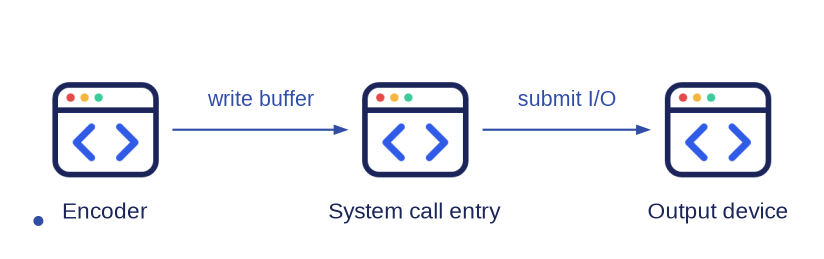
Inside this chapter
- CPU Ring Protection Levels (Ring 0 vs Ring 3)
- On x86 the kernel normally runs at ring 0 and applications at ring 3. The processor enforces privileged operations. Other architectures name their privilege levels differently.
- The cost of Context Switching
- Switching tasks saves and restores execution state. Disrupted cache or translation locality can cost more than saving the registers. Compare switches per completed operation at equal load.
- User Mode vs. Kernel Mode transitions
- A syscall enters privileged execution on behalf of the current thread. The thread can return directly without the scheduler choosing a different task.
- Interrupts and Traps
- An interrupt can arrive asynchronously from a device. A synchronous exception is tied to the executing instruction. A page fault is one such exception and can be handled successfully.
- DMA (Direct Memory Access) and Zero-Copy
- DMA lets a device transfer data to mapped memory. Zero-copy paths reduce data movement between software buffers. Page ownership, lifetimes and completion notifications still matter.
How it works
Step through the idea, or press Play.
Describe a transfer. The driver maps the buffer for the device and supplies descriptors for the I/O.
Understand it
Worked incident
Small writes, busy CPU
| Observation | Kernel entries per frame (entries) | Interpretation |
|---|---|---|
| Baseline | 1 | One buffered payload crosses the boundary once. |
| Incident | 64 | Sixty-four small writes transfer the same payload and repeat the entry work. |
| After intervention | 2 | A bounded buffer combines the fields into two writes. Confirm both frame latency and flush behavior. |
Choose the next investigation
Summary
The whole topic in one minute.
The application chooses how often to call write. A longer slice may change scheduling but leaves the same number of entries for a frame.
If entries per frame remain constant, sample userspace encoding cost and compare bytes emitted.