
Linux CPU & memory triage
easy 6 minHost utilization reports how busy resources were over an interval.
Video lesson · Chapter 1 of 8
Load rises while the CPU still has headroom
Theory
Read or listen first. About 1 min.
What it is
Host utilization reports how busy resources were over an interval. Saturation describes work waiting for them. Linux load average includes runnable work and tasks in uninterruptible sleep, so a high load average does not by itself identify CPU demand. Measure pressure and queueing at the boundary where the service runs.
Why it exists
During a batch import, load average increases but many CPUs remain idle. Inspect runnable versus blocked tasks, memory pressure, disk waits and cgroup limits. A large working set can cause repeated reclaim and stalls while CPUs wait. Test a bounded reduction in import concurrency and see which counters move with user latency.
If memory and I/O stalls stay flat while runnable demand rises, inspect group bandwidth limits and core placement.
Load rises while the CPU still has headroom
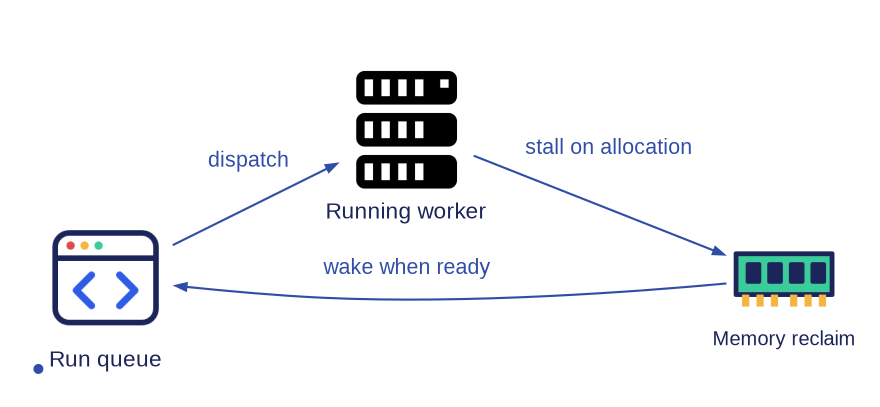
How it works
Step through the idea, or press Play.
Baseline. The interactive workload rarely stalls on memory.
Understand it
Worked incident
Load rises while the CPU still has headroom
| Observation | Memory stall time per 10 s (ms) | Interpretation |
|---|---|---|
| Baseline | 25 | The interactive workload rarely stalls on memory. |
| Incident | 1500 | An import expands the working set and stalls consume 1.5 seconds per interval. |
| After intervention | 39 | Limit import concurrency and verify stalls, request latency and batch completion together. |
Choose the next investigation
Summary
The whole topic in one minute.
Load mixes different waits. Memory stall evidence identifies a distinct bottleneck that extra cores may not relieve.
If memory and I/O stalls stay flat while runnable demand rises, inspect group bandwidth limits and core placement.