
Following a request through a node
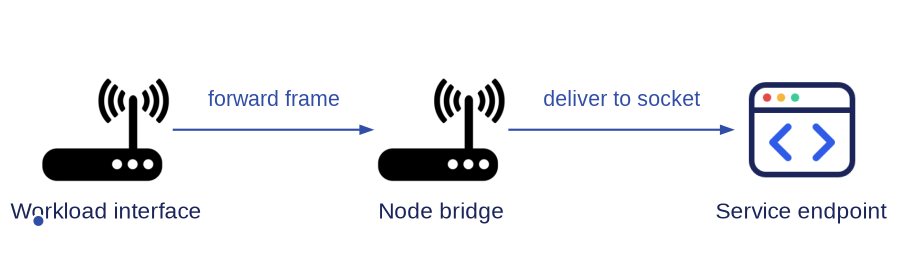
medium 7 minA workload interface can connect through a veth pair to a bridge in another namespace.
Video lesson · Chapter 1 of 4
A service works locally but is unreachable from its peer
Theory
Read or listen first. About 2 min.
What it is
A workload interface can connect through a veth pair to a bridge in another namespace. Routing, service selection and policy may operate at different points in that path. A sidecar adds an application proxy with its own connection and readiness state. A healthy process and a listening socket verify only one boundary of the route.
Why it exists
Following a rollout, one node cannot deliver traffic to a healthy service. Compare an affected and healthy node for the same service endpoint. Use interface counters, endpoint readiness and routing state to locate the first boundary where evidence diverges. Preserve normal access policy when restoring the intended route.
If endpoint selection matches a healthy node, follow interface counters, route and proxy timing across the affected node.
A service works locally but is unreachable from its peer
Inside this chapter
- Netfilter hooks
- Netfilter exposes path-specific hooks for packet processing. A packet destined locally can follow a different path from a forwarded one. Identify the actual direction before comparing counters.
- iptables chains and rules
- Rules execute within chains in ordered contexts. A counter increase identifies traffic reaching that rule. It does not by itself establish successful end-to-end delivery.
- nftables architecture
- Nftables expresses kernel packet policy with tables, chains, rules and sets. Compare the configured policy with counters on the specific affected path while preserving intended access controls.
- Network Namespaces and veth pairs
- A veth pair transfers frames between two endpoints, often in different namespaces. Observe both ends and confirm their namespace and attachment before blaming the application.
- Linux Bridge networking
- A Linux bridge forwards frames by learned link-layer destinations. A wrong port, VLAN membership or stale forwarding decision can isolate one workload on an otherwise healthy node.
- IPVS (IP Virtual Server)
- IPVS represents virtual services with a scheduler and backend destinations. A service entry can exist while its destination membership is stale or lacks a healthy endpoint.
- eBPF for Networking and XDP
- XDP allows early per-packet processing at supported receive paths. Early drops may precede higher-level socket observations, making interface counters and program-owned metrics important for diagnosis.
- tc (Traffic Control) and QoS
- Traffic control queues and schedules packets. A shaping policy can deliberately add wait or cap bandwidth, so compare offered load, queue backlog and configured capacity.
- Service Mesh basics: Envoy and Sidecar pattern
- A sidecar proxies connections on behalf of a workload. It can supply telemetry and policy but also introduces its own readiness, resource limits and failure modes.
How it works
Step through the idea, or press Play.
Leave the workload. Trace the path from the socket to the workload’s network interface.
Understand it
Worked incident
A service works locally but is unreachable from its peer
| Observation | Delivered test requests per 10 (requests) | Interpretation |
|---|---|---|
| Baseline | 10 | The workload and node agree on a reachable endpoint. |
| Incident | 0 | A stale node endpoint sends requests to an old destination. |
| After intervention | 10 | Reconcile endpoint state on the affected node and verify an actual request from that workload. |
Choose the next investigation
Summary
The whole topic in one minute.
The node can select an obsolete destination before a healthy application ever receives the request.
If endpoint selection matches a healthy node, follow interface counters, route and proxy timing across the affected node.