
What a partition forces you to decide
hard 6 minA network partition can prevent healthy replicas from exchanging messages.
Video lesson · Chapter 1 of 4
The minority cannot confirm a reservation
Theory
Read or listen first. About 1 min.
What it is
A network partition can prevent healthy replicas from exchanging messages. For a linearizable register, a replica on the isolated side cannot both acknowledge every operation successfully and guarantee the latest global value. The decision depends on the operation. Returning stale catalogue data and accepting a last-seat reservation carry different consequences.
Why it exists
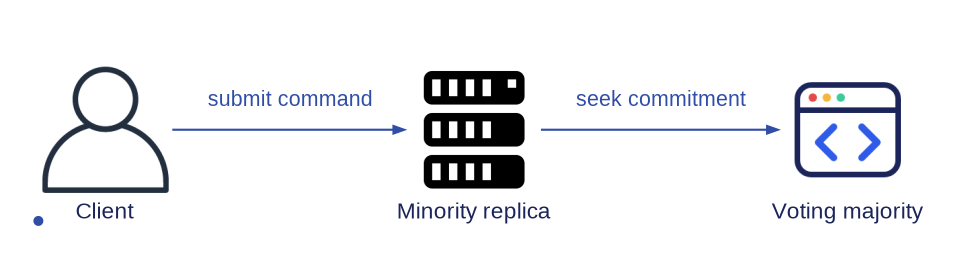
A three-member reservation service splits two against one. The minority can receive requests but cannot collect a majority for new writes. Counting an immediate rejection as a successful reservation corrupts availability reporting. Route eligible clients to the majority or return a retriable unavailable result. Reconcile ambiguous client outcomes by operation ID after reconnection.
If a majority is reachable but writes still fail, inspect leader election, persistent storage and log progress before changing the quorum.
The minority cannot confirm a reservation
Inside this chapter
- The CAP Theorem (Consistency, Availability, Partition Tolerance)
- During a partition, guaranteeing linearizable reads and writes can force some nonfailed nodes to stop completing operations successfully. State the precise operation and failure model.
- PACELC Theorem (Latency vs. Consistency trade-offs)
- PACELC also asks what cost is paid when the network is healthy. Coordinating across distant replicas can trade lower latency for stronger visibility even on an ordinary day.
- Network Partitions and Split Brain scenarios
- A partition separates communication groups. Split brain means competing parties act as authoritative. Quorum rules and fencing can keep an old owner from continuing protected writes.
- FLP Impossibility Theorem
- FLP shows deterministic consensus cannot guarantee termination in a fully asynchronous model with even one possible crash. Practical protocols make additional timing or progress assumptions.
- Byzantine Fault Tolerance basics
- Byzantine faults include arbitrary or conflicting behavior. A protocol designed only for crashes cannot simply count a misbehaving replica as a stopped machine.
How it works
Step through the idea, or press Play.
Lose contact. Replicas split into groups that cannot exchange new information.
Understand it
Worked incident
The minority cannot confirm a reservation
| Observation | Acknowledged writes on isolated minority per 10 (writes) | Interpretation |
|---|---|---|
| Baseline | 10 | The receiving node can reach a majority and commit. |
| Incident | 0 | The isolated node stops acknowledging new reservations. |
| After intervention | 10 | Connectivity returns and a current leader commits new writes. Verify earlier uncertain IDs before retrying. |
Choose the next investigation
Summary
The whole topic in one minute.
Independent confirmations can oversell. The single-seat invariant requires coordination before reporting success.
If a majority is reachable but writes still fail, inspect leader election, persistent storage and log progress before changing the quorum.