
Replication lag and stale reads
hard 7 minReplication separates log creation, transport, durability on a replica and replay into visible state.
Video lesson · Chapter 1 of 4
A confirmed order vanishes on refresh
Theory
Read or listen first. About 2 min.
What it is
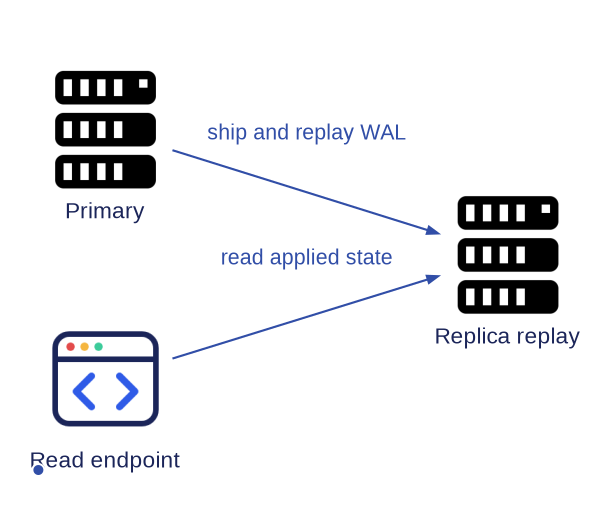
Replication separates log creation, transport, durability on a replica and replay into visible state. A primary may acknowledge before a particular reader can see its change. Byte lag indicates work outstanding. Time lag also depends on workload, reporting and replay progress. Read scaling introduces a visibility contract as well as extra capacity.
Why it exists
An order creation succeeds and the next request returns no order. Trace the two requests to determine their serving nodes. Compare the write’s position with the selected replica’s replay position. Route the follow-up to a sufficiently caught-up replica or the primary when the session requires read-your-writes. Reserve replica reads for workloads that tolerate staleness.
If the selected reader has applied the write, check transaction snapshot age, cache keys and whether the read targeted the correct tenant.
A confirmed order vanishes on refresh
Inside this chapter
- Single-leader replication
- One leader accepts writes for an assigned range and propagates changes to followers. Failover requires authority and a decision about which acknowledged history must survive.
- Multi-Leader replication
- Multiple leaders can accept independent writes. Concurrent updates may conflict, so the system needs merge semantics that preserve the application’s actual invariants.
- Synchronous vs. Asynchronous replication
- Synchronous acknowledgment waits for a configured replica condition. Asynchronous acknowledgment can return sooner while leaving more recent data at risk after primary loss.
- Replication Lag and its impact
- Separate send, receive, flush and replay positions. Two replicas with equal received bytes can serve different visible states because replay progresses at different speeds.
- Quorum Reads and Writes
- Read and write sets can be chosen to intersect. Intersection alone does not guarantee linearizability under every protocol, membership change, or concurrent write and failure pattern.
- Read Replicas and Read Scaling
- Read replicas scale workloads that accept their visibility contract. Route a causally dependent read using a replay token or an authoritative path when the product requires it.
- Conflict Resolution Strategies
- Last-write-wins discards competing versions by a chosen ordering. Domain-aware merges can preserve more information but require rules for conflicts and retries.
How it works
Step through the idea, or press Play.
Order on the primary. The primary assigns the operation a log position.
Understand it
Worked incident
A confirmed order vanishes on refresh
| Observation | Replay lag behind primary (MiB) | Interpretation |
|---|---|---|
| Baseline | 0 | The replica replays changes before the follow-up read. |
| Incident | 42 | A backup slows replay while shipping continues. |
| After intervention | 1 | Use a session position or route the follow-up appropriately. Confirm replica replay catches up. |
Choose the next investigation
Summary
The whole topic in one minute.
Received or flushed bytes may still await application to the state used by the reader.
If the selected reader has applied the write, check transaction snapshot age, cache keys and whether the read targeted the correct tenant.