
Restoring to a known point in time
hard 6 minA physical base backup captures a recoverable starting point.
Video lesson · Chapter 1 of 4
The backup that starts but misses orders
Theory
Read or listen first. About 1 min.
What it is
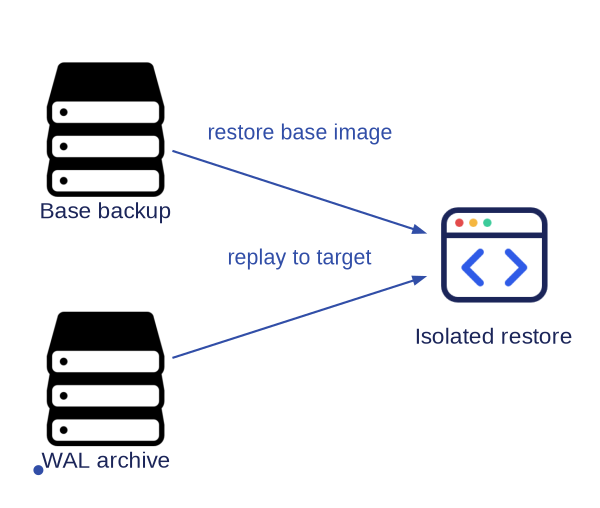
A physical base backup captures a recoverable starting point. Continuous archiving retains the log sequence needed to replay from that point to a chosen target. Recovery point objective limits acceptable data loss, while recovery time objective limits elapsed time to restore the service. A successful backup job measures neither outcome by itself.
Why it exists
An accidental bulk change is discovered at 14:35. Pick a target immediately before the first bad transaction, restore into an isolated environment and verify the entire required log chain is available. Check domain invariants and known transactions on both sides of the target. Record elapsed time, missing valid writes and the separate decision to switch traffic.
If replay succeeds yet a known business invariant fails, verify the chosen timeline, target transaction and application recovery procedure.
The backup that starts but misses orders
How it works
Step through the idea, or press Play.
Baseline. A rehearsal restores the latest known good marker.
Understand it
Worked incident
The backup that starts but misses orders
| Observation | Minutes of recent history missing (min) | Interpretation |
|---|---|---|
| Baseline | 0 | A rehearsal restores the latest known good marker. |
| Incident | 35 | An archive gap leaves the best recoverable marker 35 minutes behind. |
| After intervention | 2 | Repair archiving and repeat the drill with a fresh chain. Measure loss and recovery time independently. |
Choose the next investigation
Summary
The whole topic in one minute.
Availability of a base image does not prove log continuity or the application-level recovery point.
If replay succeeds yet a known business invariant fails, verify the chosen timeline, target transaction and application recovery procedure.