
Turning raw events into a defensible count
easy 7 minText tools answer different questions.
Video lesson · Chapter 1 of 8
Four retries look like four customers
Theory
Read or listen first. About 1 min.
What it is
Text tools answer different questions. A substring search selects matching lines, a field-aware parser respects quoting and nesting, and aggregation turns events into counts. A line can represent an attempt, span, request or customer. The unit being counted is a design decision that must match the impact statement.
Why it exists
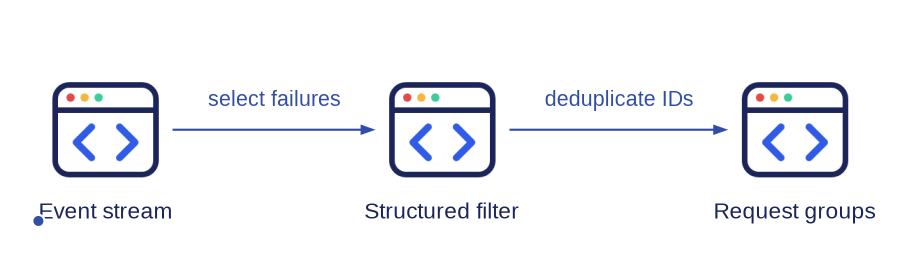
A retrying client emits four failure messages for each unsuccessful checkout. An initial incident update quadruples the affected request count. Parse valid records, select the endpoint and time window, and group by a stable request identifier. Keep malformed events and missing IDs visible as uncertainty instead of silently discarding them.
If IDs are missing or reused, the exact unique-request count is unknowable from this log alone. Bound the estimate using final outcomes.
Four retries look like four customers
Inside this chapter
- Pattern Searching with grep
- A literal or regex search is useful for narrowing an incident window. It can count incidental matches in embedded text. Validate a sample before interpreting counts as events.
- Text Processing with awk
- Awk splits records into fields and aggregates values. Define delimiters and units explicitly. Quoted or nested structured data needs a parser aware of its format.
- Stream Editing with sed
- Sed transforms a stream of text. Preserve original incident evidence and apply transformations to a copy or pipeline so later investigators can reproduce the view.
- File Finding with find
- Find selects files by properties and paths. Confirm the selected files span the intended hosts and dates because a missing rotated segment can bias the result.
- Command Building with xargs
- Xargs batches arguments for another program. Names can contain whitespace or newlines. Unambiguous record separation matters even when listing or summarizing diagnostic files.
- JSON Processing with jq
- Jq selects and aggregates JSON fields without conflating a nested field with similarly spelled text. Decide how missing fields and malformed records affect the denominator.
How it works
Step through the idea, or press Play.
Choose the unit. Define whether the result counts attempts, requests or customers.
Understand it
Worked incident
Four retries look like four customers
| Observation | Events counted as affected requests (requests) | Interpretation |
|---|---|---|
| Baseline | 10 | One final failure is recorded per request. |
| Incident | 40 | Four attempt records are counted for each of ten failing requests. |
| After intervention | 10 | Group by logical request ID and compare with the final response metric. |
Choose the next investigation
Summary
The whole topic in one minute.
Retries generate multiple events for a single logical operation. The identifier defines the grouping boundary.
If IDs are missing or reused, the exact unique-request count is unknowable from this log alone. Bound the estimate using final outcomes.