
TLS identity and certificate rotation
medium 7 minTLS negotiates keys for traffic protection and authenticates the peer according to the chosen configuration.
Video lesson · Chapter 1 of 4
An incomplete chain during rotation
Theory
Read or listen first. About 2 min.
What it is
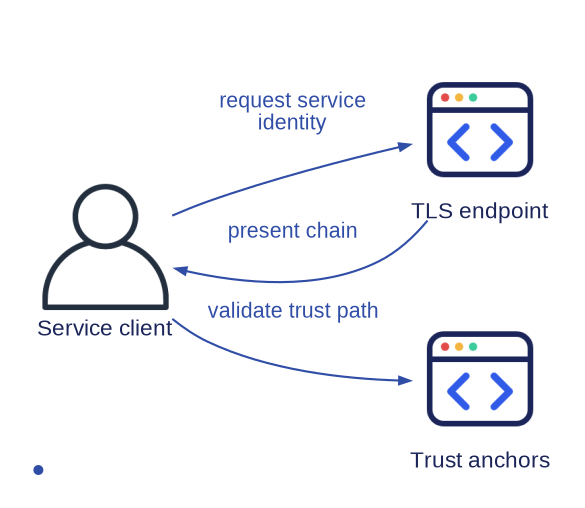
TLS negotiates keys for traffic protection and authenticates the peer according to the chosen configuration. A client validates the certificate chain against its trusted roots, the service identity and validity period. A server may need to send intermediates. Different client environments can therefore disagree about the same endpoint after a certificate change.
Why it exists
A new leaf certificate works in a developer browser while fresh workloads fail the handshake. Compare the complete chain presented with the requested server name across old and new endpoints, then inspect each affected trust store and clock. Cached intermediates can hide a missing chain element in one environment. Preserve verification throughout the repair.
If the presented chain validates for one name but not the actual requested name, investigate host identity and SNI routing.
An incomplete chain during rotation
Inside this chapter
- Symmetric vs. Asymmetric Encryption
- Public-key mechanisms authenticate peers or establish secrets under the negotiated protocol. Symmetric keys protect bulk traffic efficiently. Certificate rotation and session key generation solve different problems.
- The TLS Handshake (1.2 vs 1.3)
- Handshake messages negotiate parameters, authenticate and derive traffic keys. TLS 1.3 changes the message sequence and permitted algorithms. Measure complete and resumed handshakes separately.
- Certificate Chains and Authorities (CA)
- A client builds a valid path from the leaf through intermediates to a trusted anchor and checks service identity. A missing intermediate can affect some clients but not others.
- Performance impact of TLS termination
- TLS termination spends CPU and holds connection state at a chosen boundary. Encryption on subsequent hops is a separate decision governed by the service’s trust model.
- SNI (Server Name Indication)
- Server Name Indication identifies the desired hostname during connection setup and lets a shared endpoint select its certificate. Testing by bare IP can exercise the wrong virtual service.
- OCSP Stapling
- OCSP stapling lets the server provide a signed certificate-status response with the handshake. Its freshness and client behavior influence operational outcomes when status services are unavailable.
- mTLS (Mutual TLS) Authentication
- Mutual TLS additionally authenticates the client certificate. Mapping its validated identity to allowed operations still requires authorization and a rotation policy.
- Certificate Pinning
- Pinning constrains acceptable keys or certificates beyond normal trust. Planned rotation needs a recovery path and overlapping trusted pins to avoid disabling legitimate clients.
How it works
Step through the idea, or press Play.
Observe the leaf. The endpoint presents its certificate for the requested service name.
Understand it
Worked incident
An incomplete chain during rotation
| Observation | Handshake successes per 100 (handshakes) | Interpretation |
|---|---|---|
| Baseline | 100 | Clean clients validate the former chain. |
| Incident | 62 | A subset of clients lacks the intermediate required by the new leaf. |
| After intervention | 100 | Serve the intended intermediate chain and verify with a clean client, the correct hostname and normal trust checks. |
Choose the next investigation
Summary
The whole topic in one minute.
Different intermediate caches and trust anchors change path construction. Removing verification would discard the identity guarantee.
If the presented chain validates for one name but not the actual requested name, investigate host identity and SNI routing.