
Congestion, loss and offered load
medium 7 minCongestion control limits in-flight data according to evidence about the path.
Video lesson · Chapter 1 of 4
Sending harder makes useful throughput fall
Theory
Read or listen first. About 2 min.
What it is
Congestion control limits in-flight data according to evidence about the path. A burst can fill a bottleneck queue before the sender sees feedback one round trip later. Loss, rising delay or explicit congestion marks can signal contention. UDP exposes datagrams but leaves congestion behavior to the application or a protocol such as QUIC above it.
Why it exists
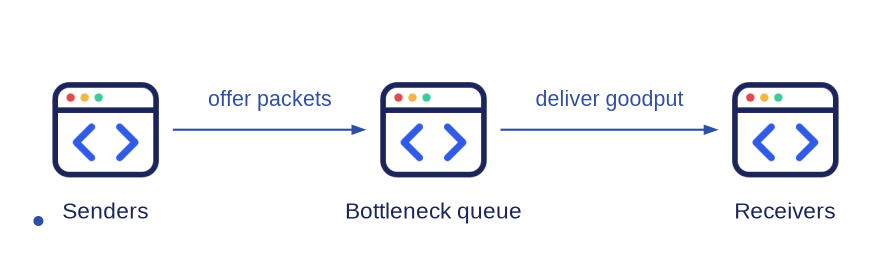
A fleet adds parallel transfers to an already busy path. Transmitted bytes rise while unique payload delivered falls. Measure goodput, retransmissions and RTT together. A larger buffer can trade drops for delay without increasing link capacity. Smooth the offered load and test under the same cross traffic before increasing parallelism.
If retransmissions and RTT stay low while goodput falls, inspect the receiving application’s drain rate and window.
Sending harder makes useful throughput fall
Inside this chapter
- Slow Start and Congestion Avoidance phases
- A sender initially probes capacity by growing its congestion window. After the growth phase it uses the algorithm’s congestion-avoidance policy, reacting to congestion evidence and acknowledgments.
- Congestion Collapse
- With too much offered load, repeated transmissions and queueing can consume capacity while successful delivery falls. Watch unique completed work and RTT together.
- Algorithms: TCP Reno, TCP Cubic
- Reno uses additive increase and multiplicative decrease during congestion avoidance. CUBIC uses a different window growth function. Kernel and path conditions affect observed behavior.
- TCP BBR (Bottleneck Bandwidth and Round-trip propagation time)
- BBR estimates bottleneck bandwidth and propagation delay to guide pacing and in-flight data. Its model is adaptive and implementation versions differ, so evaluate it on representative paths.
- ECN (Explicit Congestion Notification)
- ECN permits a congested path to mark packets when endpoints and routers support it. Endpoints still need to react. A marked packet can arrive without having been dropped.
- UDP: Characteristics and Use Cases
- UDP preserves datagram boundaries and supplies no built-in delivery, ordering or application congestion policy. QUIC implements reliable streams and congestion control above UDP.
How it works
Step through the idea, or press Play.
Share the bottleneck. Two long transfers compete for one path with limited capacity.
Understand it
Worked incident
Sending harder makes useful throughput fall
| Observation | Useful payload throughput (Mbit/s) | Interpretation |
|---|---|---|
| Baseline | 90 | The link delivers about ninety megabits of useful data per second. |
| Incident | 55 | Repeated losses consume capacity with duplicate bytes. |
| After intervention | 88 | Pace transfers below the persistent bottleneck and check useful throughput and RTT. |
Choose the next investigation
Summary
The whole topic in one minute.
Repeated transmissions consume bandwidth but do not deliver new application data.
If retransmissions and RTT stay low while goodput falls, inspect the receiving application’s drain rate and window.