
AWS Lambda
medium 25 minAWS Lambda runs your function when an event arrives and stops charging when it ends.
Video lesson · Chapter 1 of 5
The first thumbnail after a quiet morning
Cold and warm starts in 75 seconds
1:15Reel coming soon
Theory
Read or listen first. About 2 min.
What it is
AWS Lambda is functions as a service. You upload code and say which events start it. AWS finds a machine, prepares an isolated environment, runs the code and keeps or removes the environment afterwards.
You do not choose servers. You choose memory (which also sets the CPU share), a timeout, permissions and limits on concurrency. A function can run at zero copies or at thousands.
This page is about the classic form, which AWS now calls event functions: one event at a time per environment. Lambda has newer forms too, such as web functions, durable functions and managed instances, which are named where they matter.
Why it exists
Much code runs rarely or in bursts: resizing an upload, answering a webhook, a nightly clean-up. A server for it waits most of the day, needs patches all year and is too small on the busiest day.
Lambda turns that into a cost per run. The trade is less control: limited run time, no lasting local state, start-up delay and a platform that belongs to one provider.
A short history
November 2014
AWS announces Lambda in preview: run code in response to events, without servers.
October 2018
The longest run time goes from 5 to 15 minutes.
November 2018
AWS releases Firecracker, the small virtual machine monitor it built for serverless work, as open source.
December 2019
Provisioned concurrency arrives: environments prepared before the request.
By November 2026
The quotas page lists up to 30 minutes for a function, and 90 minutes for asynchronous and most event-source invocations on managed instances.
Words to know
- Handler
- The method Lambda calls for each event.
- Execution environment
- The isolated place where your function runs. It is reused while it stays warm.
- Cold start
- Creating and initializing a new environment before the handler can run.
- Concurrency
- How many requests are in progress at the same moment.
- Reserved concurrency
- A guaranteed share that is also a hard cap for one function.
- Provisioned concurrency
- Environments prepared in advance, for a charge.
- Event source mapping
- A Lambda component that polls a queue or stream and invokes your function with batches.
- Layer
- A shared package of libraries or a runtime, at most five per function.
How it works
Step through the idea, or press Play.
An event arrives. A request, a file, a message or a timer
Understand it
Start here
The helper and the bell
Imagine a counter with a bell. Nobody stands there. When the bell rings, a helper appears. The first time they must put on an apron, which takes a moment. If another ring comes soon, they are ready at once. Two rings at the same time need two helpers.
The apron is the cold start. The number of helpers is the concurrency.
What you get
Why teams choose it
No servers to run
Provisioning, patching the platform and scaling are done by AWS.
Pay per use
Requests and duration, measured per millisecond. Idle on-demand functions cost no compute.
Fast growth
Each function may add 1,000 environments every 10 seconds, up to the account limit.
Event triggers
S3, API Gateway, SNS, SQS, DynamoDB Streams, Kinesis, EventBridge and more.
Several zones
Functions run across Availability Zones. The service level agreement is 99.95% per Region and month.
Quick to ship
Upload a zip file or a container image and it is live.
Architecture
What happens to an invocation
Inside the service
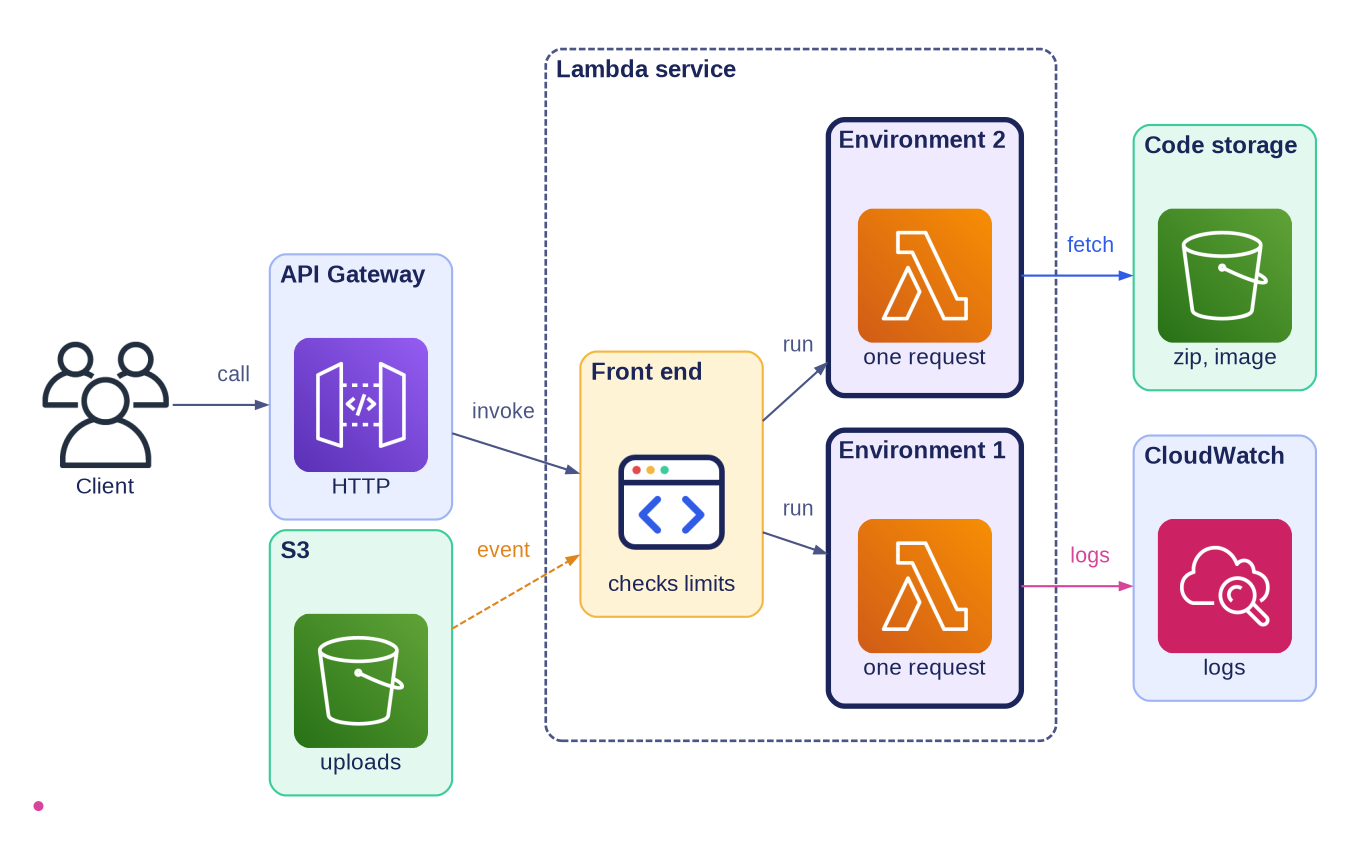
- 1
Request
An API call waits for the answer. A file or a notification is handed over. A queue is polled.
- 2
Front end
Lambda checks permissions and the concurrency limits. Above the limit it throttles.
- 3
Find an environment
A worker manager gives out a warm one, or asks for a new one.
- 4
Initialize if new
Download the code, start the runtime and extensions, run everything outside the handler. This phase may take up to 10 seconds for on-demand functions.
- 5
Run the handler
The event arrives as JSON together with a context object. CPU follows memory: 1,769 MB equals one vCPU.
- 6
Freeze
The answer is returned and the environment freezes. It may serve again. Lambda ends environments every few hours even when they are busy.
Two requests, one environment
Two planes
| Plane | Does | Why the split |
|---|---|---|
| Control plane | Create functions, change code and settings | Rare, and may be slower |
| Data plane | Invoke functions | Must keep working while nothing is being changed |
Isolation comes from Firecracker microVMs: small virtual machines on top of KVM, with a minimal device model. The project states a boot time under 125 ms and less than 5 MiB of memory overhead each, which is why thousands can share one machine.
Cold starts
Where the first delay comes from
AWS says cold starts typically occur in under 1% of invocations and take from under 100 ms to over 1 second. A large framework can take several seconds. They are more common in development than in busy production functions.
Reducing a cold start
| Remedy | How it works | Watch out |
|---|---|---|
| Lighter init | Fewer imports, only the SDK clients you use | Measure before and after |
| More memory | More CPU, so init and handler run faster | Cost per second rises, duration may fall |
| Provisioned concurrency | Environments are ready before requests | Charged while configured. Above it, cold starts return |
| SnapStart | Restore a snapshot taken after init (Java, Python, .NET) | Random seeds, ids and connections must be renewed |
Concurrency
How many environments?
Concurrency from rate and duration
Limits that act together
| Limit | Value | Meaning |
|---|---|---|
| Regional concurrency | 1,000 by default, can be raised | Shared by all functions. New accounts start lower |
| Scaling rate | 1,000 environments per 10 s, per function | A sudden jump can throttle for a moment |
| Requests per environment | 10 per second (synchronous) | Very short functions hit this one first |
| Reserved concurrency | You set it, no charge | A guarantee and a cap. Zero switches the function off |
| Unreserved pool | 100 always left | So you can never reserve everything |
Reserved
- No charge
- Protects a critical function from its neighbours
- Caps a function that would overload a database
Provisioned
- Charged while configured
- Removes the cold start up to that number
- Does not cap the function by itself
Invocation
Who waits, and who retries
| Model | Sources | On error | When throttled |
|---|---|---|---|
| Synchronous | API Gateway, direct call | Returned to the caller | Status 429, the caller retries |
| Asynchronous | S3, SNS, EventBridge | Two more tries, after 1 and 2 minutes | Back to the queue for up to 6 hours |
| Queue polling | SQS | Message visible again after the timeout | The poller slows down |
| Stream polling | Kinesis, DynamoDB Streams | The shard waits and retries the batch | Retries until success or expiry |
An asynchronous event that keeps failing
SQS done right
- 1
Report partial failures
Turn on ReportBatchItemFailures and return the ids that failed. Otherwise one bad message repeats the whole batch.
- 2
Put the dead-letter queue on the source queue
The function's own dead-letter queue is for asynchronous invocations only.
- 3
Long visibility timeout
AWS recommends at least six times the function timeout.
- 4
Cap with maximum concurrency
From 2 up. A mapping starts with five concurrent batches, adds up to 300 a minute and stops at 1,250 by default.
Limits
The numbers
| Resource | Limit |
|---|---|
| Memory | 128 MB to 10,240 MB, in 1 MB steps |
| Run time | 30 minutes. 90 on managed instances for asynchronous and most polled events |
| Temporary disk | 512 MB to 10,240 MB |
| Zip package | 50 MB zipped by direct upload, 250 MB unzipped with layers |
| Container image | 10 GB uncompressed |
| Layers | 5 |
| Environment variables | 4 KB in total |
| Payload, synchronous | 6 MB each way, 200 MB for a streamed response |
| Payload, asynchronous | 1 MB |
| File descriptors, threads | 1,024 each |
What you are billed for
Network and security
VPC, permissions, secrets
Execution role
What the function may do. Give each function its own, as small as possible.
Resource policy
Who may invoke it, such as one bucket or one API.
VPC
Attach it only to reach private resources. Shared Hyperplane network interfaces are made ahead of time, so the old long VPC cold start is gone. Internet access then needs a NAT or an endpoint.
Secrets
Read them from a secrets service and cache them outside the handler. Environment variables are visible to anyone who can read the configuration.
Newer forms
Other ways to run on Lambda
| Form | Difference | Use it for |
|---|---|---|
| Event function | One request per environment | Events, queues, small APIs |
| Web function | An HTTP server, many requests per environment | Web apps and API back ends |
| Durable function | Checkpoints and replays, up to one year | Workflows that wait |
| Managed instances | Runs on instances you own, several requests per environment | Steady or special workloads |
Operations
Deploy and watch
zip -r function.zip index.mjs node_modules/aws lambda update-function-code --function-name my-function \ --zip-file fileb://function.zipaws lambda wait function-updated-v2 --function-name my-function# an immutable version, an alias, and ready environments on the aliasaws lambda publish-version --function-name my-functionaws lambda update-alias --function-name my-function --name prod \ --function-version 7aws lambda put-provisioned-concurrency-config \ --function-name my-function --qualifier prod \ --provisioned-concurrent-executions 10# protect the databaseaws lambda put-function-concurrency --function-name my-function \ --reserved-concurrent-executions 50AWSTemplateFormatVersion: '2010-09-09'Transform: AWS::Serverless-2016-10-31Resources: MyFunction: Type: AWS::Serverless::Function Properties: Handler: index.handler Runtime: nodejs24.x CodeUri: src/ MemorySize: 512 Timeout: 30 Events: Api: Type: Api Properties: Path: /hello Method: getWatch these
- 1
Throttles and ConcurrentExecutions
Per function and for the Region.
- 2
Duration against timeout
A timeout at the limit means lost work. Set it above the slow percentile, not at the maximum.
- 3
Init duration
In the report line of each cold invocation.
- 4
Age of events
AsyncEventAge, the age of the oldest SQS message, the iterator age of a stream.
- 5
Failure destinations
Alert when anything arrives there.
Choose
When Lambda, and when not
Choose Lambda
- Reacting to uploads, messages, webhooks
- Uneven traffic with idle hours
- Work of seconds or minutes
- Functions that must scale separately
- Prototypes
- Scheduled jobs
Choose something else
- Work beyond 30 minutes in one go
- Steady high load where containers are cheaper
- Latency that cannot accept a rare cold start
- GPUs or more than 10 GB of memory
- Long-lived state in memory
- Packages beyond 250 MB (or use an image)
Where should this code run?
Where else could it run?
| Lambda | Fargate | EC2 | Kubernetes | |
|---|---|---|---|---|
| Unit | Function call | Task | Machine | Pod |
| Scale to zero | Yes | Only if you set it to zero tasks | Only by stopping machines | With add-ons, the cluster stays |
| Run time | 30 minutes | No fixed limit | No fixed limit | No fixed limit |
| Paid by | Requests and GB-seconds | vCPU and memory seconds | Instance time | Nodes and control plane |
| You operate | Code | Images | Everything above the hardware | Cluster and images |
| Portability | AWS | AWS, standard containers | High | High |
Strengths
- No servers to patch
- Nothing to pay for when idle
- Grows in seconds
- Triggers from many AWS services
- Several zones by default
Costs
- Cold starts
- Bounded run time
- No lasting local state
- Deep ties to AWS
- Steady load can cost more than containers
- 10 GB of memory, CPU tied to it
Summary
The whole topic in one minute.
Lambda runs a function in an isolated environment per concurrent request. New environments cost a cold start, idle ones are frozen and reused. Concurrency equals requests per second times seconds per request, and it is limited per Region and by how fast each function may grow.
How the function is invoked decides who retries. A synchronous caller must retry, asynchronous events are tried up to three times by default, and queues and streams are polled in batches. All of them can repeat, so make the function idempotent. Use Lambda for events and spikes. Use containers for long, steady or stateful work.
- One event function environment handles one request at a time.
- Concurrency is rate times duration.
- Reserved caps and protects. Provisioned removes cold starts up to a number.
- The invocation model decides who retries.
- Expect repeats and make effects idempotent.
- Protect the database from your own scaling.