
Consistency models
hard 30 minA consistency model is the promise a replicated store makes about what a read may return.
Video lesson · Chapter 1 of 5
A read begins after the receipt arrives
The consistency ladder in 75 seconds
1:15Reel coming soon
Theory
Read or listen first. About 2 min.
What it is
When data has several copies, a new value reaches some of them before the others. A read in that moment may see the new value or an older one. A consistency model is the contract that says which answers are allowed.
Strong models allow few surprises: the copies behave like one. Weak models allow more: you may see an old value, or two values in a different order from your neighbour. They are steps on a ladder, not just two camps.
Why it exists
Programmers reason about code as if a value written is a value read. When the store promises less than that, programs show strange effects: a comment you just wrote vanishes on reload, or an answer appears before its question.
A stronger promise costs waiting. The copies have to talk before they answer, and if they cannot talk they cannot answer. So the work is to find the weakest promise under which the feature still makes sense to its users.
A short history
1979
Leslie Lamport defines sequential consistency for computers with several processors.
1987 to 1990
Maurice Herlihy and Jeannette Wing define linearizability; the journal paper appears in 1990.
1994
Douglas Terry and colleagues describe four session guarantees, among them read your writes and monotonic reads.
1995
Ahamad, Neiger and colleagues publish the causal memory model.
2008
Werner Vogels of Amazon publishes "Eventually Consistent", which brings the term to a wide audience.
2011
The COPS paper shows causal consistency for wide-area stores and calls it "causal+".
Words to know
- Replica
- One copy of the data on one machine.
- Staleness
- How old an answer is compared with the latest write.
- Linearizable
- Every operation appears to happen at one instant between its start and its end.
- Happens before
- One event could have influenced another: same process, read of a write, or a chain of these.
- Concurrent
- Neither of two events happens before the other.
- Vector clock
- One counter for each node, used to see whether one version came before another.
- Session
- The sequence of requests of one client, which can be given its own promises.
- Convergence
- Replicas that have received the same writes hold the same value.
How it works
Step through the idea, or press Play.
A write reaches copies at different times. The first copy has it now, the last one later
Understand it
Start here
News on the rooftops
In an old town, news travels by flags. A watcher on the first roof raises a new number, the next roof copies it, then the third. People in the streets read whichever roof is above them. How careful the watchers are decides what the people may see.
More care means a later "done". Less care means the streets may disagree for a while.
The telephone game tells the same thing. If everybody must repeat the exact words before anybody goes on, the message is right but slow. If each whispers on at once, it is fast, and for a while different people have heard different things.
The ladder
Five steps
From strongest to weakest
| Model | Promise | Waiting | Where it is offered |
|---|---|---|---|
| Linearizable | Like one copy, in real time | Most | etcd by default; MongoDB linearizable reads; Spanner goes further, with external consistency |
| Sequential | One order for all, each client's order kept | Much | ZooKeeper reads |
| Causal | Effects never before causes | Some | MongoDB causally consistent sessions; COPS |
| Read your writes | You see your own changes | Little | Session consistency in Azure Cosmos DB |
| Eventual | Copies agree once writes stop | Least | Cassandra at level ONE; DynamoDB default reads; DNS |
Weaker step by step
Strongest
Linearizability
Every operation appears to happen at one instant between its call and its answer, and everybody sees the same order. If a write has finished, every later read returns it or something newer. Programs can pretend there is a single copy.
A linearizable write and read
Benefits
- The simplest mental model
- No stale reads
- Easy to reason about, tests and locks included
Costs
- Every write, and often every read, waits for a majority
- The minority side refuses during a partition
- Coordination limits throughput for one item
One order
Sequential consistency
All clients see one and the same order, and each client's own operations stay in their order. But that order need not match the clock. A read may return an old value even after a newer write has finished somewhere else.
P1 writes x = 1 then y = 2. P2 writes x = 3 then y = 4
| Order shown to everybody | Allowed? | Why |
|---|---|---|
| x=1, y=2, x=3, y=4 | Yes | Both programs are in order |
| x=3, x=1, y=4, y=2 | Yes | P1: x=1 before y=2. P2: x=3 before y=4 |
| y=2, x=1, x=3, y=4 | No | P1 wrote x=1 first |
| One client sees the first order, another the second | No | There must be one order for all |
ZooKeeper shows the difference in practice: its writes are linearizable, while a read is answered by the server the client is connected to and may be behind. The client can send sync first to catch up; even then, its documents are careful about the exact guarantee.
Cause and effect
Causal consistency
Operations that could have influenced each other are seen in that order by everybody. Independent ones may be seen in different orders. What makes two operations related?
- 1
Program order
Operations of one client are in order.
- 2
Reads from
If A writes x, and B reads that x and then writes y, the write of y depends on x.
- 3
Transitivity
If A comes before B and B before C, then A comes before C.
The third replica waits for the cause
Versions
Vector clocks
A vector clock keeps one counter for each node. Version [3, 2, 1] has seen 3 events of node A, 2 of B and 1 of C. Version [3, 4, 1] has seen all that and two more from B, so it is newer. [4, 2, 1] and [3, 4, 1] are concurrent: each has seen something the other has not.
Comparing two versions
One client
Session guarantees
Read your writes
After you save, you see your change. Without it, a new profile picture seems to vanish on reload.
Monotonic reads
You never go back in time. Without it, a comment appears and disappears as you refresh.
Monotonic writes
Your writes are applied in your order.
Writes follow reads
Your reply is ordered after the post you read.
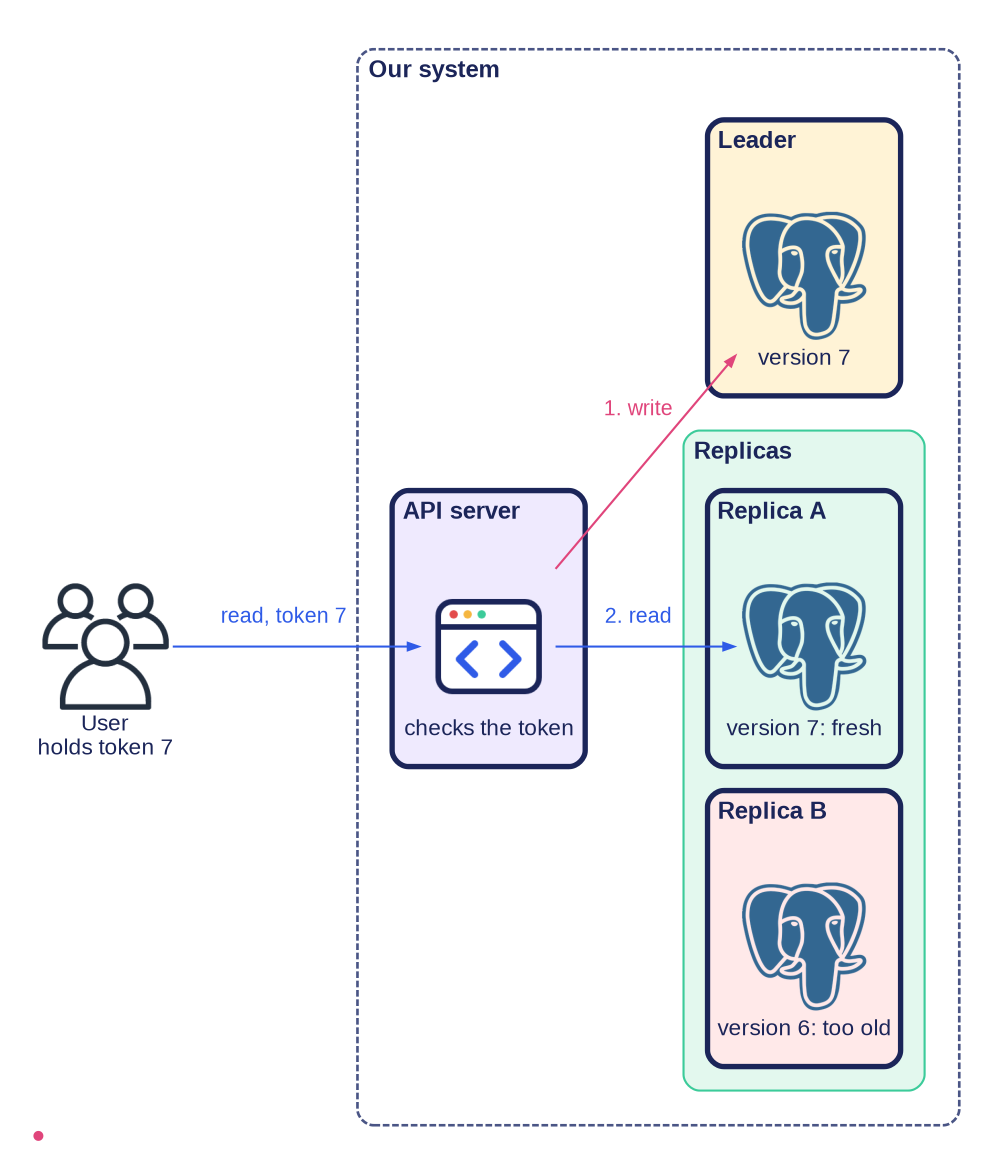
Two ways to build them: send a client always to the same replica (sticky sessions), which breaks when that replica fails, or let the client carry a token with the version it has seen, so that any replica knows whether to answer, wait or pass the request on.
Read your writes with a token
Weakest
Eventual consistency
If writes stop, all copies end up equal. That is all. Nothing is said about when, or about what reads return until then. Writes can be accepted by any copy, so they are fast and go on during a partition.
When two copies accepted different values
| Rule | Good | Weak | Used by |
|---|---|---|---|
| Last write wins | Simple, converges | Drops one write; depends on clocks | Cassandra |
| Keep both versions, let the application merge | Nothing is lost | Work for the application | The Dynamo paper, with vector clocks |
| Mergeable data types (CRDT) | Converges without a decision | Only for some shapes: counters, sets, maps | Riak data types |
How likely is a stale read?
Price
What each step costs
An estimate for three replicas in three regions
| Read | Waits for | Latency | During a partition |
|---|---|---|---|
| Eventual | Nearest replica | about 1 ms | Answers |
| Read your writes | A replica at my version | 1 ms, or a trip if it is behind | May wait or move to another replica |
| Causal | Local dependencies | about 1 ms, rarely more | Answers with what is safe to show |
| Linearizable | A majority | about 71 ms | Minority refuses |
Different features, different promises
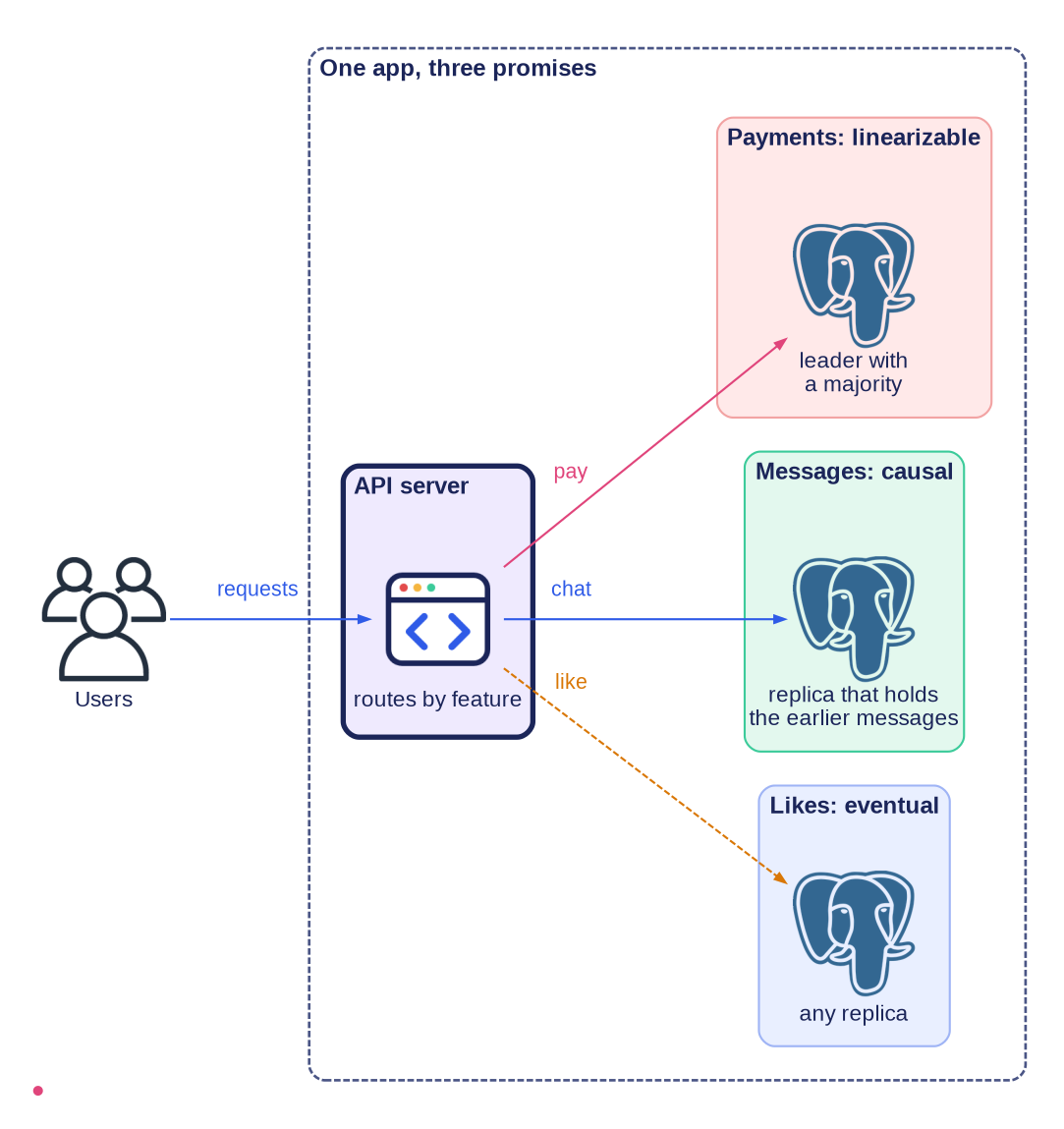
Which one do I need?
Traps
Quorums and clocks
Reading and writing with R + W greater than N means that the two sets share a copy. That is useful, but it is not linearizability by itself. If a write reached only one copy, one reader may see it and the next may miss it. A reader that repairs, by writing the newest value back to a majority before answering, closes that gap. And if the order of writes comes from wall clocks, a clock that runs ahead can make an old value win.
Do
- Choose for each feature
- Use majorities or a leader for critical operations
- Have a conflict rule before the first conflict
- Test with delays and cut links
- Write down the promise next to the API
Do not
- Assume strong by default
- Ignore replication lag
- Trust wall clocks to order writes
- Mix levels by accident
- Leave staleness unmeasured
Summary
The whole topic in one minute.
A consistency model says which values a read may return. Linearizable means one copy in real time. Sequential keeps one order for all but not real time. Causal keeps effects after their causes. Session guarantees protect one client's view. Eventual promises only that copies agree after writes stop.
Stronger means more coordination, more latency and less availability when the network breaks. Give each feature the weakest model that its users can live with: linearizable for a lock, read your writes for a profile, causal for a conversation, eventual for a like count.
- A consistency model says which values reads may return.
- Linearizable: one copy in real time. Sequential: one order without real time.
- Causal: effects after causes; concurrent writes may be seen in any order.
- Session guarantees protect one client; a token makes them portable.
- Eventual says nothing about when, and needs a conflict rule.
- Choose the weakest model that the feature can live with.