
A transfer crosses two shards
medium 6 minAn allocation moves credits between two accounts on different shards.
Video lesson · Chapter 1 of 5
A ticket spans two accounts
Both shards said ready. Is the transfer committed?
1:14Reel
Theory
Read or listen first. About 1 min.
What it is
Moving credits involves a local question at each shard and a shared question across them. Is the debit valid against the current balance? Will both shards finalize the same transfer outcome? Replicating each shard helps it survive a machine failure. A cross-shard transaction also needs agreement on whether this particular operation committed.
A prepared participant waits for the decision
Why it exists
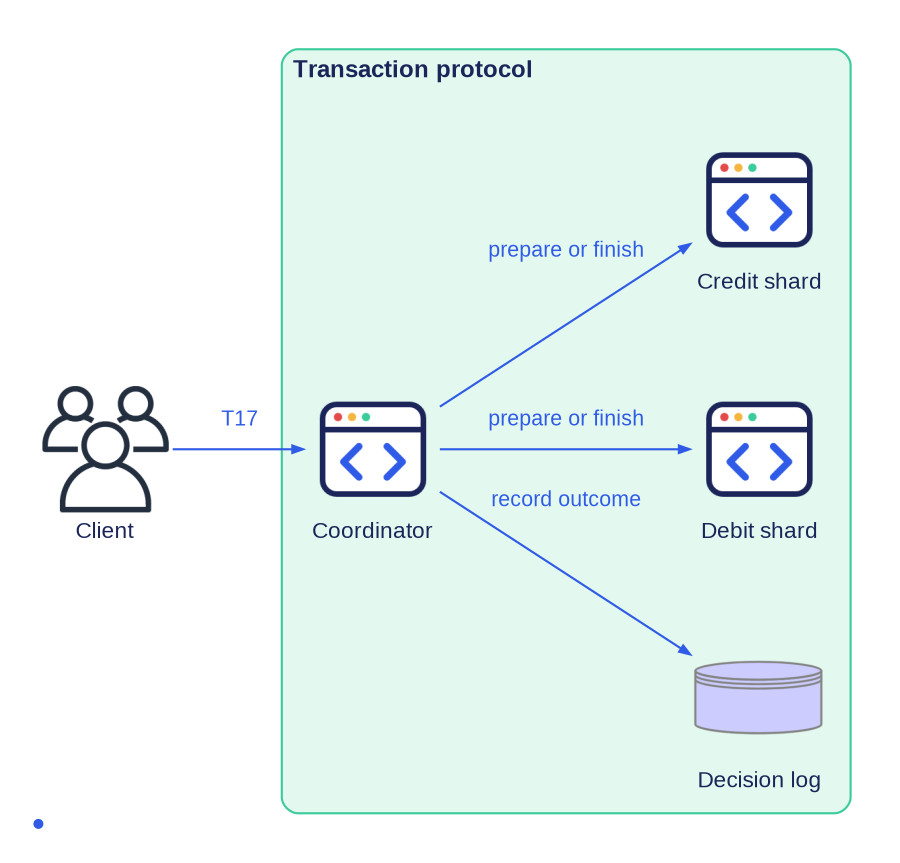
In a prepare-and-commit protocol, a participant that promises it can commit must retain enough durable state to honor the eventual decision. If the decision is temporarily unavailable, independently guessing an outcome can leave one account debited and the other uncredited.
View diagram · Commit decision
Words to know
- Atomic commit
- Participants agree on one outcome for all parts of a transaction.
- Prepared state
- A durable promise that a participant can commit if instructed.
How it works
Step through the idea, or press Play.
Separate replication and commit. Consensus orders changes within a replica group. Atomic commit coordinates the outcome across participating groups. A quorum on one shard says nothing about whether the other shard debited its account.
Understand it
Start here
Follow transfer T17
Track receipt T17 as forty credits move from A to B. Watch the account values and the receipt separately: the money can move even when the client never receives the reply.
Check the original transaction identity.
Structure
Commit decision
Commit decision
One missing acknowledgment
Debit 40 credits on shard A and credit 40 on B. Drop the reply immediately after a durable commit. Replay the same logical transfer. Check both account histories and the total across accounts: there should be one movement of 40, with the total unchanged.
One outcome across participants
Follow transfer T17
| Observation | What the client knows | Safe next step |
|---|---|---|
| Validation rejects debit | No transfer was accepted | Report insufficient credits |
| Both participants prepare | Resources are reserved for the decision | Await a durable outcome |
| Coordinator commits, reply drops | Client sees a timeout | Look up T17 |
| Lookup returns committed | The transfer succeeded | Return its existing receipt |
Why uncertainty becomes expensive
Prepared work can occupy locks or other resources while the outcome is resolved. Long network paths and slow participants extend that interval. Place strongly related data together when the common operation needs a single commit boundary. If the data must span shards, monitor time spent prepared and the oldest unresolved transactions.
When intermediate states are acceptable
A travel itinerary can sometimes expose a flight reservation while a hotel request is pending, then cancel the flight if the hotel fails. That choice requires customer-visible states, a durable workflow, and a plan for failed compensation. Account balances that promise atomic movement impose a different contract. Choose the contract before choosing the protocol.
Resolve T17
- Check the original transaction identity.
Create a new transfer
- An unknown outcome can become a duplicate movement.
Balance after one transfer
Summary
The whole topic in one minute.
A missing reply is an observation about transport. Recover the durable outcome of the original operation before initiating another movement.