
The ranker never saw the best item
medium 6 minA learning feed scores 200 candidate lessons per user.
Video lesson · Chapter 1 of 5
A relevant lesson disappears upstream
The ranker never saw your best lesson
1:13Reel
Theory
Read or listen first. About 1 min.
What it is
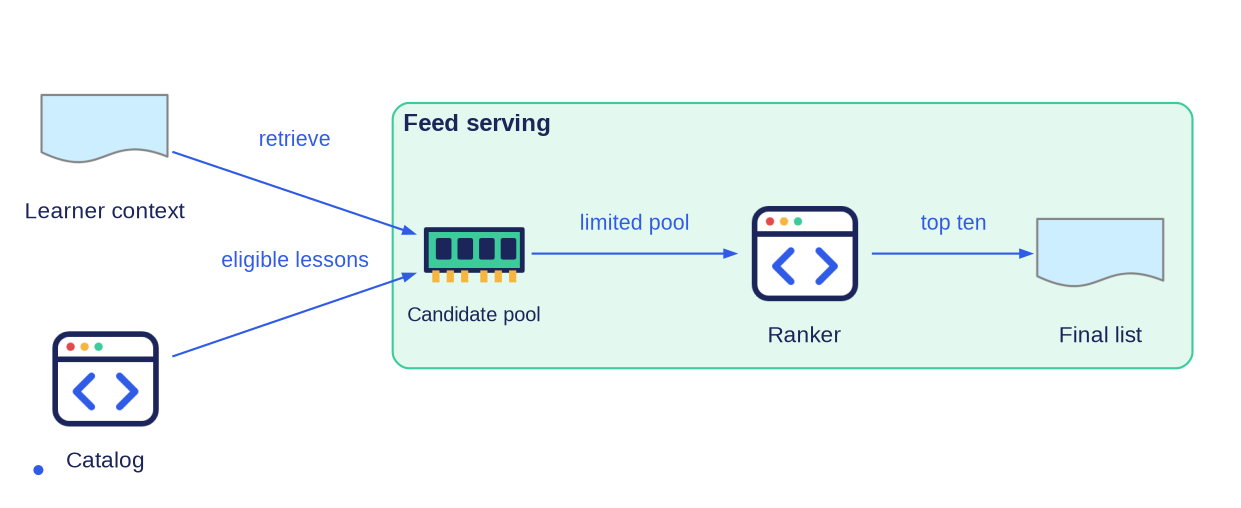
Scoring every lesson against every learner with a large model would make opening the app slow and expensive. Candidate generation cheaply finds a manageable pool. A later ranker can then afford richer features for that pool, such as prior attempts or the relationship between the lesson and a recent mistake.
Where did the relevant lesson disappear?
Why it exists
The boundary changes what a metric means. Poor results may come from a relevant item that never entered the pool, an item the ranker buried, or a useful item removed by an eligibility filter. Each failure calls for a different intervention.
View diagram · Candidate boundary
Words to know
- Candidate recall
- The fraction of relevant targets that enter the pool.
- Ranking objective
- The quantity a scoring model is trained to predict or optimize.
How it works
Step through the idea, or press Play.
Audit the candidate set. Generate a small pool from a large catalog using inexpensive retrieval. Log which sources supplied each candidate so you can locate omissions.
Understand it
Start here
Where did the lesson go?
Imagine marking one lesson that should appear in each of a hundred learning sessions. Count those marked lessons at each stage to see exactly where a better ranker can help.
Log the pool and the final list.
Structure
Candidate boundary
Candidate boundary
Find the failing stage
For 100 labeled sessions, suppose 80 target lessons reach the candidate pool and 60 reach the final ten. Candidate recall is 80%. Even a perfect ranker under this pool cannot surface the other 20. Audit retrieval first for those sessions.
Where a lesson can disappear
Trace 100 target lessons
| Stage | Targets remaining | Interpretation |
|---|---|---|
| Catalog with 100 judged targets | 100 | Reference set for this example |
| Candidate pool | 80 | Twenty targets cannot reach the ranker |
| Final ten per session | 60 | Three quarters of retrieved targets make the final list |
| Improve ranker alone | At most 80 | Candidate coverage caps the result |
Cold-start lessons
A new lesson has no interaction history. A popularity-only source can omit it repeatedly, leaving no chance to collect feedback. Add a retrieval source based on content or topic, log its contribution, and reserve a bounded opportunity to evaluate new material. Check whether new items reach the pool before increasing their final-ranking weight.
Buying recall with latency
Doubling the pool can increase coverage while doubling expensive scoring work. Measure the extra targets reached per additional candidate and look at slow requests, especially for users with large histories. An additional retrieval source may bring more distinct candidates than simply asking an existing source for another hundred.
Measure each stage
- Log the pool and the final list.
Inspect final ranks alone
- You cannot tell whether a missing item ever reached scoring.
Where the recall went
Summary
The whole topic in one minute.
Log where an item entered and left the pipeline. Candidate recall, ranking quality and end-user value answer different questions.