
Resilience in distributed systems
medium 28 minA resilient system keeps doing its most important work while parts of it fail, and returns to normal by itself.
Video lesson · Chapter 1 of 6
Stop waiting before the pool fills
Resilience in 85 seconds
1:25Reel coming soon
Theory
Read or listen first. About 2 min.
What it is
Resilience is the ability of a system to handle failures and recover from them while still serving people. It does not mean that nothing breaks. It means that a broken part stays a small problem.
In a distributed system every call to another machine can fail, hang, answer late or answer wrongly, and the caller often cannot tell which. Resilience is the set of decisions about what to do then: how long to wait, whether to try again, when to stop asking, and what to give the user instead.
Why it exists
Failures multiply. A request that needs ten parts, each available 99.9% of the time, succeeds only about 99% of the time. And failures spread: one slow part holds the threads of its callers, then the threads of theirs, until something unrelated stops.
A slow part is often worse than a dead one. A dead part answers with an error at once. A slow part makes everyone wait, and waiting costs memory, threads and patience.
A short history
1976
Metcalfe and Boggs publish Ethernet. Stations that collide wait a random time whose range doubles: exponential backoff with jitter.
1982
Lamport, Shostak and Pease publish The Byzantine Generals Problem, about agreeing when some members lie.
1985
Jim Gray asks Why Do Computers Stop and What Can Be Done About It? Software and operations, not only hardware, are the causes.
2007
Michael Nygard's book Release It! makes the circuit breaker and the bulkhead well-known software patterns.
2011
Netflix describes its Simian Army. Chaos Monkey stops instances in production on purpose; its code is released in 2012.
2012
Netflix open-sources Hystrix, a library of breakers, bulkheads and fallbacks. In 2018 it goes into maintenance and Resilience4j takes its place for many Java teams.
2021
AWS launches Fault Injection Simulator, a managed service for controlled failure experiments.
Words to know
- Transient failure
- One that goes away by itself, such as a dropped packet.
- Cascading failure
- One failure that causes the next, and so on.
- Timeout and deadline
- The longest one call may take, and the moment the whole request must be done.
- Backoff and jitter
- Waiting longer before each retry, with a random part.
- Circuit breaker
- A guard that stops calls to a part that keeps failing.
- Bulkhead
- A limit that keeps one part from using everything.
- Idempotent
- Doing it twice has the same effect as doing it once.
- Blast radius
- How much is affected when something fails.
How it works
Step through the idea, or press Play.
Limit the wait. A timeout on every call and a deadline for the whole request
Understand it
Start here
The doorbell
Imagine you want to play with a friend who does not open the door. You do not ring for an hour, and you do not give up after one second either. You do what a resilient system does. Older tales say the same: the superhero who finds another way when a door is locked or a bridge is broken.
The four rings: 3:00, then 3:02, 3:05 and 3:10, because Sam gives each ring one minute before the next wait begins.
The idea
Four pillars, and one promise
Timeout
Do not wait forever. Set the longest time each operation may take.
Retry
Try again, for failures that pass by themselves, with backoff and jitter.
Circuit breaker
Stop the bleeding. Do not call a part that keeps failing.
Bulkhead
Contain the failure. Keep parts from using each other's resources.
Safety equipment in a car works the same way: try starting again, do not wait forever, a fuse box for the breaker, separate compartments for the bulkhead. The promise to the user is the fifth part, the fallback: what they get when the first plan fails.
With resilience
- Failures are contained
- Answers stay quick, because waits are limited
- Recovery is automatic
- Users see a little less, not nothing
Without
- One service fails and the system goes with it
- One slow service makes every request hang
- Failures spread from caller to caller
- Users see errors and lose trust
Why ten good parts are not good enough
Failure
How things fail
A robot helper can break in three ways a child would notice: it stops, it becomes slow, or it does the wrong thing. Engineers use five names.
| Failure | What happens | Example | Detected by | Severity |
|---|---|---|---|---|
| Crash | Stops and stays silent | Out of memory | Health checks, heartbeats | High |
| Omission | Some messages are lost | Dropped packets | Timeouts, acknowledgements | Medium |
| Timing | Too slow, or too early | A query takes 30 s instead of 100 ms | Deadlines, SLOs | Medium, often the most damaging |
| Response | The wrong answer | Another user's data, a wrong sum | Checksums, validation, reconciliation | High |
| Byzantine | Anything, including lies that differ per listener | A compromised node | BFT agreement among 3f + 1 nodes | Critical |
How one slow service stops everything
Little's law shows the cascade
Pattern 1
Timeouts and deadlines
| Timeout | Start with (inside one region) | Why |
|---|---|---|
| Connect | Well under 1 s | Connecting to a healthy server takes milliseconds |
| Read, one attempt | The dependency's p99.9 plus some room, such as 500 ms | About 1 call in 1,000 is cut off wrongly |
| Whole request | What the user will wait, such as 2 s | Attempts and waits must fit inside it |
| Batch or report | Minutes, asynchronous | Give people a progress state, not a spinner |
Pass the deadline along: if the user's 2 seconds began 1.6 seconds ago, the next service has 0.4 seconds and should refuse work it cannot finish. Work for someone who has left is wasted load.
Pattern 2
Retries that help
Exponential backoff with full jitter
Retry or not?
| Situation | Retry? | Reason |
|---|---|---|
| Connection refused, reset, 503, 429 | Yes, later | Often temporary. Respect a Retry-After header |
| Timeout on a read | Yes | Reading twice is harmless |
| Timeout on a payment | Only with an idempotency key | It may have succeeded |
| 400, 401, 404, validation | No | The same request fails the same way |
| Breaker open, bulkhead full | No, use the fallback | Retrying fights the protection |
Decide before you retry
Pattern 3
The circuit breaker
Three states
- 1
Closed: normal
Calls pass. Failures are counted, and a success resets the count.
- 2
Open: refuse
No call leaves. The caller gets an error in microseconds and uses its fallback. The dependency gets a rest.
- 3
Half-open: test
A few calls are allowed, not all that are waiting. Enough successes close it, one failure opens it again.
Pattern 4
Bulkheads
A ship is divided into compartments, so one hole floods one of them. In software the water is slow calls, and the compartments are pools, semaphores, queues or whole copies of the system.
Three pools in one machine
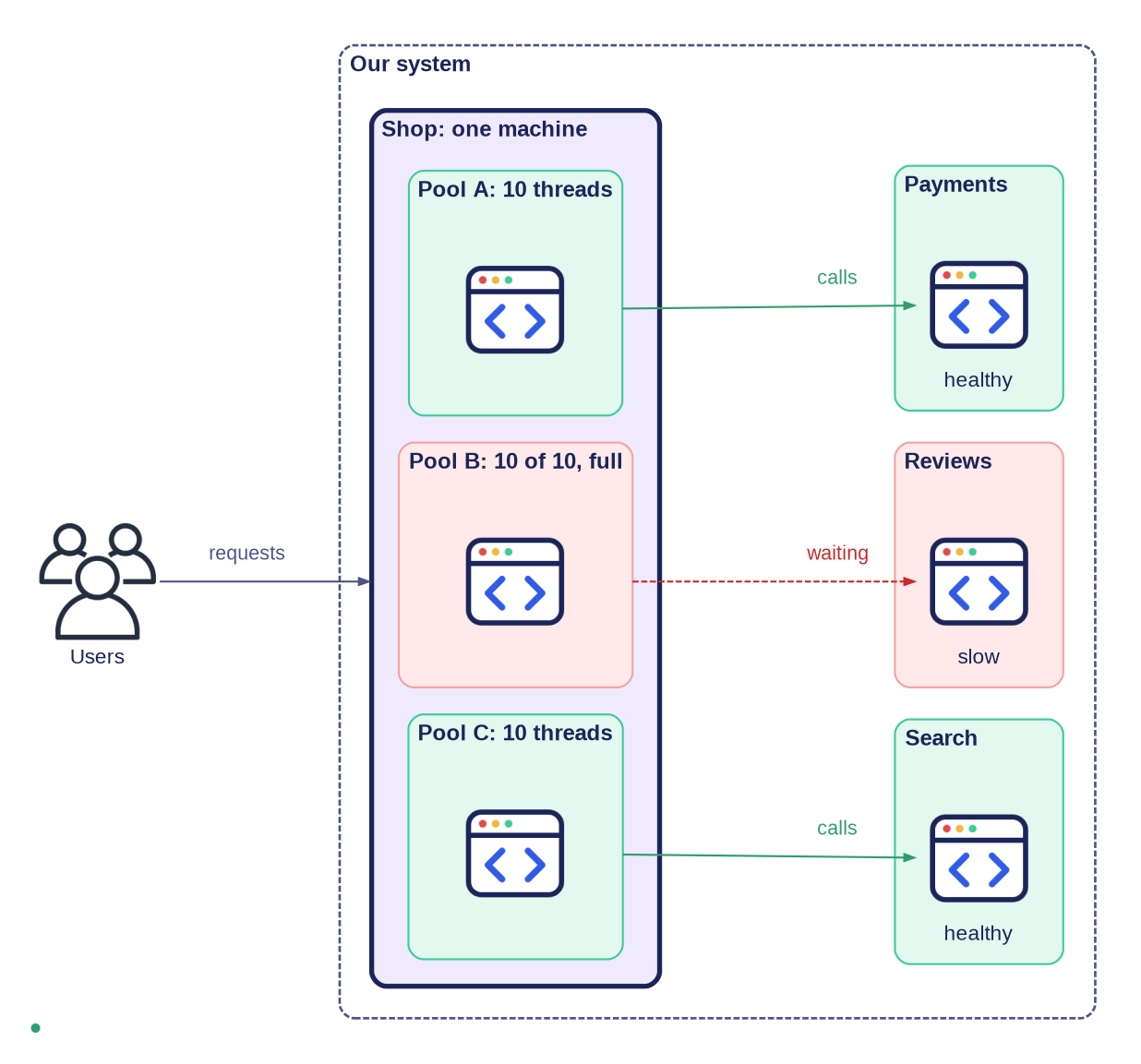
Larger bulkheads are cells: complete copies of the service that each serve a share of customers, so a bad release or a poison request reaches only that share. Smaller ones are limits per customer, which is rate limiting.
Pattern 5
Fallbacks and graceful degradation
| Feature | When its part fails | The user sees |
|---|---|---|
| Product reviews | Cached copy, or leave them out | "Reviews are coming back soon" |
| Recommendations | A fixed list of popular items | Slightly less personal |
| Search | A second, simpler index | Fewer filters |
| Payment | Accept and queue, confirm later, if the business agrees | "Payment pending" |
| Account balance | No fallback | A clear error, never an invented number |
Together
Layers of defence
One protected call
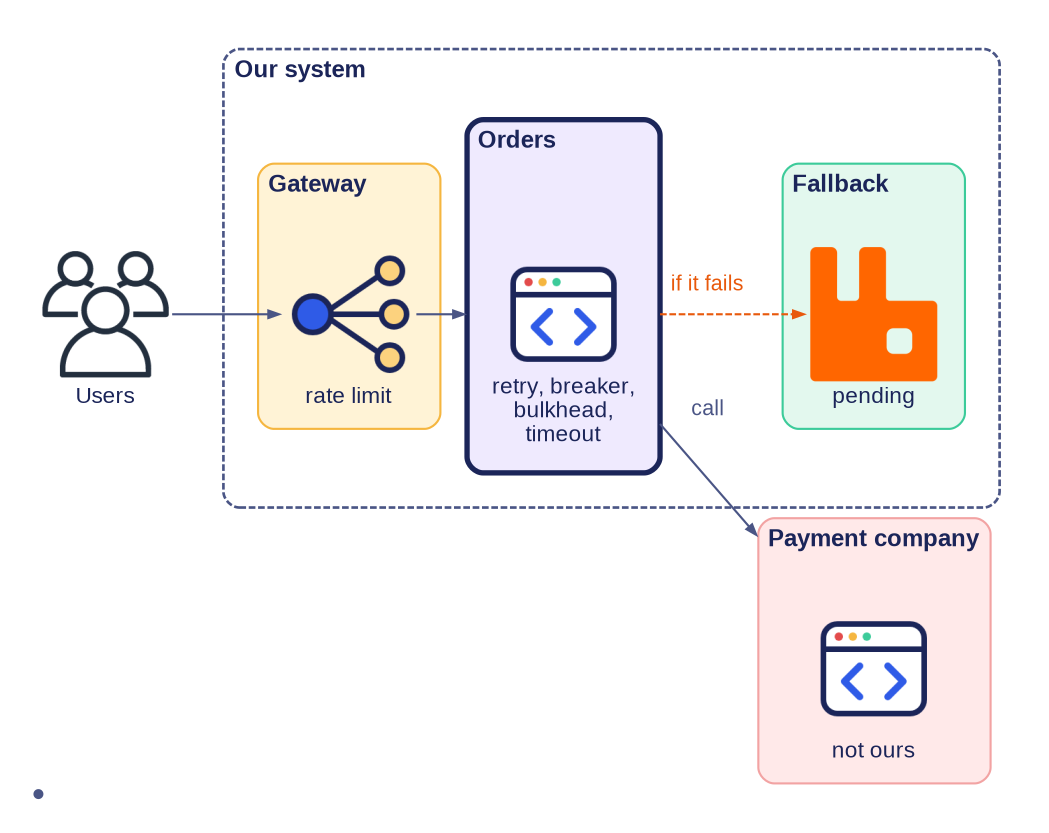
From the outside in
- 1
Rate limit and load shedding
Refuse extra work at the door, cheaply, before it uses anything.
- 2
Fallback
Wraps the rest: whatever fails inside, the user gets something sensible.
- 3
Retry
With backoff, jitter, a budget and the request's deadline.
- 4
Circuit breaker
Each attempt asks it first. A refusal is not retried.
- 5
Bulkhead
Each attempt needs a place in this dependency's pool.
- 6
Timeout
The innermost: each single attempt is limited.
Six design principles
Design for failure
Engineers of earthquake-safe buildings do not hope for calm ground. Every network call can fail, every disk can fill, every service can crash. Plan for it.
Fail fast
Do not hide errors. Stop early instead of writing corrupt data. Short feedback, clear messages.
Degrade gracefully
Show cached data, switch off extras, queue for later, tell people.
No single points
Several load balancers, database replicas, more than one zone, N+1 capacity. See high availability.
Automate recovery
Restart on crash, replace on failed health checks, scale with load. People handle what is new.
Test failure
Chaos experiments, load tests, failover drills, game days.
Proof
Chaos engineering
A fire drill has no fire. People practise, so that they know what to do in a real one. Chaos engineering does this for software: controlled experiments that build confidence that a system can withstand trouble in production. The definition is kept at principlesofchaos.org, started by people at Netflix.
- 1
Define steady state
A number for normal, such as 99.9% of checkouts succeed.
- 2
Form a hypothesis
"If one zone disappears, it stays above 99.5%."
- 3
Inject the failure
The smallest useful one, for a small share of users, with a stop button.
- 4
Observe
Compare with a control group. Stop at once if the limit is crossed.
- 5
Learn and fix
Repair, then run it again. Automate the ones that pass.
May this experiment go on?
Experiments and tools
| Experiment | What you do | Example tool |
|---|---|---|
| Instance termination | Stop random servers | Chaos Monkey (Netflix, the first well-known one) |
| Network latency | Delay calls | Toxiproxy (Shopify) |
| Resource exhaustion | Fill a disk, use memory | Gremlin (commercial platform) |
| Dependency failure | Make an API return errors | Litmus (Kubernetes, CNCF) |
| DNS failure | Break name lookups | Chaos Mesh (Kubernetes, started at PingCAP) |
| Zone outage | Remove a zone | AWS Fault Injection Service |
A game day
| Before | During | After |
|---|---|---|
| Define the blast radius | Watch the dashboards | Blameless review |
| Tell the people involved and get agreement | Check that the alerts fire | Actions with owners and dates |
| Have a stop button and a rollback plan | Write down what you see, with times | Share what was learned |
Checklist
Is this design resilient?
- 1
Timeouts on every external call
And a deadline for the whole request.
- 2
Retries with backoff, jitter and a budget
Only where a repeat is safe.
- 3
Breakers for dependencies
With their state visible.
- 4
Bulkheads
The optional parts cannot starve the essential ones.
- 5
Health checks
Separate liveness and readiness. See operability.
- 6
Degradation paths
A written answer for each dependency: what does the user get?
- 7
Monitoring
Error rate, latency, retries, breaker state, queue length.
- 8
Regular failure tests
A date in the calendar, not an intention.
Summary
The whole topic in one minute.
Assume every call can fail, hang or lie. Give each a timeout, retry only what is safe and temporary, wait longer each time with a random part, stop calling what keeps failing, and cap what one dependency may use.
Decide in advance what the user gets when a part is missing. Then prove it: break things on purpose, in a small area, with a stop button, and repair what you learn.
- Every call can fail, hang, answer late or lie.
- Slow is worse than dead: limit every wait.
- Retry only temporary failures of safe calls, with backoff, jitter and a budget.
- Breaker: closed, open, half-open. Bulkhead: one part cannot use everything.
- Write the fallback down, and test it by breaking things on purpose.