
Talking and drawing
easy 30 minA good design that nobody can follow scores like a weak one.
Video lesson · Chapter 1 of 5
Build the reservation path
Messy drawing, clear drawing
1:15Reel coming soon
Theory
Read or listen first. About 1 min.
What it is
A design lives in someone else's head only if they can follow it. Drawing shows the parts and how they connect. Talking carries the listener through them in order.
Both follow simple conventions that anyone can learn.
Why it exists
Interviewers score what they understood. A good idea in a tangled drawing is hard to credit.
Clear pictures also help you. Gaps in the design show up as gaps on the board.
A short history
1921
Frank and Lillian Gilbreth present process charts, ancestors of the flow chart.
1976
Peter Chen introduces the entity-relationship diagram for data.
1997
The Unified Modeling Language becomes a standard.
2000s
Simon Brown develops the C4 model: context, containers, components and code.
Words to know
- Boundary
- A line around what belongs together.
- Legend
- A key to the symbols.
- Synchronous
- The sender waits; solid arrow.
- Asynchronous
- The sender does not wait; dashed arrow.
- Narration
- Saying what happens as you draw.
How it works
Step through the idea, or press Play.
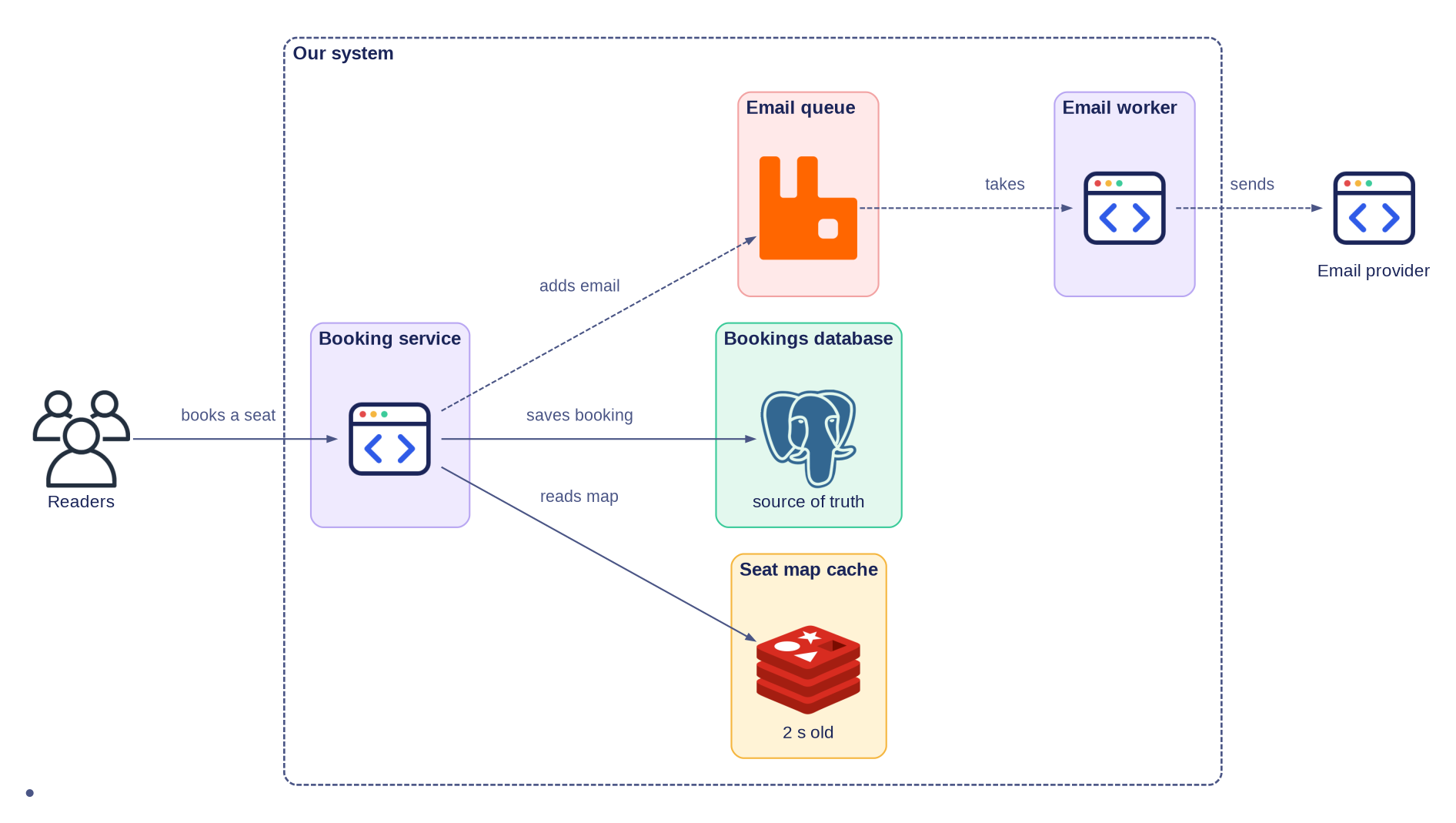
Draw. Left to right, one box per system, verbs on arrows
Understand it
Start here
Giving a visitor directions
A visitor needs the museum. You know the town, but knowing it is not enough. What you say and draw has to work in their head.
Draw
Seven rules for a readable diagram
- 1
Left to right
Users on the left, stored data on the right. People read it like a sentence.
- 2
One box per system
A box is something you could switch off. Two copies of a service are one box marked "x 3".
- 3
A dashed outline around what you run
Users and other companies stay outside it.
- 4
Verbs on arrows
"books a seat", not "HTTP". The arrow points at whoever is asked.
- 5
Dashed means later
Solid arrows are waited for. Dashed ones happen in their own time.
- 6
Mark the source of truth
One word beside the store that wins when copies disagree.
- 7
Leave room
Use the middle third first. New parts need somewhere to go.
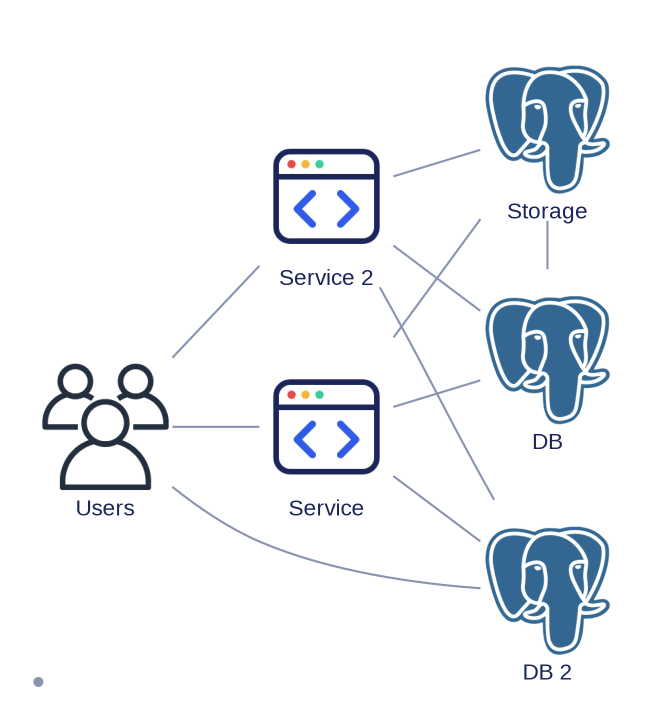
Messy: what does it do?
Clear: the same system
Notation
Eight symbols are enough
| Draw | Means | Example |
|---|---|---|
| Stick person or circle | Someone outside | Reader, driver |
| Rectangle | A service we run | Booking service x 3 |
| Cylinder | Stored data | Bookings database, source of truth |
| Rectangle with a clock or "2 s" | A cache, and how old it may be | Seat map, 2 s |
| Row of small squares | A queue or log | Email queue |
| Solid arrow with a verb | Asks and waits | saves booking |
| Dashed arrow with a verb | Happens later | adds email |
| Dashed outline | Edge of our system | Email provider is outside |
The same notation in Mermaid
Arrow labels that help
- "claims driver"
- "reads map"
- "adds click event"
- "refreshes every 2 s"
Arrow labels that do not
- "data"
- "HTTP"
- "uses"
- No label and two heads
Order
What to draw first
Build the picture in this order
Do not draw in silence for three minutes. Say the next box before you draw it: "Next I need somewhere to keep bookings." They can stop you early, and you get thinking time while your hand moves.
Narrate
Follow one request
Choose one real person doing one thing. Point at each box. Give each one a sentence with the same shape: who asks, what happens, what changes.
How long it takes
Worked example: booking a seat, word for word
You
Let me follow one booking. Maya wants seat 12 at ten o'clock.
- Maya's phone asks the booking service for the map.
- The service reads it from the cache. It may be two seconds old.
- Maya taps seat 12. The service saves the booking in the database.
- The database has a unique rule on seat and slot, so if someone was faster it refuses.
- It worked, so the service adds an email to the queue and answers Maya straight away.
- Later the worker sends the email. That arrow is dashed because nobody waits for it.
You
That is the main path. Is anything unclear before I look at what breaks at nine?
Interviewer
What if the email queue is down?
You
Good, the dashed arrow. The booking stays valid. We keep the email to send in the same database and pass it on when the queue is back.
The same walk as a sequence
Second example, the bus tracker, in five sentences. "Bus 14 reports where it is every ten seconds. The bus service checks that the report really came from bus 14 and keeps only the latest position. A parent's app asks for the bus. The service checks that this parent has a child on bus 14, and only then answers. The trip is stored later, on this dashed arrow, for the school's records."
Think aloud
Talking without rambling
- 1
Answer first
"I would use a queue." Then the reason.
- 2
One reason, one number
"Sending takes three seconds and the reader does not need it."
- 3
Stop
About thirty seconds is enough for most answers.
- 4
Check
"Shall I go into retries, or move on?"
Say your thinking, not your noise
| Instead of | Say |
|---|---|
| "Um, so, maybe, I guess..." | "Two options come to mind. Give me a moment." |
| A long silence | "I am checking what happens if two people do this at once." |
| "And also, and also..." | "The main point is X. I can say more." |
| "Obviously" | Leave it out |
| "Does that make sense?" every minute | "Where would you like more detail?" |
Disagree
When you see it differently
Disagree without a fight
Recipe sharing: search
Interviewer
I would put all recipes in a search engine from day one.
You
That would give good ingredient search straight away. My worry is a second copy to keep in step while we have 50,000 recipes. The database's own text search can serve that, and I would move when ranking or size asks for it.
Interviewer
I still prefer the search engine.
You
Then let us draw it that way: the database stays the source of truth, and the index is a copy filled on this dashed arrow. A load test with real recipes would tell us which of us is right.
Remote
On a shared screen
Before
Open the tool. Practise a box, an arrow with a label and a dashed line until your hands know them.
Layout
Requirements in the top left, numbers under them, design in the middle, a to-do list on the right.
Show where you are
Move the cursor to the box you are naming. Zoom out between phases.
Type, do not draw letters
Short names, large text. Copy and paste a box instead of drawing it again.
Pause more
Sound is delayed and they cannot wave. Stop after each box for a breath.
Plan B
If the board fails, draw in a shared text page:
[Reader] -> books -> [Service] -> saves -> (DB).
Change it
Editing in front of them
- 1
Say the break
"At nine, map reads overload the database."
- 2
Add one thing
Draw the cache and its verb. Leave the rest alone.
- 3
Mark what changed
A colour or a star for the new part.
- 4
Walk only the new part
"Reads stop here now. Writes are the same."
Summary
The whole topic in one minute.
Draw left to right, one box per system, a verb on each arrow, dashed for what nobody waits for.
Follow one request out loud, then pause so the other person can speak.
- Left to right, one box per system, a boundary, verbs on arrows.
- Solid is now, dashed is later, and one store is the source of truth.
- Follow one request with a sentence for each box.
- Answer first, one reason, stop, check.
- State their point fairly before you disagree.