
API authorization
medium 24 minAuthorization decides what a known caller may do, to which object, right now.
Video lesson · Chapter 1 of 6
Start with roles
API authorization
1:18Reel
Theory
Read or listen first. About 2 min.
What it is
Authorization decides whether a caller may perform an action on a thing. It starts where authentication ends: the caller's identity is already known.
Every decision has four inputs: the subject (who), the action (what), the resource (on which object) and the context (when, from where). The answer is allow or deny.
Why it exists
Knowing who someone is does not make their request safe. A real, logged-in customer can still ask for another customer's order. If nobody checks, they get it.
Good authorization limits damage. A stolen account, a buggy script or a partner app can only reach what it was given. It also answers auditors, who ask who was able to do what, and why.
A short history
1975
Saltzer and Schroeder describe least privilege and fail-safe defaults: start with no access, and grant only what is needed.
1992
David Ferraiolo and Richard Kuhn formalise role-based access control (RBAC).
February 2004
The NIST model for RBAC becomes American national standard INCITS 359.
January 2014
NIST publishes SP 800-162, a guide to attribute-based access control (ABAC).
2019
Google describes Zanzibar, a global authorization system built on relationships, at USENIX ATC.
2021
Broken access control moves from fifth to first place in the OWASP Top 10.
Words to know
- Permission
- The right to do one action on one kind of thing, such as
products:read. - Role
- A named set of permissions, such as seller.
- Scope
- A limit on what an app may do for a user. It never gives more than the user has.
- Ownership check
- Comparing the caller with the owner of the exact object.
- Tenant
- One customer organisation whose data must stay apart from the others.
- Least privilege
- Give the smallest set of rights that does the job.
- Policy decision point
- The part that answers allow or deny. The enforcement point asks it and obeys.
- BOLA
- Broken object level authorization: the server forgets to check the object. First in the OWASP API list of 2023.
How it works
Step through the idea, or press Play.
Identify. Authentication says who the caller is
Understand it
Start here
The swimming pool story
At a swimming pool, everyone shows a ticket at the entrance and gets a wristband. Being inside does not mean you may go everywhere.
Role, owner, time: three different questions, and a real API often needs all three.
Authentication
- Who are you?
- Verifies identity: login, JWT, session
- Returns a user ID such as
usr_123 - Fails with 401
Authorization
- What may you do?
- Checks permissions: roles, policies, scopes
- Returns allowed or denied
- Fails with 403, or 404 to hide that a thing exists
One request, two checks
Why
What happens without it
With authorization
- Only admins delete products
- Each role sees its own dashboard
- Sellers reach only their own stock
- People see only their own orders
Without it
- Any user can delete products
- Customers open admin pages
- Sellers read other sellers' data
- Every order is visible to everyone
Models
Four ways to write the rules
Access list (ACL)
Each object lists who may do what to it. Simple for files and shared documents.
Roles (RBAC)
Users get roles, roles get permissions. Easy to understand and to audit.
Attributes (ABAC)
Rules compare facts about user, object, action and situation. Flexible, and harder to review.
Relationships (ReBAC)
Access follows links: editor of this folder, member of that team. Good for sharing.
Which model do I need?
Model 1
Roles: RBAC
Permissions belong to roles, and users are given roles. When somebody changes job, you change one role assignment instead of thirty permissions.
The shop's roles
| Permission | Customer | Seller | Admin |
|---|---|---|---|
| View products | Yes | Yes | Yes |
| Create a product | No | Yes | Yes |
| Edit a product | No | Own only | Yes |
| Delete a product | No | No | Yes |
| View and edit a cart | Own only | No | Yes |
| Place an order | Yes | No | Yes |
| View orders | Own only | Own sales only | Yes |
| Manage stock | No | Own only | Yes |
| Manage users | No | No | Yes |
Why roles save work
RBAC is good at
- Easy to understand and manage
- A clear audit trail
- Scales well for most applications
- Little maintenance
- Supported by most frameworks
RBAC struggles with
- Role explosion in complex systems
- Decisions that need context
- Rules that change with the situation
- Ownership of single objects
- Many tenants, unless roles are per tenant
Role explosion
Model 2
Attributes: ABAC
Four kinds of attribute
| Kind | Question | Examples |
|---|---|---|
| Subject | Who is asking? | role, department, clearance, location |
| Resource | What are they touching? | owner, type, classification, status |
| Action | Which operation? | read or write, sensitivity, impact |
| Environment | In which situation? | time, IP address, device type, risk score |
# Sellers edit their own productsPERMIT IF subject.role == "seller" AND action == "update" AND resource.type == "product" AND resource.owner == subject.id# Customers cancel their own pending orders within 24 hoursPERMIT IF subject.id == order.customer_id AND action == "cancel" AND (now - order.created_at) < 24 hours AND order.status == "pending"# Premium customers get the holiday discount of 20%PERMIT IF subject.membership == "premium" AND action == "apply_discount" AND env.is_holiday_sale == trueRBAC or ABAC?
| Situation | RBAC | ABAC |
|---|---|---|
| Simple app, few roles | Best | More than you need |
| Ownership of objects | Needs extra code | A natural rule |
| Office hours only | Not by itself | Easy |
| Many tenants | Roles per tenant, or extra code | Natural: compare tenant IDs |
| Audit | Easy: list the roles | Detailed logs, harder to answer "who can?" |
Model 3
OAuth scopes
A scope says what an app may do for a user. The user sees the list and agrees. A scope can only narrow what the user already has.
What the app can really do
Scope examples
| Scope | Allows | Note |
|---|---|---|
products:read | View products | Also written read:products; pick one order |
products:write | Create and update | Does not include delete |
products:delete | Delete | Sensitive, asked for separately |
cart:write | Change the cart | |
orders:read | View orders | Only the orders this user may see |
users:admin | Manage users | Rarely given to other apps |
Consent
Practice
Three patterns that matter most
| Pattern | Wrong | Right |
|---|---|---|
| Check on the server | Hide the delete button in the browser | The server checks and answers 403. Hiding the button is only good manners |
| Least privilege | Give admin because someone needs reports | Give reports:read |
| Deny by default | Allow unless it is on a block list | Deny unless a rule allows it |
const requirePermission = (permission) => (req, res, next) => { if (!req.user.permissions.includes(permission)) { audit.denied(req.user.id, permission); return res.status(403).json({ error: "forbidden" }); } next();};app.delete("/products/:id", authenticate, // 1. who are you? requirePermission("products:delete"), // 2. may you do this kind of thing? deleteProductHandler // 3. may you touch this object? then do it);SELECT * FROM orders WHERE id = :order_id AND tenant_id = :tenant_of_caller AND customer_id = :caller_id;403 or 404?
Architecture
Where the decision is made
Coarse at the edge, fine next to the data
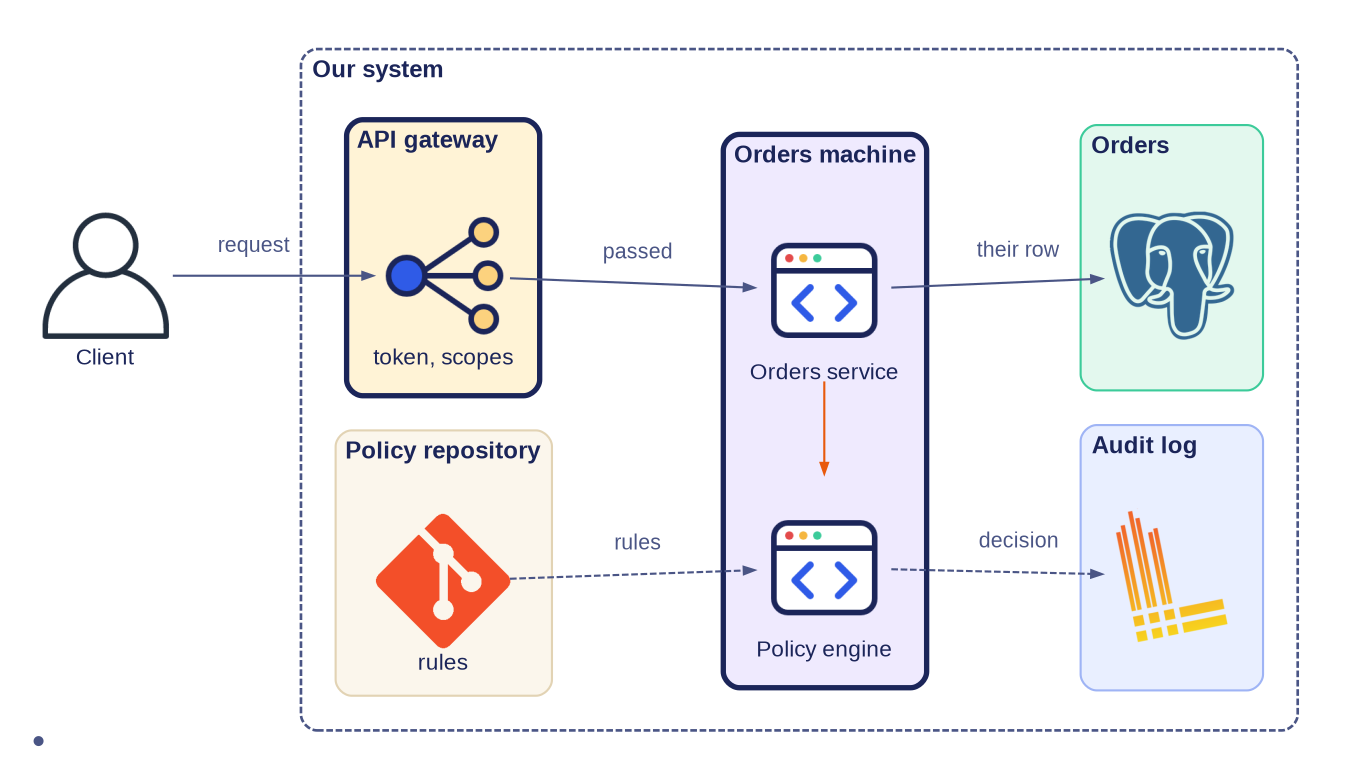
Three places to decide
| Place | Good | Cost |
|---|---|---|
| In each service's code | Simple, fast, has the data | Rules are copied and drift apart |
| Policy engine beside each service | One language, local calls, tested apart | Rules and data must be distributed |
| Central authorization service | One answer for all, shares and groups | Every call depends on it: needs caching, a timeout and high availability |
Checking a list
Freshness
Roles inside tokens grow old
If a JWT carries role: admin and you remove the role, the token still says admin until it expires. Keep tokens short, or carry only the user ID and read roles at the service. For dangerous actions always read the current role.
How old may a right be?
| Action | Source of the role | Oldest answer |
|---|---|---|
| Read a product list | Token | 15 minutes |
| Edit stock | Cache | 30 seconds |
| Refund, delete, change roles | Database | Now |
Operations
Test it and record it
- 1
Keep a permission matrix as a test
For each role and endpoint, assert allow or deny. A new endpoint without a row fails the build.
- 2
Always test with two users
User B tries to read, change and delete what user A owns. Expect 403 or 404 each time.
- 3
Log each denial
Who, what, which object, which rule. Many denials from one caller is a warning sign.
- 4
Review rights
Remove roles that nobody used for months. Give dangerous rights for a limited time.
Summary
The whole topic in one minute.
Check on the server, on every request, at two levels: may this caller use this endpoint, and may they touch this object? Deny unless a rule allows it.
Start with a few roles plus ownership and tenant checks. Add attributes when rules depend on time, state or place, relationships when people share things with people, and scopes whenever another app acts for a user.
- Authorization asks what a known caller may do, to which object, in which situation.
- Check on the server, on every request, at endpoint level and at object level.
- Roles for jobs, ownership and tenant for objects, attributes for context, scopes for other apps.
- Deny by default and give the least that works.
- Rights in tokens and caches are old copies. Decide how old is acceptable for each action.