
Cache eviction policies
easy 22 minA cache has a memory limit.
Chapter mnemonic
Three cache eviction policies
First through the door. Longest since a visit. Fewest visits.
Maya arrived first, Leo last visited longest ago, and Jo visited least. Who leaves under each policy?
FIFO evicts Maya, LRU evicts Leo, and LFU evicts Jo.
Video lesson · Chapter 1 of 5
Three shelves and a recency list
Cache eviction in 75 seconds
1:15Reel coming soon
Theory
Read or listen first. About 2 min.
What it is
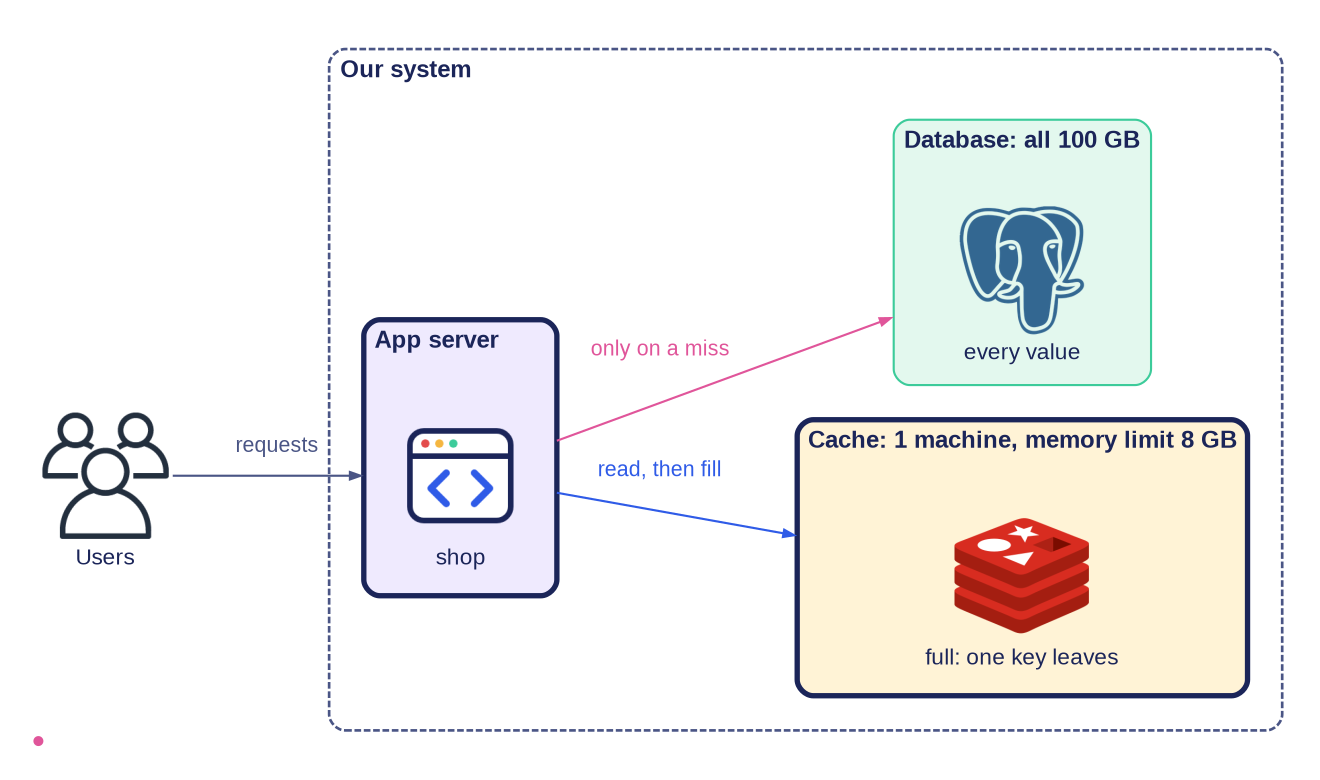
A cache keeps copies of values in fast, limited memory. Sooner or later it is full. Eviction is the removal of a value to make room, and the eviction policy is the rule that chooses which one.
Evicting is not data loss. The value still exists in the database, so the only price is a slower read if somebody asks for it again. A good policy evicts values nobody asks for again.
Why it exists
Nobody knows the future, so a policy must guess from the past: what was used recently, what was used often, what is oldest, or what expires soonest. Real traffic is uneven, and a small share of keys usually receives most of the reads.
The guess matters more than it looks. If the hit rate rises from 90% to 95%, the share of reads that reach the database falls from 10% to 5%. Half of the database load disappears without buying any memory.
A short history
1993
The LRU-K paper proposes ranking database pages by their K-th most recent use, so that one lucky read does not make a page look hot.
2003
The Adaptive Replacement Cache (ARC) is presented at USENIX FAST. It keeps re-balancing between recency and frequency by itself.
2015
The TinyLFU paper describes a compact frequency sketch that decides whether a new value deserves a place at all.
October 2018
The memcached project describes its segmented LRU (hot, warm, cold), the default since version 1.5.0.
Words to know
- Hit
- The value was in the cache.
- Miss
- It was not, so it must be fetched from the source.
- Capacity
- The most entries or bytes the cache may hold.
- Victim
- The value chosen to leave.
- Recency
- How long ago a value was last used.
- Frequency
- How often a value has been used.
- Scan
- A read of many keys once each, such as a nightly export.
- Admission
- Deciding whether a new value may enter at all.
How it works
Step through the idea, or press Play.
The cache fills up. Every miss adds a value until the memory limit is reached
Understand it
Start here
The toy shelf
Imagine a small toy shelf with four places. All four are taken, and a child gets a new toy. One toy must leave. Which one? That question is cache eviction.
No rule is always right. A good rule makes few trips to the box.
The problem
Why caches must forget
Memory is limited and the data is not. At 70% full there is still room and no decision to make. At 100% every new value forces one.
A small cache beside a big database
Storing a value
Why one hit-rate point matters
Four common policies
LRU
Least recently used: evict the entry not accessed for the longest time.
LFU
Least frequently used: evict the entry with the lowest access count.
FIFO
First in, first out: evict the entry that was inserted first.
TTL
Time to live: evict the entry that is closest to expiry.
Recency
LRU: least recently used
LRU assumes that something used recently will be used again soon. This property of real programs is called temporal locality.
How it works
- 1
Remember the order of use
Keep the entries in a list, most recent at one end. No clock is needed.
- 2
On each access
Move the entry to the recent end.
- 3
When full
Remove the entry at the other end. With A, B, C, D, E from newest to oldest, E leaves next.
Best for
- Web page caching
- Database query results
- General purpose caching
Limitations
- A sequential scan pushes out hot entries
- It ignores how often an entry is used
Frequency
LFU: least frequently used
LFU assumes that popular entries stay popular. Each entry has a counter. The lowest counter leaves, and ties are usually broken by recency.
Who leaves next?
| Entry | Accesses | Decision |
|---|---|---|
| A | 15 | stays |
| B | 8 | stays |
| C | 3 | stays |
| D | 1 | leaves next |
| E | 5 | stays |
Best for
- A CDN with clearly popular content
- Finding hot data
- Stable access patterns
Limitations
- Yesterday's star keeps its high count
- New entries start low and leave quickly
- More complex than LRU
Age
FIFO: first in, first out
FIFO is a queue. New entries join at the back and the front leaves, however often it was read. A hit changes nothing, which makes reads cheap and easy to run in parallel.
FIFO is a line
Best for
- Simple implementations
- Streams, where age is importance
- Building blocks inside newer policies
Limitations
- Ignores access patterns
- Can evict hot data
- Often a lower hit rate than LRU
Expiry
TTL: two different jobs
A time to live makes an entry invalid after a while. That is expiry: it happens even when the cache is half empty. A TTL can also choose a victim when the cache is full: take the entry with the shortest remaining time. That is eviction.
Remaining time
| Entry | Seconds left | State |
|---|---|---|
| A | 300 | fresh |
| B | 120 | fresh |
| C | 10 | leaves next |
| D | 60 | low |
| E | 180 | fresh |
Best for
- Session tokens
- Data that changes in real time
- Rate-limit counters
- DNS answers
Limitations
- The right TTL is hard to choose
- A useful entry may leave
- Absolute expiry times need clocks that agree
The steps are simple: set an expiry when storing, treat an expired entry as a miss, sweep old entries in the background, and optionally renew the time on access. Choosing the time is a topic of its own: cache TTL.
Compare
The same requests, four answers
Three places. The requests are A B C A A D A E A B. The last row is the best possible result: Bélády's algorithm evicts the entry whose next use is furthest away. It needs the future, so it is only a yardstick.
| Policy | Hits of 10 | Evicted, in order |
|---|---|---|
| FIFO | 3 | A, B, C, D |
| LRU | 4 | B, C, D |
| LFU, LRU on ties | 4 | B, C, D |
| Best possible | 5 | C, D |
When to use which
| Policy | Use when | Avoid when |
|---|---|---|
| LRU | Recently used means likely used again | Sequential scans and one-time reads |
| LFU | Hot and cold data are clearly different | Access patterns change often |
| FIFO | Older data is naturally less relevant | The same entries are read again and again |
| TTL | Data has a natural expiry | Expiry time is unpredictable |
Choosing a policy
Trouble
Scans, and the policies that survive them
A nightly export reads a million rows once. LRU treats each as the newest and pushes every hot entry out. In a small trace, A A B B C D A B E A B with three places, LRU and FIFO get 4 hits, while LFU gets 6, which is the best possible here.
Common answers
- 1
Segmented LRU
New entries wait on probation. Only a second use promotes them. memcached uses hot, warm and cold parts.
- 2
LRU-K
Rank by the K-th last access instead of the last one.
- 3
Admission filter
Compare the newcomer's estimated frequency with the victim's and refuse the weaker one. Caffeine uses Window TinyLFU.
- 4
Skip the cache
Let batch jobs read without storing. Often the simplest fix.
A probation area protects hot keys
In products
What Redis really does
Redis does not keep a perfect LRU list. It samples a few keys and evicts the best candidate; maxmemory-samples is 5 in the documented example. That is close enough to LRU and cheaper in memory.
Redis policies by family
| Family | Candidates | Note |
|---|---|---|
noeviction | none | Commands that add data fail when memory is full |
allkeys-lru, -lfu, -random | every key | Normal choice for a pure cache |
volatile-lru, -lfu, -random | keys with a TTL | Behaves like noeviction if no key has a TTL |
volatile-ttl | keys with a TTL | Shortest remaining time first |
maxmemory yourself.Numbers
How many entries fit?
Capacity
What to watch
- 1
Hit rate
Hits divided by hits plus misses, per key group if you can.
- 2
Evictions per second
A steady few are normal. A jump means a scan, a traffic shift or too little memory.
- 3
Age of the victim
If evicted entries were used seconds ago, the cache is too small.
- 4
Expired versus evicted
Many expiries and few evictions mean memory is not your limit; the TTL is.
Common combinations
| Pair | What it gives |
|---|---|
| LRU + TTL | Recency with automatic expiry: the usual start |
| LFU + TTL | Frequency with time-based clean-up |
| LRU-K | Recency of the K-th last access, a mix of both |
Eviction is one half of keeping a cache useful. The other half is filling it: see cache-aside, and distributed caching for more memory than one machine has.
Summary
The whole topic in one minute.
A full cache must drop something. LRU drops what was used longest ago, LFU what was used least often, FIFO what arrived first, and TTL-based eviction what would expire soonest. Each is a guess about the future.
Start with LRU plus a TTL. Move to a frequency-aware policy when scans or one-time reads push out hot keys. Measure the hit rate and the eviction rate, and remember that the largest gain may be a bigger cache or fewer useless entries.
- Eviction removes a copy, never the source.
- LRU guesses by recency, LFU by frequency, FIFO by age, TTL by expiry.
- Expiry happens because of time; eviction happens because of space.
- Scans break plain LRU: use probation, admission or skip the cache.
- Start with LRU plus TTL, then let the hit rate decide.