
Unique IDs with causality
hard 30 minNumber events so that a cause always comes before its effect, even when clocks disagree.
Video lesson · Chapter 1 of 5
A number on a letter travels between servers
Happened before, in 75 seconds
1:15Reel coming soon
Theory
Read or listen first. About 1 min.
What it is
Causality is the relation between a cause and its effect. A reply is caused by its question. An edit is caused by the version it changes. An ID with causality carries enough information that the effect never sorts before the cause.
Ordinary timestamps cannot promise that, because every computer has its own clock. Logical clocks count events and messages instead of seconds.
In one line: track how events relate, not what the wall clock said.
Why it exists
Time-ordered IDs are nearly sorted. When one clock is ahead, a reply can get a smaller ID than the message it answers.
Sometimes order is not enough. If two people changed the same thing without knowing of each other, we want to know that both happened, so that neither change is lost.
A short history
1978
Leslie Lamport's paper on time, clocks and the ordering of events defines happened-before and a simple counter that respects it.
1988
Colin Fidge and Friedemann Mattern independently describe vector clocks.
2007
Amazon's Dynamo paper describes a store that uses vector clocks to find conflicting versions of an object.
2014
A technical report of the University at Buffalo introduces hybrid logical clocks, which combine clock time with a small counter.
Words to know
- Happened before
- Written a → b: a could have influenced b.
- Concurrent
- Neither happened before the other.
- Clock skew
- The difference between two clocks at one moment.
- Lamport clock
- One counter for each process: larger than everything it has seen.
- Vector clock
- One counter for every process, kept by each of them.
- Hybrid logical clock
- Clock time plus a small counter that keeps causes in order.
- Total order
- Every two events have an order, sometimes an arbitrary one.
- Partial order
- Only related events have an order.
How it works
Step through the idea, or press Play.
Count. Each event raises a counter
Understand it
Start here
Chess by post
The date on the letter was never needed, only what the writer had seen.
What we want to know
Cause and effect
An effect never sorts before its cause.
Independence
Which events did not know of each other?
No common clock
It works with clocks that disagree.
Only what matters
Related events are ordered, others may be in any order.
Problem
Why wall clocks fail
One clock is half a second behind
| Server | Its clock says | Event | Really |
|---|---|---|---|
| A | 10:00:01.000 | X: the question | first |
| B, behind | 10:00:00.600 | Y: the answer to X | 0.1 s later |
Definition
Happened before
Three rules
- 1
Same process
If a comes before b in one process, then a → b.
- 2
Message
If a is the sending and b the receiving of one message, then a → b.
- 3
Chain
If a → b and b → c, then a → c.
If neither a → b nor b → a, they are concurrent. That does not mean at the same moment. It means neither could have known of the other.
Who could have influenced whom?
One number
Lamport clocks
Three rules for one counter L
| Event | Rule |
|---|---|
| Something happens here | L = L + 1 |
| Send | L = L + 1, put L in the message |
| Receive m | L = max(L, m) + 1 |
The promise, and what it is not
Three processes
Add the process name to break ties, and the pairs (number, name) give one total order that everybody agrees on. That is enough for mutual exclusion, for replicated state machines and for queues. Reading a real time from it is impossible.
Many numbers
Vector clocks
Rules for a vector V with one counter for each process
| Event | Rule |
|---|---|
| Something happens here | V[me] = V[me] + 1 |
| Send | V[me] = V[me] + 1, send the whole vector |
| Receive W | Take the larger of each pair, then V[me] = V[me] + 1 |
Comparing
| X | Y | Answer | Why |
|---|---|---|---|
| [2, 1, 0] | [2, 2, 0] | X before Y | Every number of X is at most that of Y, one is smaller |
| [2, 0, 1] | [1, 2, 0] | Concurrent | X is larger in one place, Y in another |
| [2, 2, 0] | [2, 1, 0] | Y before X | The first rule, the other way round |
| [1, 1, 0] | [1, 1, 0] | The same | All equal |
Good
- Finds concurrent events
- Full cause and effect
- The answer is exact
Not so good
- One counter for each writer, in every event
- Every message carries it
- Writers come and go, so old entries must be removed
- Not a sortable number
What it costs
Both
Hybrid logical clocks
A hybrid logical clock (HLC) is a pair: l, the largest clock time seen so far, and c, a counter for events with the same l. It follows the real clock when it can, and the counter when it must.
An HLC timestamp as an ID
| Part | Bits | Job |
|---|---|---|
| l: time | 48 | Milliseconds; sorts by real time |
| c: counter | 16 | Keeps cause before effect inside one l |
| Node | varies | Breaks ties, makes the ID unique |
def local_or_send(): old = l l = max(l, pt) c = c + 1 if l == old else 0def receive(msg): old = l l = max(old, msg.l, pt) if l == old == msg.l: c = max(c, msg.c) + 1 elif l == old: c = c + 1 elif l == msg.l: c = msg.c + 1 else: c = 0Order and bound
Receiving a message
Architecture
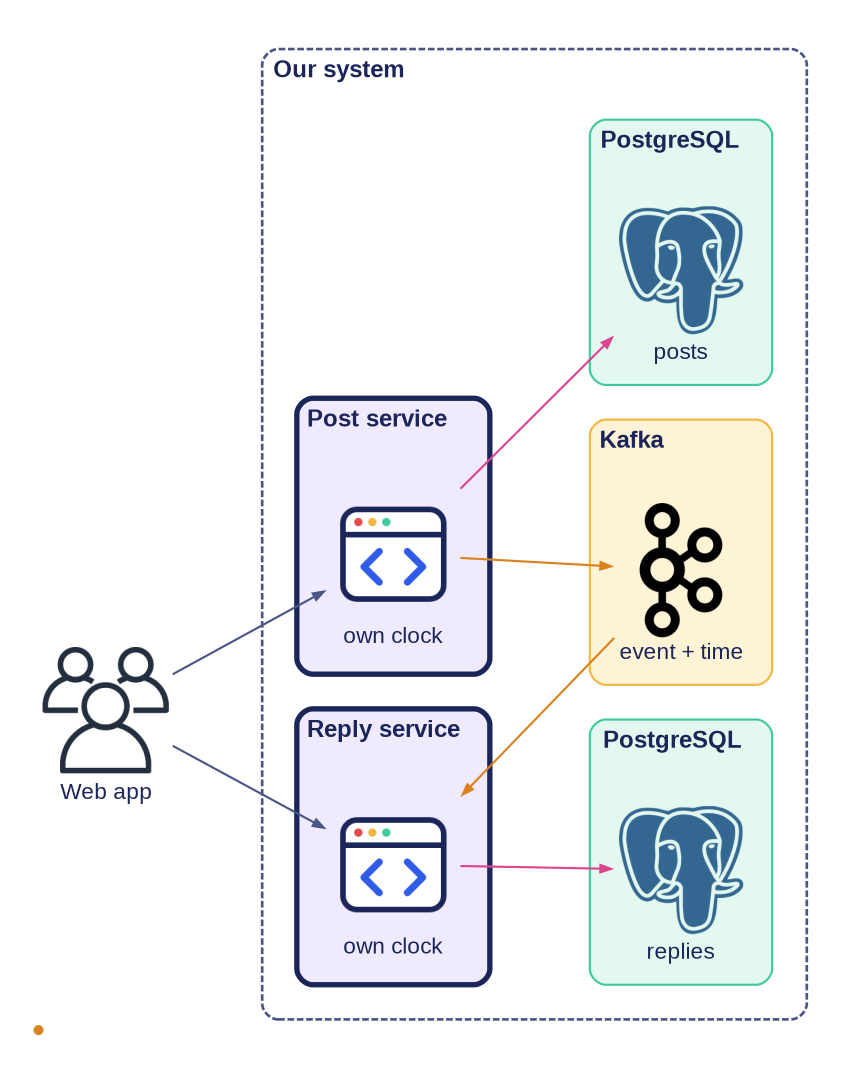
Passing the clock along
The timestamp travels with every message
Compare
Which clock?
| Wall clock | Lamport | Vector | Hybrid | |
|---|---|---|---|---|
| Size | 8 bytes | 8 bytes | 8 bytes per writer | 8 bytes, plus node |
| Cause before effect | No | Yes | Yes | Yes |
| Finds concurrency | No | No | Yes | No |
| Near real time | Yes | No | No | Yes |
| Many nodes | Yes | Yes | No | Yes |
| Difficulty | None | Simple | Medium | Medium |
Choosing
Simpler
Often a sequence is enough
All messages of one chat can go through one leader or one partition. It numbers them 1, 2, 3. Cause before effect follows at once, the numbers have no gaps a reader must worry about, and a client can ask for everything after 41. You need logical clocks when no single place sees all related events.
How databases order transactions
| System | Way | Cost |
|---|---|---|
| CockroachDB | Hybrid logical clocks; default maximum offset 500 ms | Uncertain reads may have to restart |
| YugabyteDB | Hybrid logical clocks | Similar |
| TiDB | One timestamp oracle | A call to it for timestamps |
| Spanner | TrueTime: special clocks with a known error | Hardware, and waiting out the error |
Care
Using them safely
Do
- Use a hybrid clock for sortable IDs across services
- Lock the counter, or use one atomic value
- Add the node to every ID
- Watch clock offset and refuse absurd times
- Test with clocks that are wrong on purpose
Do not
- Read a smaller Lamport number as a cause
- Use vectors with thousands of writers
- Ignore a full counter
- Mix clock types in one column
- Trust wall clocks alone for last writer wins
Summary
The whole topic in one minute.
Happened-before has three rules: order inside one process, send before receive, and chains of both. A Lamport clock gives every effect a larger number than its cause. A vector clock also says when two events were concurrent, and grows with the number of writers. A hybrid clock keeps causes in order and stays near real time.
For IDs, use a hybrid clock plus a node number. For conflicts, use vectors with few writers. For a chat, one sequence for each conversation is often simpler than all of them.
- Happened before: same process, message, chain. Everything else is concurrent.
- Receive rule: take the larger, add one.
- Lamport gives order, vector also finds concurrency, hybrid gives order near real time.
- A smaller number does not prove a cause.
- The chain must be unbroken: carry the timestamp in every message.