
Choosing a cache pattern
medium 24 minCache-aside, write-through and write-back differ in what happens on a save, what a reader can see and what a crash can take.
Video lesson · Chapter 1 of 5
Start with the decision the stale value could change
Theory
Read or listen first. About 2 min.
What it is
A cache pattern is a rule for keeping a cache and a database together. Three are used most. With cache-aside the application fills the cache on a miss and deletes the copy on a change. With write-through a save changes both before the caller is answered. With write-back a save changes the cache, and the database follows later.
Choosing means asking how the data is read and written, how old a copy may be, and what may be lost in a crash. The answers point to a pattern, often a different one for each kind of data.
Why it exists
No pattern is best. Each one makes something cheap and something else expensive or risky. If you pick by name, the cost shows up later, usually on a bad day.
In interviews and in design reviews the reason counts more than the choice. A short list of questions gives you that reason, and the numbers to go with it.
A short history
2003
Memcached is released in May: a cache that knows nothing about the database, so the application has to apply a pattern.
2013
Two papers from Facebook show both sides: a demand-filled look-aside cache in front of databases (NSDI), and TAO, where writes go through a leader cache (ATC).
2017
Amazon introduces DAX in April, a managed cache for one database that comes with a pattern built in: write-through.
Words to know
- Read and write ratio
- How many reads there are for each write.
- Staleness
- How old a copy may be when someone reads it.
- Loss window
- How many confirmed saves a crash may take.
- Read your own write
- A person sees the change they just made.
- Cache pollution
- Copies that take room and are never read.
- Cold start
- The time when the cache is empty.
- Hybrid
- Different patterns for reads and saves, or for different data.
- Write-around
- A save that goes only to the database.
How it works
Step through the idea, or press Play.
Ask. Reads, writes, age, loss
Understand it
Start here
Which shoes today?
Max has three pairs of shoes by the door. None of them is the best pair. It depends on the ground outside.
The three
What each pattern does
Cache-aside (lazy loading)
Read from the cache, fetch on a miss. On a change write the database and delete the copy. The application manages both stores.
Write-through
Every save goes to the cache and the database before the answer. It counts only when both are done.
Write-back (write-behind)
Save to the cache and answer. A worker writes the database later, in batches.
Each has its own page with the details: cache-aside, write-through and write-back.
Step by step
| Step | Cache-aside (read) | Write-through (save) | Write-back (save) |
|---|---|---|---|
| 1 | A read arrives | A save arrives | A save arrives |
| 2 | Look in the cache | Write the cache or, in your own code, the database first | Write the cache |
| 3 | Hit: return it | Write the other one | Answer: saved |
| 4 | Miss: read the database | Wait for both | Queue the key |
| 5 | Store the copy | Answer: saved | A worker collects a batch |
| 6 | Return the data | Reads look in the cache first | Write the batch to the database |
Compare
The comparison
Three patterns, nine questions
| Question | Cache-aside | Write-through | Write-back |
|---|---|---|---|
| Copy and database agree | After the delete or the TTL | Closely, not as one transaction | After the flush |
| Save waits for | Database and delete | Database and set | Cache only |
| Read after a save | Miss | Hit | Hit |
| First read of old data | Miss | Miss | Miss |
| Confirmed saves lost in a crash | No | No | Yes, up to the flush |
| Unread copies | Few | Many | Many |
| Cache is down | Slow reads | Slow reads, saves need a rule | Recent saves at risk, saves stop or fall back |
| Effort | Low | Medium | High |
| Best for | Read-heavy | Save, then read | Write-heavy |
Save and next read
Work for the database
Decide
The questions
From a worry to a pattern
What to ask, and why
| Question | Changes the choice because |
|---|---|
| How many reads for one write? | Cache-aside lives from reads between changes |
| How old may a copy be? | Zero means no cache for that decision |
| What may a crash take? | Only write-back can lose confirmed saves |
| Do people read their own save at once? | Write-through gives a hit with the new value |
| Who else writes the database? | Writers that skip the cache leave old copies |
| What if the cache is away? | Cache-aside is the easiest to live without |
Cache-aside
Good and bad fits
Best for
- Read-heavy applications
- Data that does not change often
- A cache that may be unavailable
- Places where slightly old data is fine
Not for
- Write-heavy data: the copy is deleted before it pays off
- Values that must be exact
- Data that changes every moment
In its favour: it caches only what is asked for, a cache failure does not stop the application, and it is simple. Against it: the first request is slow, a miss costs three trips, a copy is stale if someone changes the database directly, and the application has to do the work.
Write-through
Good and bad fits
Best for
- Reads that follow a save
- Read-heavy data with some writes
- Profile and settings updates
- Data where confirmed saves must be safe
Not for
- Write-heavy data
- Very large data that is rarely read
- Saves that must be very fast
In its favour: the copy is new right after the save, nothing confirmed is lost, and the model is easy to think about. Against it: the save waits for the database, both systems take part in every save, and the cache fills with values nobody reads.
Write-back
Good and bad fits
Best for
- Write-heavy data
- Analytics and logs where small gaps are fine
- Game leaderboards
- Sensor data, latest value
Not for
- Financial transactions
- Data that must never be lost
- Readers that need the database to be current
In its favour: the fastest saves, fewer database writes, and it absorbs bursts. Against it: confirmed saves can be lost, the database is behind, it is hard to build and to debug, and the cache has to be very reliable.
Mix
One shop, several patterns
Choose per kind of data. Reads and saves can also use different rules: cache-aside for reads together with write-through for saves is a common pair.
One shop, a pattern per kind of data
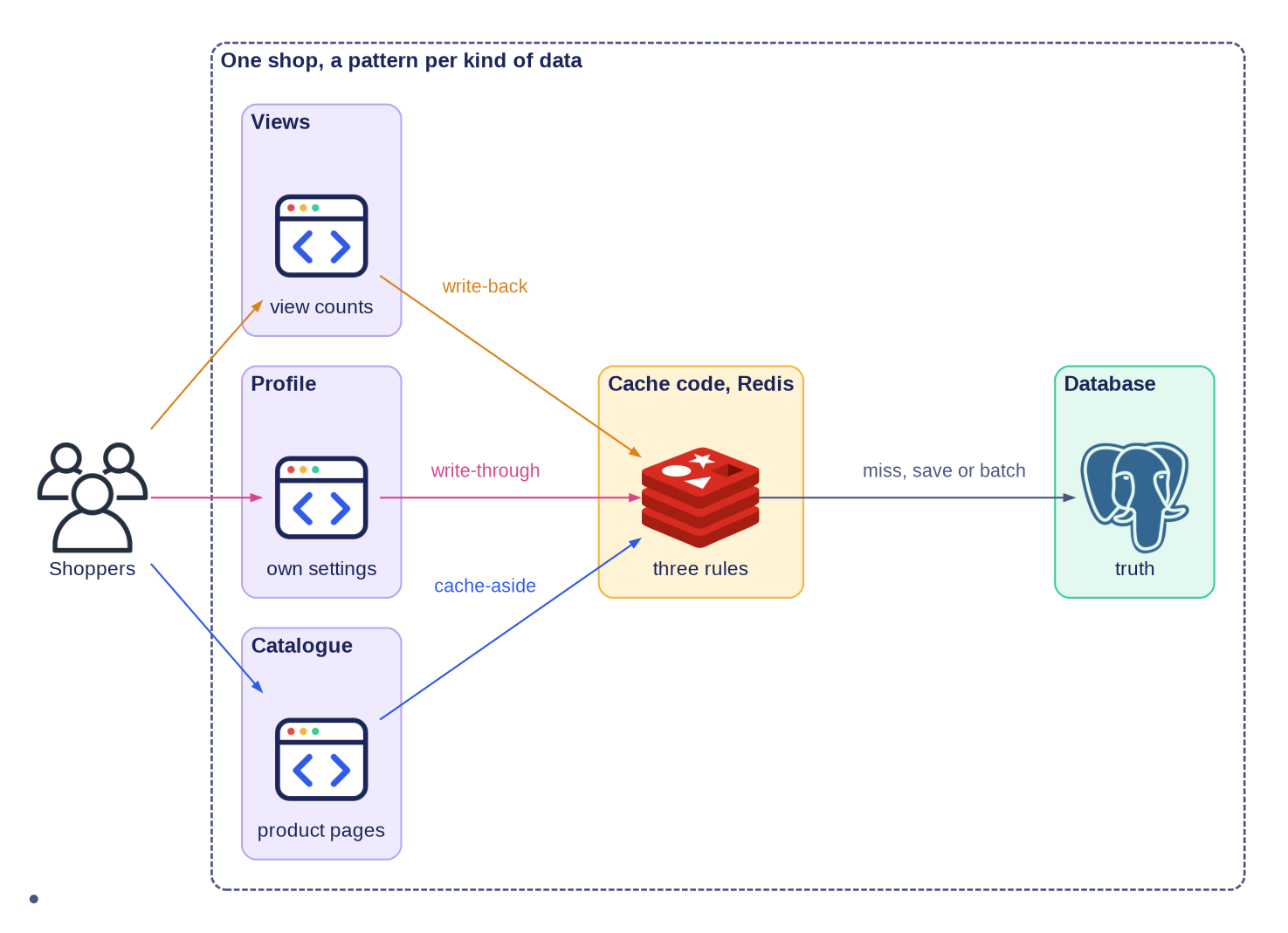
Cache-aside reads with write-through saves
No cache
When the answer is none
Show from the cache, decide in the database
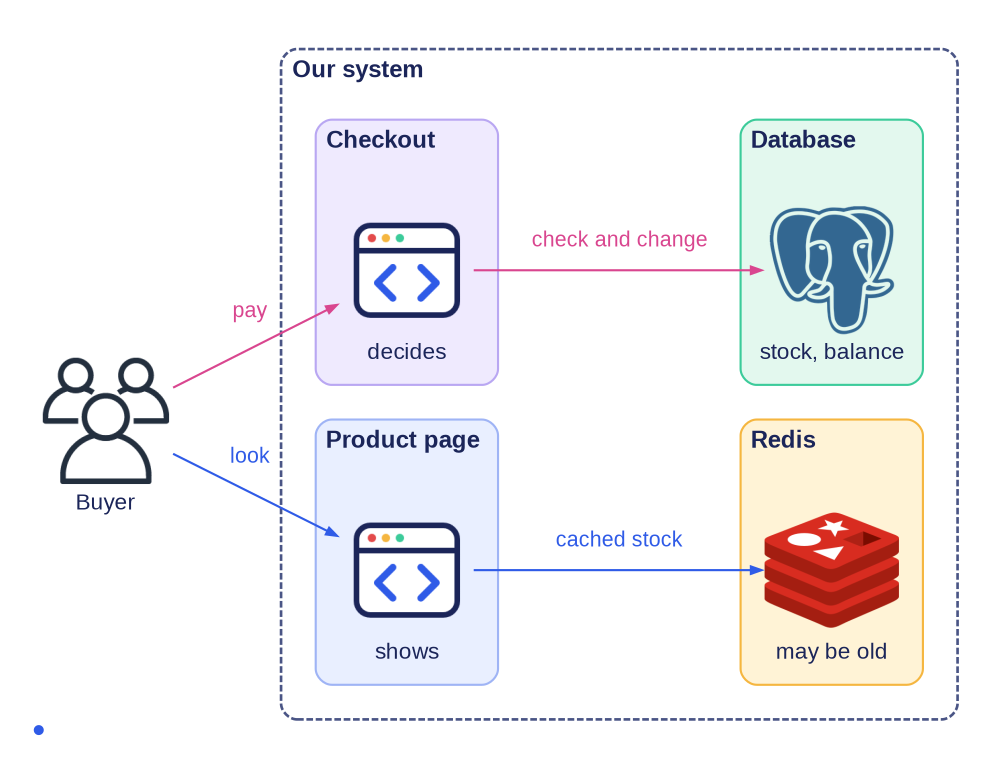
Failure
What breaks in each
| Event | Cache-aside | Write-through | Write-back |
|---|---|---|---|
| Cache restarts empty | All reads miss for a while | Reads miss, need a fallback | Unflushed saves gone, reads miss |
| Database is down | Hits still work, saves fail | Hits still work, saves fail | Saves go on until the buffer is full |
| App crashes in the middle | Delete may be lost | One of two writes may be missing | Nothing, if the buffer is shared |
| Someone edits the database | Old copy until the TTL | Old copy until the TTL | Their edit may be overwritten by a flush |
The cache fails during a write-through save
Change
When to change your mind
| Today | Signal | Move to |
|---|---|---|
| No cache | Repeated reads fill the database | Cache-aside |
| Cache-aside | People do not see their own save | Set on save (write-through) for that data |
| Cache-aside | Hit rate under about 20% with many deletes | No cache, or cache something else |
| Write-through | Most copies are never read | Cache-aside |
| Write-through | Writes are the limit and loss is fine | Write-back |
| Write-back | The loss is no longer acceptable | A durable log, or write-through |
Changing the pattern of live data
Summary
The whole topic in one minute.
Ask four things about each kind of data: what hurts most, how old a copy may be, what may be lost, and whether people read their own save. Read-heavy and a little stale: cache-aside. Must see own save: write-through. Write-heavy and a small loss is fine: write-back. Exact decisions: no cache.
Give the reason, the number and the cost, and say what would make you change your mind. Most systems use more than one pattern.
- Ask about reads, writes, allowed age and allowed loss before you name a pattern.
- Cache-aside for reads, write-through for reading your own save, write-back for many small writes.
- A cache-aside save and a write-through save wait about equally long.
- Write-back is the only one that loses confirmed saves.
- Choose per kind of data, and keep exact decisions in the database.