
Write-through
medium 22 minWith write-through, a save goes to the cache and to the database in the same request, and the caller hears success only when both are done.
Video lesson · Chapter 1 of 5
A saved name should appear on the next device
Theory
Read or listen first. About 2 min.
What it is
Write-through is a way to save data when there is a cache in front of a database. Each save changes the cache and the database, one right after the other, before the caller is told that it worked.
In the pure form the application writes only to a cache layer, and that layer passes the write on to the database. In many systems the application makes both writes itself. The idea is the same, but the failures are different.
It describes saves only. Reads still need a rule for values that are not in the cache, usually the same fallback as in cache-aside.
Why it exists
People often look at what they just saved: settings, a profile, a message. If the save also refreshes the cache, the next read is fast and shows the new value.
It also avoids the empty moment after a delete, when the next reader has to wait for the database. The cost is paid on the write: the caller waits for the database, and every saved value takes memory, read or not.
A short history
1968
IBM announces the System/360 Model 85 in January, with a cache between the processor and main memory. From then on processor designers have to decide how writes reach main memory.
1984
Papamarcos and Patel publish the Illinois protocol for write-back processor caches, which saves traffic compared with writing everything through.
2013
The TAO paper describes a cache for the social graph at Facebook in which all writes to a shard go through one leader cache, instead of each web server handling a look-aside cache.
2017
Amazon introduces DynamoDB Accelerator (DAX) in April, a cache that works in write-through mode.
Words to know
- Synchronous
- The caller waits until it is done.
- Cache layer
- A library or service that owns both the copy and the write to the database.
- Read-through
- The cache layer loads a missing value itself. The usual partner of write-through.
- Write amplification
- One save causes more than one write.
- Undo
- Removing the new value from the cache because the database refused it.
- Unread copy
- A value that was cached on save and never asked for.
- Version
- A number that grows with every save, used to refuse older ones.
How it works
Step through the idea, or press Play.
Save. The caller sends a change
Understand it
Start here
Keeping score
At a match, one person keeps the score in two places: a match book that counts as the official record, and a big board that everyone can see.
The idea
Four things that define it
Two writes, one answer
The caller hears success only when both are done.
Fresh copy
The cache holds the new value right after the save.
Ready for the first read
A saved value does not need a miss to get into the cache.
Slower saves
The caller waits for the database.
The whole picture
The cache layer owns the write
One call, two stores
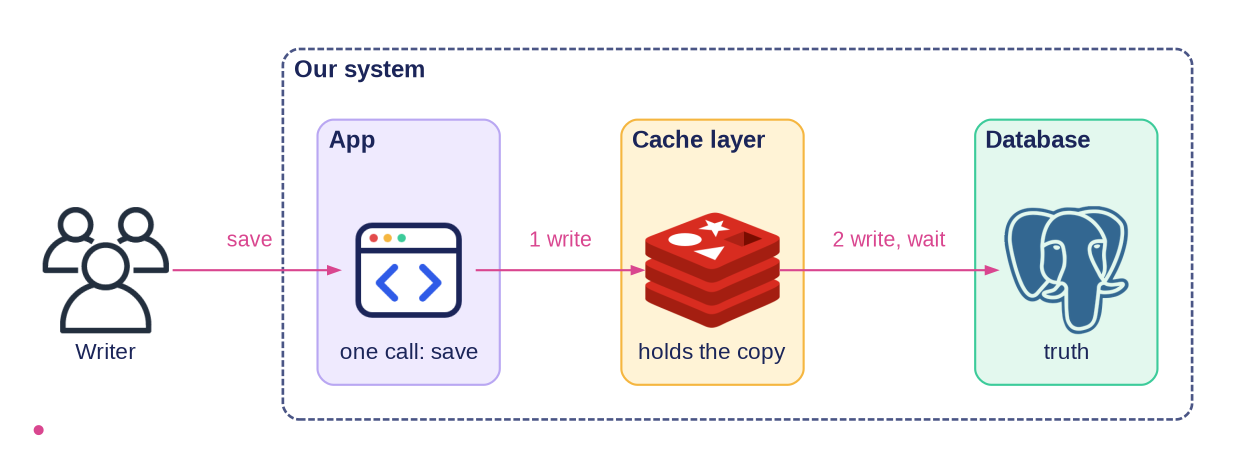
A save, then a read
What the caller waits for
Order
Which write comes first?
When your own code makes both writes, the order decides what can go wrong. With the cache first, readers can see a value that the database then refuses. With the database first, the worst case is an old copy for a while.
Safer and risky order
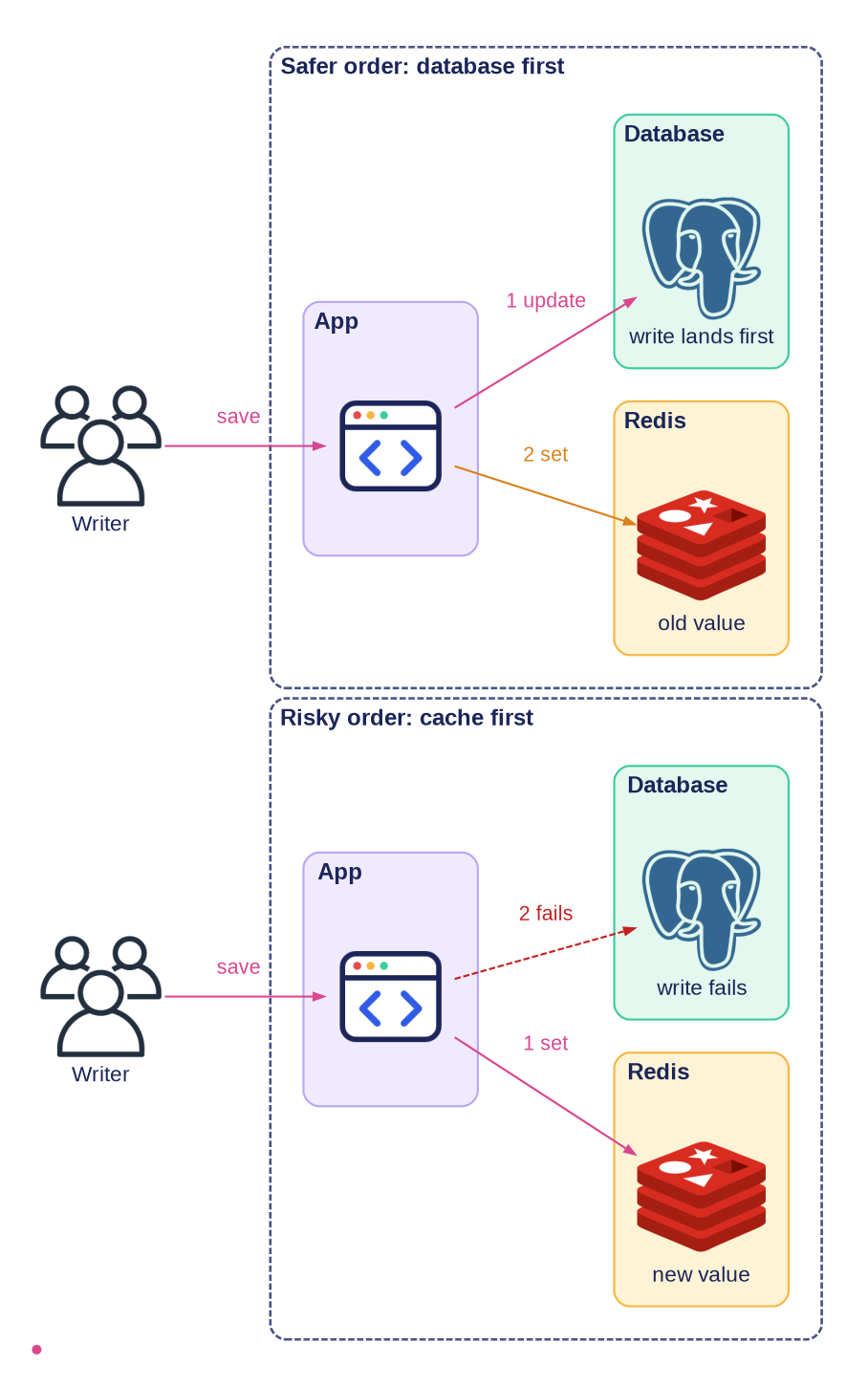
One of the two writes fails
| Order | Second write fails | What readers see | Repair |
|---|---|---|---|
| Cache, then database | Database refuses | A value that was never saved | Delete the key, return an error |
| Database, then cache | Cache is unreachable | The old value for a while | Queue a delete, rely on the TTL |
A save, step by step
Limits
Why it is not a transaction
The database and the cache are two systems. A process can stop between the two writes, and no database transaction covers the cache. So write-through keeps the two close, not identical.
Two writers, two orders
Ways to keep one order
- 1
One owner per key
All writes for a key go through one cache node, which applies them in order.
- 2
Versions
The database returns a growing version. The cache refuses a lower one.
- 3
Delete instead
After the database write, delete the key. Then you have cache-aside, and the next read is a miss.
- 4
Change log
Feed the cache from the database's own ordered log. See cache consistency.
Reading
Reads still need a fallback
It is tempting to say that every read is a hit. That is only true for values that were saved since the cache started, have not expired and were not evicted. A new cache node starts empty, and rows saved before the cache existed were never in it. The Amazon ElastiCache guide names this missing data as the first weakness of write-through and suggests adding lazy loading.
Where a miss comes from
| Cause | Example | Cure |
|---|---|---|
| New node | A cache machine was replaced | Fall back and fill |
| Evicted | Memory was full | Fall back and fill, watch evictions |
| Expired | The TTL ended | Fall back and fill |
| Old row | Saved before the cache existed | Fall back and fill, or warm it |
Memory
Copies nobody reads
Unread copies
Should this save go into the cache?
Deleting
Removing a row
A delete goes to both places as well. Remove the row from the database first, then the key. In the other order a reader could load the row again in between.
Trade-offs
Strengths and weaknesses
Strengths
- People see their own save at once
- Reads of saved values are fast, also the first one
- Acknowledged saves are in the database
- Reading code stays simple: look, with a fallback
- Very good for save, then read
Weaknesses
- The caller waits for the database
- Two writes for each save
- Caches values that are never read, so memory grows
- If a save needs both, a cache outage stops saves
- Every writer must use the same door
- Not for write-heavy data
When to use it
Where it fits
| Data | Why it fits | Watch out |
|---|---|---|
| Profiles and settings | Read right after saving | Scripts that write the database directly |
| User sessions | Saved and read on each request | Cost of a database write each time |
| Stock count on a product page | Should change with each sale | Check the database at checkout |
| Account balance on a home screen | People expect the new number | Payments are decided in the database |
| Read-heavy data with some writes | Fast reads, safe saves | Memory for unread copies |
Write-through and cache-aside
| Write-through | Cache-aside | |
|---|---|---|
| On a save | Sets the new value | Deletes the old one |
| Caller waits for | Database and set | Database and delete |
| First read after a save | Hit | Miss |
| What is cached | Everything saved | Everything read |
| Empty cache | Needs a fallback | Fills itself |
Summary
The whole topic in one minute.
Write-through saves to the cache and the database before it answers. The next read is a hit and shows the new value, at the cost of waiting for the database and caching things nobody reads.
It is not a transaction. If your code makes both writes, write the database first, keep a TTL, order writers with one owner or a version, and give reads a fallback.
- A save changes the cache and the database before the caller hears success.
- Two systems, two writes: close, but not a transaction.
- In your own code, write the database first and the cache second.
- Keep one order per key with an owner or a version.
- Reads need a fallback, and every copy needs a TTL.