
The CrowdStrike outage of 2024
medium 30 minOn July 19, 2024 a content update for the CrowdStrike Falcon sensor asked a kernel driver to read a 21st input from a list of 20.
Video lesson · Chapter 1 of 5
A rollback with two clocks
The 21st input in 75 seconds
1:15Reel coming soon
Theory
Read or listen first. About 2 min.
What it is
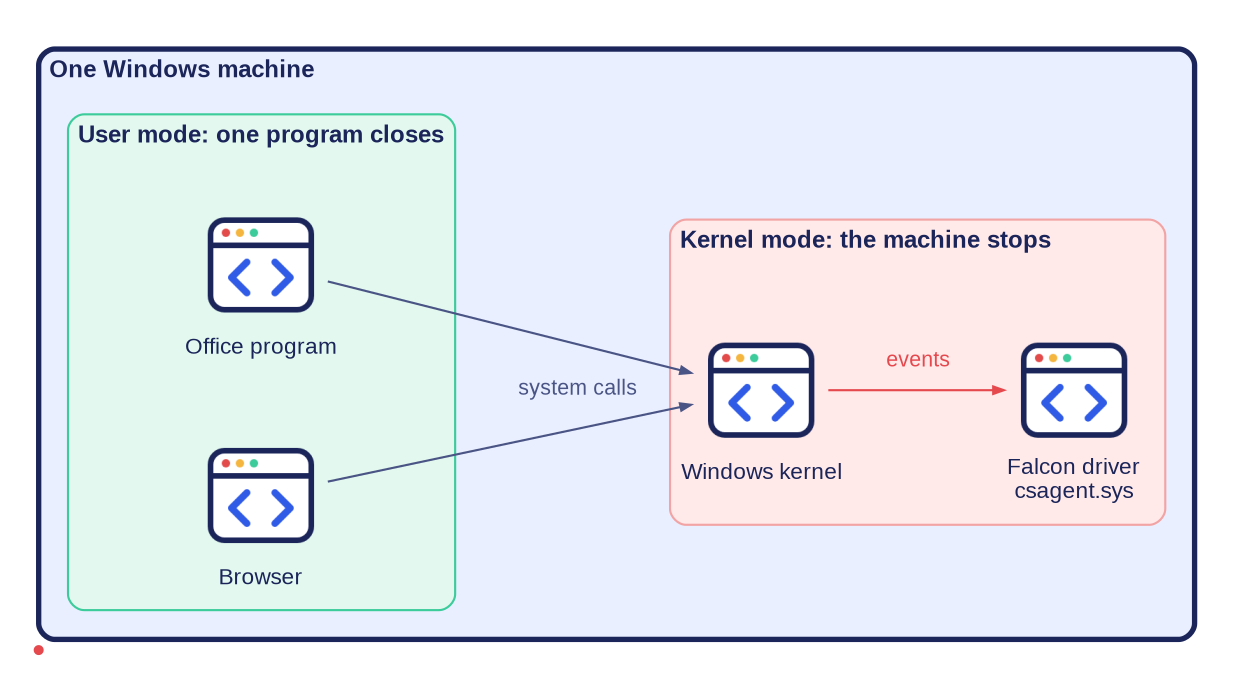
CrowdStrike Falcon is security software. A part called the sensor runs on each computer and watches for signs of an attack. On Windows the sensor uses a kernel driver: code that runs inside the operating system itself, where one invalid memory read stops the whole computer.
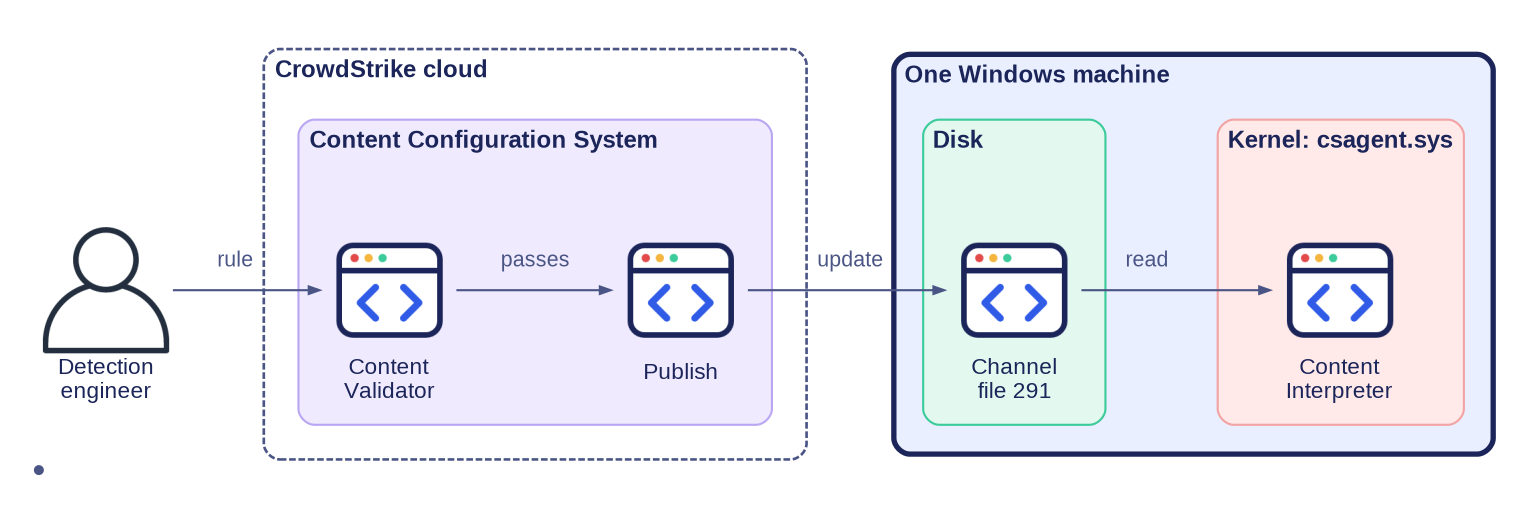
Attack methods change daily, so the sensor receives small data files, called channel files, several times a day. On July 19, 2024 a new version of channel file 291 met a mistake that had been waiting in the sensor since February. The file told the sensor to compare a 21st input. The sensor had only 20.
This page follows CrowdStrike's own root cause analysis. Where we add an idea of our own, we say so.
Why it exists
It is worth studying because no single part was careless on its own. There were tests, a validator and months of successful updates. Every one of them looked at the same wrong number, 21, or used data that never touched the last field.
It also teaches a rule that applies to every system you will design: data that changes behaviour deserves the same gradual release as code. A staged release does not remove the bug. It decides whether the bug meets a few machines or all of them.
And it shows the difference between stopping a fault and recovering from it. Stopping took 78 minutes. Recovery took days, because a computer that crashes while starting cannot be repaired over the network.
A short history
February 28, 2024
Sensor 7.11 becomes generally available with the new IPC Template Type, which is defined with 21 fields while the sensor code supplies 20.
March 5, 2024
The stress test passes and the first content for channel file 291 goes to production. Three more follow between April 8 and April 24. All of them work.
July 19, 2024
Two more template instances are released at 04:09 UTC. One of them inspects the 21st field. The file is reverted at 05:27 UTC.
July 20, 2024
Microsoft estimates 8.5 million affected Windows devices, less than one percent of all Windows machines.
July 29, 2024
About 99% of Windows sensors are online again, compared with the week before.
August 6, 2024
CrowdStrike publishes the full root cause analysis with six findings.
Words to know
- Sensor
- The Falcon program on each computer. It is released like normal software, in stages.
- Channel file
- A data file that the cloud sends to the sensor. Number 291 carries the named pipe rules.
- Template Type
- A capability compiled into the sensor, with a fixed list of input fields.
- Template Instance
- One rule for a Template Type: what each field must match.
- Content Interpreter
- The sensor code that compares inputs with the rule.
- Content Validator
- The cloud program that checks a channel file before release.
- Wildcard
- A rule that accepts anything, so nothing has to be read.
- Out-of-bounds read
- Reading memory beyond the end of a list.
How it works
Step through the idea, or press Play.
A hidden mismatch. The rule format has 21 fields, the sensor fills 20
Understand it
Start here
The recipe with a 21st box
A chain of bakeries sends its recipe cards from one office. Follow one card before we look at the computers.
The card was not code. It still decided what every oven did.
What happened
The timeline
From the first release to the report
| When (UTC) | What happened |
|---|---|
| Feb 28 | Sensor 7.11 generally available, with the IPC Template Type |
| Mar 5 | Stress test passes; first instance in production |
| Apr 8 to Apr 24 | Three more instances; all work |
| Jul 19, 04:09 | Two more instances released; crashes begin |
| Jul 19, 05:27 | Content reverted; new downloads are safe |
| Jul 20 | Microsoft estimates 8.5 million devices |
| Jul 23 | Bad file put on the cloud known-bad list in US-1, US-2 and EU; some looping machines can now heal |
| Jul 25, 00:00 | More than 97% of Windows sensors online |
| Jul 25 | Bounds check added to the interpreter |
| Jul 27 | Build-time field count check in production |
| Jul 30, 00:00 | About 99% online |
| Aug 6 | Full root cause analysis |
How long the window was open
How it works
Two kinds of content
Falcon receives new knowledge in two ways. They differ in speed, and in July 2024 they also differed in how carefully they were released.
| Sensor Content | Rapid Response Content | |
|---|---|---|
| What it is | Code, models, Template Types | Rules as data: Template Instances |
| How it arrives | With a new sensor version | From the cloud, as channel files |
| How often | Per sensor release | Several times a day |
| Tests before | Unit, integration, performance, stress | The Content Validator |
| Release before | Staged: own machines, early adopters, all | To all, no rings |
| Customer choice before | Newest, one or two versions behind | None |
From a rule to a kernel driver
One update on its way
The bug
20 inputs, 21 fields
The report shows the memory of a crashed machine. The interpreter had an array of 20 pointers. The rule selected index 0x14, which is 20 in decimal, so the 21st entry. What lay there was not a pointer to valid memory. Windows stopped with PAGE_FAULT_IN_NONPAGED_AREA in csagent.sys.
inputs = 20 pointers index 0 .. 19rule = compare index 20 (the 21st)check = noneresult = read beyond the array, follow an invalid pointerCounting from zero
Why it stayed hidden
Six findings
Every layer, and the hole in it
| Layer | What was missing | What changed |
|---|---|---|
| Build | Field count not compared with inputs | Compiler check, July 27 |
| Run time | No bounds check | Check added July 25 |
| Feature tests | 12 static cases, wildcard in field 21 | A real value for every field |
| Validator | Trusted the number 21 | Refuse more fields than inputs |
| Instance tests | Only the first instance of a type was stress tested | Every instance tested |
| Deployment | No staged release | Canary, rings, bake time, rollback |
Same wrong source
Type definition and validator shared one number. A check that reads the same source as the code cannot find that the source is wrong.
Success is not coverage
Four good releases proved only that the wildcard path works.
No limit on reach
Without rings, the number of victims is the number of machines online.
No way back
A revert helps machines that can download it. A machine in a crash loop often cannot.
The kernel
Why one read stops a computer
A normal program that reads invalid memory is closed by the operating system. The kernel has nobody above it. If it continued with damaged state it could write wrong data to disk, so Windows stops on purpose and shows a blue screen.
Two zones in one machine
What the kernel gives a security product
- It sees process starts and file writes everywhere
- It can block them while they happen
- It loads early, before programs of an attacker
What it costs
- A read error stops the machine
- Loading early also means crashing early
- The driver is hard to repair from outside
CrowdStrike writes that it moves work to user space as Windows adds support, and that much of that support is still missing. A design rule follows (ours): keep the privileged part small and dull, and interpret complicated rules where a crash is survivable.
Recovery
Why the revert was not enough
One machine after 05:27 UTC
The official ways back
- 1
Restart, with a network cable
The machine may fetch the reverted file before it crashes again.
- 2
Boot a recovery image
CrowdStrike described bootable images, and Microsoft released a USB recovery tool.
- 3
Repair by hand
Start in Safe Mode, go to the CrowdStrike folder under System32 drivers, delete the files whose name begins with C-00000291, restart. A BitLocker disk asks for its recovery key first.
- 4
Repair a virtual machine from outside
Take a snapshot of the system disk, attach it to a healthy machine, delete the file, attach it again. Or go back to a snapshot from before 04:09 UTC.
What hand repair costs (our example)
Impact
What we can say, and what we leave out
Microsoft's estimate of 8.5 million devices is less than one percent of all Windows machines. They were concentrated in organisations that run many services people depend on, so few machines caused wide trouble. News reports named airlines, hospitals, banks, broadcasters and emergency lines in several countries. Money totals, cancelled flights and lawsuits are not in the company's report, so this page does not give figures for them.
The repair
The design after the outage
Content release with rings
What to copy into your own designs
- 1
One schema, checked at build time
Generate the reader and the validator from one definition, and compare that definition with the code that supplies the values.
- 2
A reader that distrusts its input
Check length and index. On a bad rule: skip the rule, keep the last good set, report.
- 3
Test with the real reader
Run every new file through the program that will read it in production, with values that use every field.
- 4
Rings and bake time
A small share first, wait for crash and health signals, then widen. Silence from machines is also a signal.
- 5
A way back without the network
Our suggestion: count crashes at start. After two, load the last good content or none.
- 6
Choice for the customer
Critical machines can stay a ring behind. Falcon now offers control over where and when content arrives.
For the people who run machines
- Recovery keys reachable when the main systems are down
- Recovery media and steps tested before
- Critical machines in a later ring
- A plan for the case that many machines fail together
For vendors: avoid
- One release step for the whole fleet
- Treating data as harmless
- A validator that shares the code's assumptions
- Counting on the network for rollback
Related ideas with their own pages: failure models, operability, resilience and high availability. For the same lesson with a policy record instead of a channel file, read the Google Cloud outage of 2025.
Summary
The whole topic in one minute.
A definition said 21 inputs, the code supplied 20, and for months every rule used a wildcard for the last one. The first rule that really read it made a kernel driver read invalid memory. Because the update went to all online sensors in the same period, the first real test was everywhere.
The report names six findings: no check of the field count when the sensor is built, no bounds check at run time, tests that always used a wildcard in the last field, a validator that trusted the same wrong number, no test of each instance in the real interpreter, and no staged deployment for content.
The lesson for your designs: release data like code, let the reader protect itself, test what you ship with the program that will read it, and make sure a machine can come back without a person in front of it.
- The definition had 21 fields, the code supplied 20, and wildcards hid it from February to July.
- A missing bounds check in a kernel driver turned a bad index into a stopped machine.
- The revert took 78 minutes; about 99% of sensors were back on July 29.
- Content reached all online sensors without rings, so the bug met everyone.
- Release data like code, test with the real reader, and plan a return that needs no network.
Sources
- CrowdStrike: root cause analysis, channel file 291 (PDF)
- CrowdStrike: remediation and guidance hub, with the preliminary review
- CrowdStrike: technical details for Windows hosts
- CISA: widespread IT outage due to CrowdStrike update
- Microsoft: helping our customers through the outage
- Microsoft: KB5042421, recovery steps
- Google SRE workbook: canarying releases