
Design a news feed like Facebook's
hard 50 minShow each person the best recent posts from everyone they follow, in a fifth of a second.
Grow the design
Start with the smallest system that works. Change it only when something breaks.
Version by version
From one query to the full system
Seven versions
Version 1: One service, one database
Forced by: The features: post, and read what your friends posted.
- What changes
- Posts and follows are two tables. A feed is a join: posts whose author I follow, newest first, limit 20. Add a standby, because posts must not be lost.
- What it costs
- Almost nothing. One thing to run.
- What breaks next
- Every read gathers from 500 accounts. At 231,000 reads a second that is 116 million small reads. At a few hundred reads a second, stop here.
Say: Let me get a correct feed first, then see which number it cannot meet.
Architecture
High-level design
The whole system
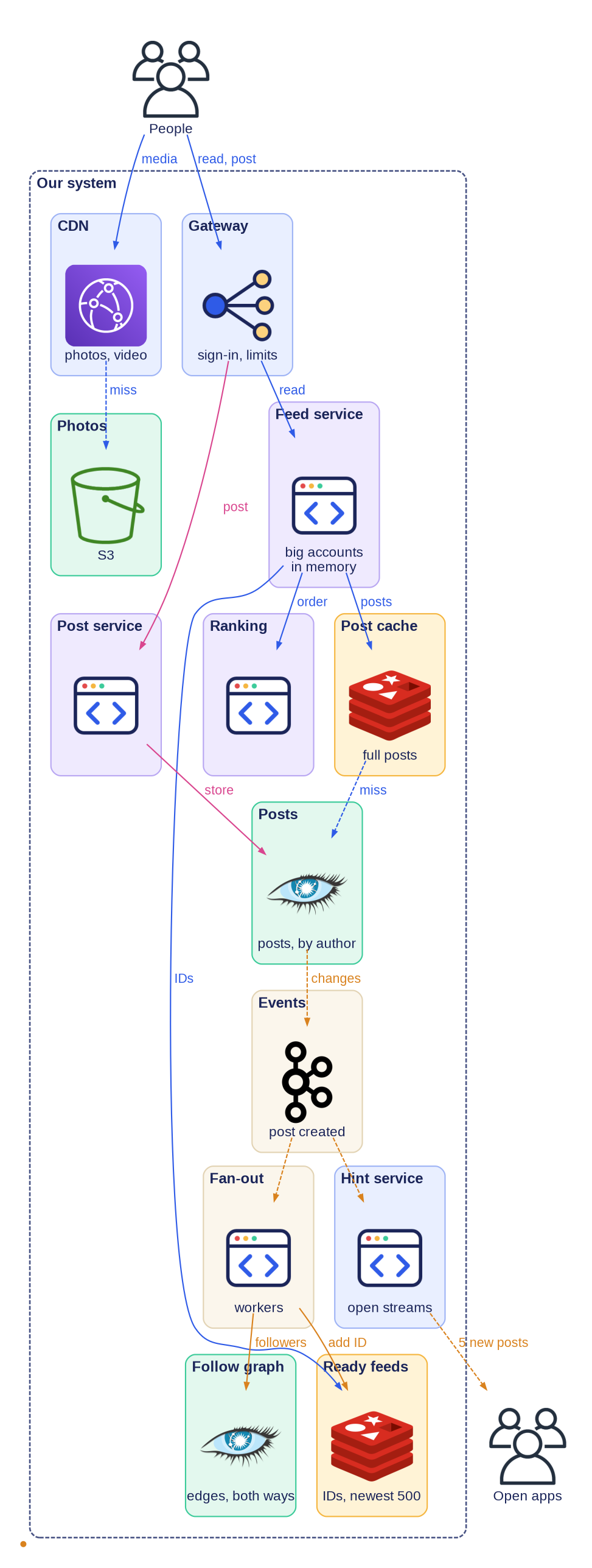
Four layers
- 1
Edge
A CDN serves photos, video and scripts. The nearest region is chosen by DNS. Personal feed replies are never cached there.
- 2
Gateway
Sign-in checks with cached keys, rate limits, routing to feed or post services. Any instance can serve any user.
- 3
Services
Feed (gather, merge, filter, assemble), ranking (score), post (validate, store), graph (follows and blocks), hint (open streams). The first three keep no user state.
- 4
Data
Redis for ready feeds, a post cache, Cassandra for posts and edges, PostgreSQL for accounts, Kafka for events, S3 for media.
Flows
The three flows
Flow 1: open the feed
Flow 2: create a post
Flow 3: a hint
Step through each flow, the fan-out decision, the ranking passes and the failures in Visualize.