
Design a news feed like Facebook's
hard 50 minShow each person the best recent posts from everyone they follow, in a fifth of a second.
Deep dives
Compare the options before you open them, then say which you would pick.
Deep dive 1
Fan-out
A post is written. How does it reach feeds?
BreaksPush to everyone
- How
- Write the ID into every follower's list, whoever the author is.
- Limit
- 100 million inserts for one post take 100 seconds of a million inserts a second, and all other posts wait behind them.
- Choose when
- Only when follower counts are limited.
WorksPull for everyone
- How
- On each read, ask for recent posts of all followed accounts and merge.
- Limit
- 116 million partition reads a second on average, and the slowest of 500 decides the latency.
- Choose when
- Small products, or people who rarely open the app.
StrongSplit by follower count
- How
- Push under 10,000 followers, pull above, skip cold feeds, merge at read.
- Limit
- Two paths. Accounts that cross the limit need care: for a while, their posts may be in both places, so remove duplicates by ID.
- Choose when
- Follower counts are very uneven, as here.
Two paths, one merge
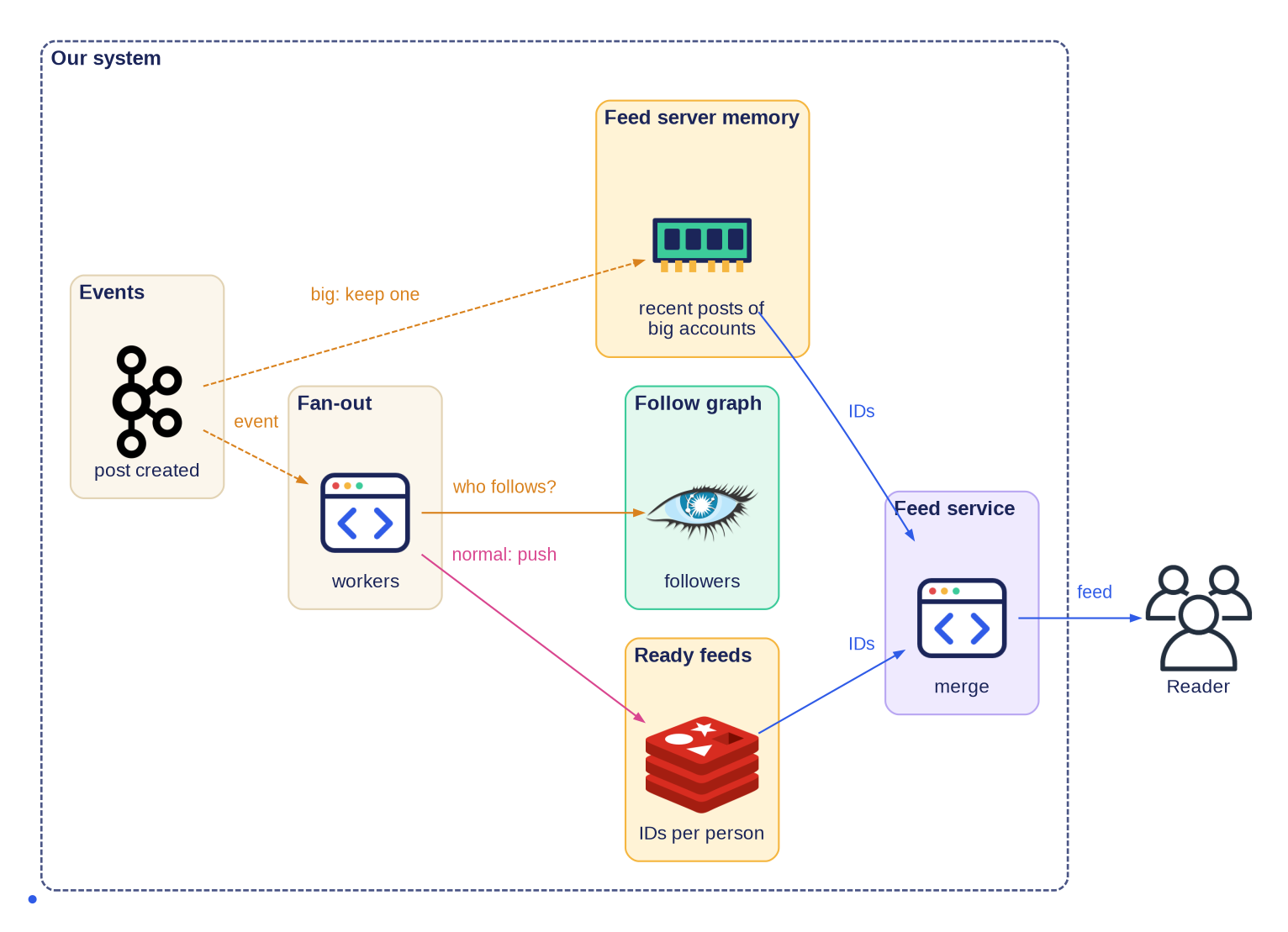
Who gets which path
| Followers | On write | On read |
|---|---|---|
| Up to 10,000 | Push to every warm feed | Nothing extra |
| 10,000 to 1 million | Push to followers active in the last day (say 15,000 of 50,000), keep once for the rest | Merge, drop duplicates |
| Over 1 million | Keep once | Merge |
How workers behave
- 1
Split
One post becomes tasks of up to 1,000 recipients, so one task never blocks a worker for long.
- 2
Batch
Send many inserts in one round trip to each Redis node. A pipeline is not a transaction: if half succeeds, repeat it all. Adding an ID again is harmless.
- 3
Commit after
Move the Kafka position only after Redis confirms. Retry three times, then park the task and alert.
- 4
Enough partitions
A partition has one consumer in a group. 694 workers at peak need at least 694 partitions; we take 1,024.
- 5
Slow down safely
Watch the delay in seconds, not only the backlog. Add workers; skip feeds that are cold; delay large accounts first.
Deep dive 2
What a ready feed holds
What do you store for each person?
BreaksFull posts
- How
- Copy the 3 KB post into each follower's feed.
- Limit
- 500 × 3 KB × 2.5B is 3.75 PB of memory, and each like changes 500 copies.
- Choose when
- Never at this size.
WorksIDs with a rank score
- How
- Sorted set, the score is the predicted interest.
- Limit
- Interest changes by the minute. Scores written yesterday put stale posts on top, and rewriting them is another fan-out.
- Choose when
- The rank depends only on slow facts.
StrongIDs with the time, ranked on read
- How
- The newest 500 IDs are candidates. Ranking happens once for each visit.
- Limit
- Ranking costs compute on each visit and needs a time limit.
- Choose when
- Order depends on the viewer and the moment, as here.
Deep dive 3
Ranking in passes
From 500 to 20
A score you can explain
Features
| About | Examples | How fresh |
|---|---|---|
| The viewer | Interests, session age, device, connection | Daily batch, plus the last minutes |
| The post | Age, type, likes a minute, author's reach, topic | Seconds, from a stream |
| The pair | How often this viewer reacts to this author and this type | Hours |
When there is little data
| Case | Show |
|---|---|
| New person, no follows | A shared popular list for the region and chosen interests, friend suggestions; one cache entry for many people |
| A few follows | Those posts first, then gradually less of the shared list |
| Back after months | Rebuild the feed, weight the best posts of the gap |
| New post | Author's usual response, content type, a small first audience, then wider |
| Uncertain choices | Keep about 10% of places for exploration, so the model keeps learning |
Run models on machines that score many candidates in one batch, cache slow-changing inputs, and release a new model to 5% of people first. The 60 ms limit includes everything: at the limit, newest first is used.
Deep dive 4
Cursor and order
The user asks for page 2. Which posts?
BreaksOffset 20
- How
- Skip 20, take 20 of the current order.
- Limit
- Five new posts arrived, so five repeat. A deletion makes one vanish unseen.
- Choose when
- Lists that never change.
WorksCursor of score and ID
- How
- Continue below the last score seen.
- Limit
- Re-ranking moves posts between requests: one can be shown twice, another never.
- Choose when
- Order is by time or another fixed value.
StrongRank once, keep the order
- How
- Store 100 IDs for the visit; the cursor is session and position.
- Limit
- 42 GB of sessions, and posts newer than the visit wait for the banner.
- Choose when
- Order is personal and moving, as here.
Deep dive 5
Privacy and removal
Alice blocks Bob. Bob's post is in Alice's ready feed, and Alice's in Bob's.
BreaksClean the caches
- How
- Find and remove the IDs, then trust the feed.
- Limit
- It takes minutes, some tasks fail, and until then the wrong person sees a post.
- Choose when
- Never as the guarantee.
WorksCheck at fan-out time
- How
- Only push to people allowed at that moment.
- Limit
- Permission changes later. Everything already delivered stays visible.
- Choose when
- As a saving, together with a read check.
StrongCheck every post on every read
- How
- Load the viewer's follows and blocks once (about 4 KB), the post's audience and status with its header, and drop what does not match.
- Limit
- A little work on each read, and permission data must itself be fresh: an unfriend updates the store and deletes the cached list before it answers.
- Choose when
- Always. Cleaning is a background saving.
Post status
| Status | Who sees it | Feed does |
|---|---|---|
| Active | Its audience | Rank normally |
| Restricted | Its audience, not recommended | Lower the score |
| In review | The author | Skip for others |
| Removed or deleted | Nobody | Skip; background cleaning; hard delete later |
Moderation beside the feed
- 1
Before wide delivery
Automatic checks of text, images and links run in the background, under about 500 ms. Example limits: over 95% sure, remove; 70 to 95%, reduce and send to a person; below, allow and watch.
- 2
After delivery
Reports, hides and unusual reaction patterns open a review. One report alone should not hide a post, or groups will abuse it: weigh who reports.
- 3
Appeals
A person sees the post and the model's reason, then upholds, overturns or escalates. An overturned post becomes active and can be ranked again. Outcomes are training data; a bad model version can be switched off and its decisions reversed together.
- 4
Coordinated fakes
Signals: young accounts, near-duplicate posts, the same accounts reacting together, odd graph shapes. Do not count their reactions; limit reach; remove when confirmed.
Deep dive 6
Hints
How does an open app learn that new posts exist?
BreaksPoll every 30 seconds
- How
- Each app asks for updates.
- Limit
- 500M / 30 s is 16.7M requests a second, almost all answered "nothing".
- Choose when
- As a fallback, with longer gaps.
WorksWebSocket with whole posts
- How
- Send every new post into the open app.
- Limit
- Two-way connections we do not need, and the server must filter and rank for each push.
- Choose when
- The product also has chat on the same connection.
StrongServer-sent events with a count
- How
- One-way stream, grouped for 10 seconds, only while the feed is visible.
- Limit
- Connection servers and presence. Delivery is at least once; the browser sends the last event ID when it reconnects.
- Choose when
- One-way, small, tolerant of delay, as here.
Reconnect after 1, 2, 4 and up to 30 seconds with some randomness; after three failures poll every 30 seconds. If a stream server dies, clients reconnect elsewhere and presence corrects itself within 30 seconds. Offline people need nothing: their next read is fresh. Mentions may send a phone notification, see notification service.
Deep dive 7
Keeping caches alive
A miss on a ready feed
Protections
Hot post
Keep it in each server's memory for a second or two, or under several cache keys.
Old is fine
Serve the last known page while a rebuild runs.
Breaker
When the store is slow, stop asking. Return fewer posts, newest first.
Counts
Likes go to sharded counters and reach the post cache every few seconds.
More in thundering herd, circuit breaker and sharded counters.
Edge cases
What can go wrong
| Case | Problem | Answer |
|---|---|---|
| Own post missing | Fan-out is not finished when the author refreshes | Add the author's recent posts at read time |
| Feed jumps while reading | New posts arrive on top | Banner, fixed order for the visit |
| Ranking down | No scores | Newest first, announced to nobody, alerted to us |
| Graph slow | No follow list | Follow list up to a minute old may choose candidates; blocks must be fresh, or the post is left out |
| Viral normal post | Hot key and counter | In-process copy, sharded counts, pull beyond active users |
| Hot partition | One author's posts on one shard | Partition posts by post ID, author index by month |
| Audience narrowed | Copies remain with people who lost access | Audience is read from the post, not the feed entry |
| Account crosses the limit | Post in both paths | Remove duplicates by ID; change path with a gap between raise and lower limits |
| Follow a new account | Feed has none of its posts | Pull its last few posts into the feed at once |
| Store write fails | Post not durable | Return an error; never claim success after a queue write alone |
Failure drill: say it before you read it
- 1
Half the feed cache is lost
Replicas take over for single nodes. For the rest, rebuilds are limited: at 20,000 rebuilds a second and 500 reads each, the store sees 10M reads a second, so measure before choosing the limit. Others get the shared list.
- 2
Kafka is behind by ten minutes
Reads work, posts arrive late. Own posts still show. Add workers, drop tasks for cold feeds, tell nobody to repost.
- 3
Ranking is slow
The 60 ms limit trips. Newest first, cheaper, so capacity returns. Watch the fallback rate.
- 4
Load is ten times normal
Shorter pages (20 to 10), longer visit life, no heavy ranking, hints every minute, background refresh off. Each step is tested beforehand.