
Design a Matchmaking System
medium 45 minPut ten people who are waiting into one fair game, near enough to a server, before they give up.
Video lesson · Chapter 1 of 5
Press Play twice without joining two games
Theory
Read or listen first. About 1 min.
What it is
A matchmaking system takes players who want to play and groups them into games. It looks at how strong they are, how far they are from each server, who they came with and how long they have waited.
Three wishes pull against each other: a fair game, a short wait and a low delay to the server. Every matchmaker is a way to give up a little of each, and to give up more as time passes.
Why it exists
An unfair game is not fun for either side, and an empty waiting screen makes people leave. Both look to the player like a broken game.
The same problem appears when drivers meet riders, people meet tutors or kidneys meet patients: a pool of waiting people, rules about who fits, and a price for waiting.
A short history
1960
The United States Chess Federation adopts Arpad Elo's rating system.
1970
The world chess federation FIDE adopts Elo ratings.
2006
Herbrich, Minka and Graepel present TrueSkill at NIPS: a rating with a mean and an uncertainty, for teams and many players.
Words to know
- Ticket
- A request to play: one player or a whole party, with attributes.
- Pool
- The waiting tickets for one mode in one region.
- Rating (MMR)
- A number that estimates strength, for choosing opponents.
- Uncertainty
- How sure we are of a rating. High for new players.
- Widening
- Accepting a larger difference as the wait grows.
- Ready check
- Everybody in a proposed game must press Accept.
- Backfill
- Filling an empty place in a game that is already running.
Solve it like an interview
New to it? Start with Approach. Revising? Go straight to the mock.
- 1ApproachWhat this question tests, where it gets hard, and how to spend the time.
- 2ScopeAsk what changes the design, then commit to a short list.
- 3NumbersWork out a number when the answer changes what you build.
- 4API and dataThe contract first, then the data that serves it.
- 5DesignStart with the smallest system that works. Change it only when something breaks.
- 6Deep divesCompare the options before you open them, then say which you would pick.
- 7Explain your choicesAnswer first. Then compare your reasoning.
- 8By levelThe same question is judged differently for mid, senior and staff.
- 9MockAnswer against the clock, then score yourself.
How it works
Step through the idea, or press Play.
Ask. A player or party opens a ticket with a rating and delays to each region
Understand it
Start here
Fair tug-of-war teams
What we build
Games of five against five
A service for a game with 50 million players a day. It takes tickets from players and parties, forms balanced games, checks that everybody is ready, takes a server close to them, and fills places when somebody leaves. It does not run the game itself: see game state sync.
Skill
Both teams have about the same chance.
Wait
Usually under a minute, never endless.
Delay
A server that all ten can reach quickly.
Company
Friends stay together, and parties meet parties.
The hard part
Choosing, not storing
At peak about 312,000 players are waiting. At 1 KB each that is 312 MB, which fits in the memory of one small machine. What is hard is the choice: 100 candidates can make 17 trillion different groups of ten. And two matchers must never take the same player.
Three wishes
The finished system
Where the design ends up
This is the last version. The Design tab starts with one service and one database.
The whole system
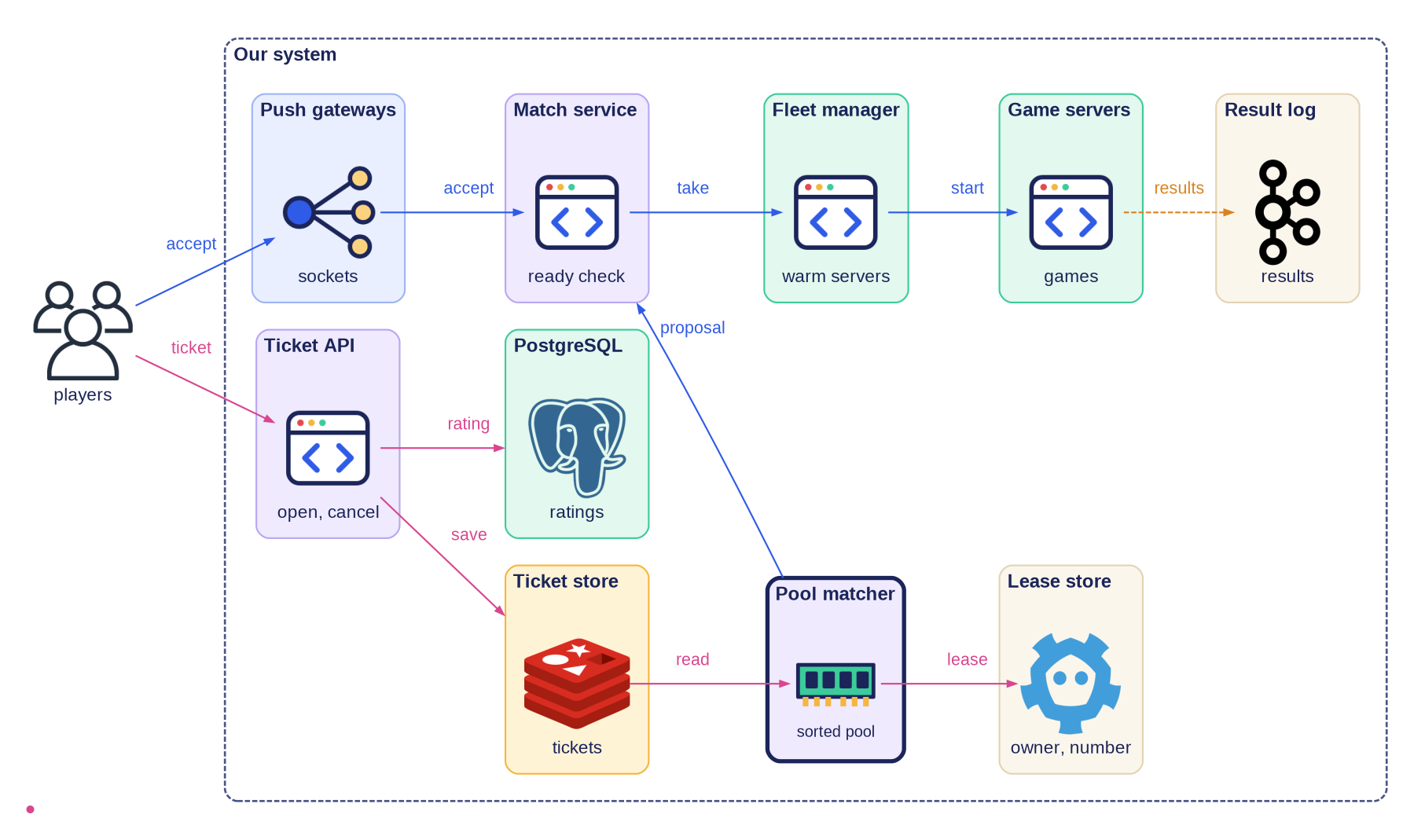
Similar systems
| System | What differs |
|---|---|
| Chess site | Two players, one rating, seconds of wait |
| Battle royale | 100 players, loose skill, bots may fill places |
| Team shooter | Roles, parties and ranks |
| Car football game | A rating for each playlist |
| Ride hailing | Distance instead of skill: uber and lyft |
Where to read more
The ideas behind it
Each idea has its own page.
- Pools as partitions: partitioning strategies.
- Who owns a pool: failure detection.
- Open connections: real-time APIs.
- Doing a step twice safely: idempotency.
- Holding a place and letting it go: ticketmaster.
- Results after the game: log-based queues and leaderboards.
For the interview: Approach, Scope, Numbers, API and data, Deep dives and Mock.
Summary
The whole topic in one minute.
A matchmaker keeps a pool of tickets for each mode and region and lets one process own each pool. The owner sorts the pool by rating, forms groups around the longest waiting tickets, and accepts a wider range as they wait.
A proposed game is a promise that can fail. Tickets are reserved, players confirm, a warm server is taken, and whoever accepted returns with the waiting time they had. Game servers cost far more than matchmaking does.
- The pool is small enough for memory. The choice is the work.
- One owner for each pool removes double booking.
- Start strict and widen with the wait, around the longest waiting ticket.
- A proposal can fail. Give back the waiting time of those who accepted.
- Servers are the bill: keep warm ones where the next games will be.