
Requirements of a rate limiter
easy 24 minBefore choosing an algorithm, agree on the rules: who is counted, what counts, how strict the limit is, where it is checked, what a refused caller gets, how fast the check must be, and what happens when the limiter itself fails.
Video lesson · Chapter 1 of 5
A burst outruns the report service
Six questions before a rate limiter, in 75 seconds
1:15Reel coming soon
Theory
Read or listen first. About 1 min.
What it is
A rate limiter decides, for each request, whether this caller may go ahead now. Its requirements are the rules people agree on before anybody writes code.
They come in two groups. Functional: who is counted, which limits, what a refusal looks like. Non-functional: how fast, how exact, how available, and how easy to change and to watch.
In one line: control who gets how much, and how often.
Why it exists
Two limiters with the same algorithm can behave very differently. One closes the shop when its counter store fails, the other lets everybody in. One counts people, the other counts addresses and blocks a whole school.
Most of these choices belong to the product and the business as much as to engineers: plans, promises to partners, protection of logins. They are cheap to change on paper and costly later.
A short history
1997
HTTP/1.1 (RFC 2068) includes Retry-After, so a server can say when to come back.
2012
RFC 6585 adds the status 429 Too Many Requests.
2023
The OWASP API Security list names unrestricted resource consumption as one of its ten risks.
Words to know
- Subject
- Who is counted: user, key, account, address.
- Rule
- Subject, what is counted, limit and time.
- Hard limit
- Nothing passes above it.
- Soft limit
- Warns or slows down first, refuses later.
- Throttling
- Slowing a caller down instead of refusing.
- Fail open
- If the limiter breaks, let requests pass.
- Fail closed
- If the limiter breaks, refuse.
- Shadow mode
- Count and log who would be refused, and refuse nobody.
How it works
Step through the idea, or press Play.
Goal. Protect, share, earn or save: each needs different rules
Understand it
Start here
Rules for a trampoline park
Every rule was agreed before the first child jumped.
Six questions
Why
Start from the goal
Reasons to limit
Protection
A flood or a broken loop must not take the service down.
Security
Slow down password guessing and scraping.
Fairness
One caller cannot use what belongs to all.
Cost
Paid calls and big reports have a ceiling.
Product
Free and paid plans differ; partners get what they signed for.
Planning
Known maximums make capacity and promises possible.
The goal decides the rule
| Goal | Count | Exactness | If the limiter fails |
|---|---|---|---|
| Survive a flood | All requests, and per address | Roughly | Keep a local limit |
| Stop password guessing | Failures per account and per address | Strict | Closed |
| Fair sharing | Per key | A few percent is fine | Open |
| Sell plans | Per account, per month | Exact enough to bill, counted in the end from records | Open, correct later |
| Protect a budget | Money per account | Strict | Closed, or a small reserve |
With limits
- Load has a known ceiling
- Costs have a ceiling
- One heavy user does not hurt the others
- Guessing is slow
- Performance stays even
Without
- Load is whatever arrives
- A popular post can bring a large bill
- One client can use nearly everything
- An easy target
- Everyone suffers together
Whom
Dimensions
| Dimension | Example rule | Careful |
|---|---|---|
| User or API key | 1,000 an hour per key | The normal choice after login |
| Account | 10,000 an hour for all its keys | So that many keys do not multiply the limit |
| IP address | 100 a minute | Many people can share one; take it from your own proxy |
| Endpoint | Login 5 a minute, search 100 a minute | In addition, not instead |
| Region | Stricter where you do not offer the service | Blocking by country is a legal question first |
| Everything | 50,000 a second in total | The last line of defence |
How strict
Hard, soft and what to do with the rest
Example: 100 a minute
| Call number | Hard limit | Soft limit |
|---|---|---|
| 1 to 100 | Pass | Pass |
| 101 to 150 | 429 | Pass, with a warning in the answer |
| 151 and more | 429 | 429 |
Four ways to treat a request over the limit
- 1
Reject
Answer 429 at once. The default: cheap and clear.
- 2
Delay
Answer slowly. It holds a connection open, so cap how many.
- 3
Queue
Work on it later. Only for jobs that nobody waits for.
- 4
Degrade
Serve something cheaper: cached or shorter. See fallbacks.
Over the limit: what now?
Windows come in three kinds: fixed (resets at each full minute), sliding (the last 60 seconds) and a token bucket (a steady refill that allows bursts). As a requirement, say what the caller may do: "bursts up to 20, 100 a minute on average". Which algorithm does it is the subject of rate limiter algorithms.
Where
Placement
Three checks on one path
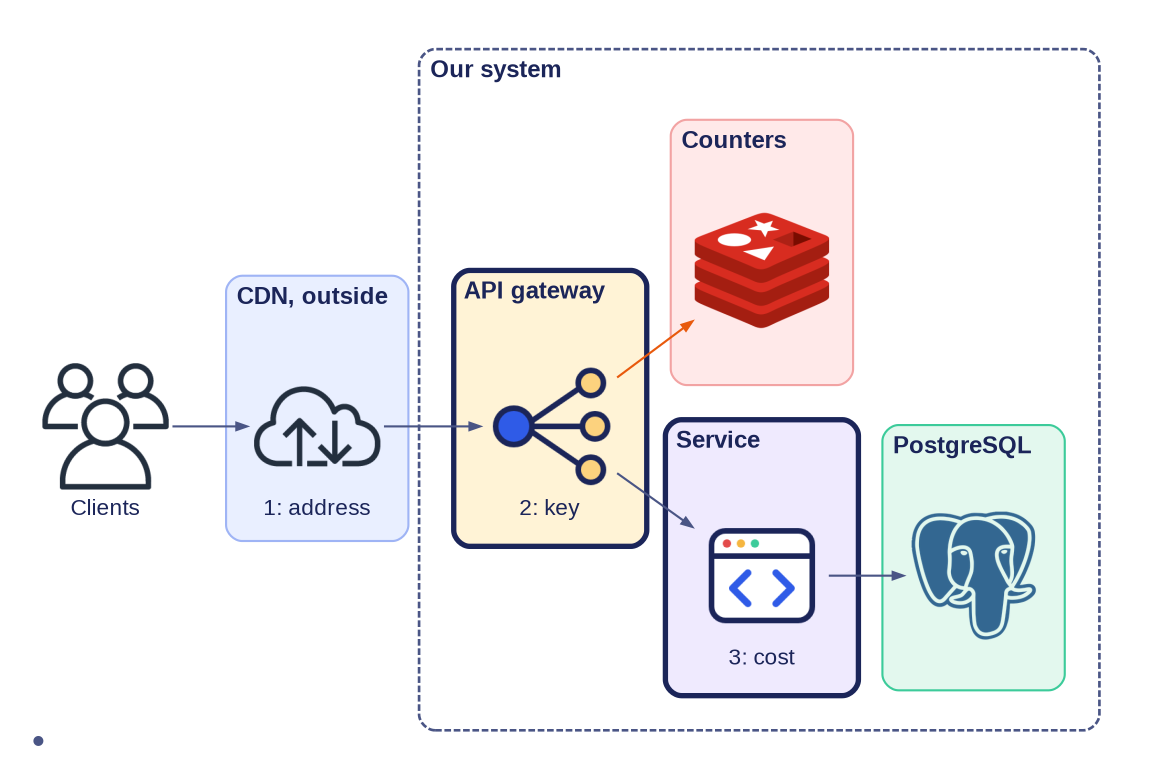
| Place | Knows | Good for | Not good for |
|---|---|---|---|
| CDN or edge | Address, path | Floods, far from your servers | Rules per user |
| Load balancer or web server | Address, path, some headers | Simple rules without another system | Plans and accounts |
| API gateway | Key, plan, route | Most rules: the usual first choice | What a call costs inside |
| Application | Everything | Business rules, calls in flight | Stopping load early |
| Sidecar proxy | Which service calls | Calls between services | End users |
On the server
- Cannot be skipped
- One place to change
- The only kind that protects you
Only in the client
- Anyone can leave it out
- No help against attackers
- Still useful: it avoids useless calls and is kind to the user
Answer
What the caller gets
HTTP/1.1 200 OKX-RateLimit-Limit: 100X-RateLimit-Remaining: 87X-RateLimit-Reset: 1703836860HTTP/1.1 429 Too Many RequestsX-RateLimit-Limit: 100X-RateLimit-Remaining: 0Retry-After: 45One request
Targets
Requirements you can test
Functional
| Requirement | Sentence to test |
|---|---|
| Counting | 101 calls in one minute with a limit of 100: 100 pass |
| Rules | Limit by key, account, address and route, and combine them |
| Plans | A change of plan counts within one minute |
| Answer | Every refusal has 429, the name of the limit and Retry-After |
| Exceptions | Support can raise one account's limit, with an end date |
Non-functional
| Requirement | Example target |
|---|---|
| Extra time | At most 2 ms at p99, never more than 10 ms |
| Volume | 350,000 checks a second at peak |
| Exactness | At most 1% over the limit, in normal operation |
| Shared | All gateways of a region count together |
| Atomic | Two requests at once can never take the last place twice |
| Memory | About 100 bytes for a caller and rule |
| Availability | If the store fails, the chosen behaviour starts within 50 ms |
| Change | New rules live in 60 s without a restart |
| Visible | Allowed, refused, errors and time per rule |
How many checks?
How much memory?
Failure
When the limiter breaks
Open, closed or in between?
Start
Bringing a limit to life
- 1
Measure
Calls per caller for some weeks: median, 99th percentile, largest.
- 2
Choose
Above the busiest honest caller, below what hurts.
- 3
Shadow
Count, refuse nobody, look at who would be refused.
- 4
Enforce
For a few percent first, with a switch to turn it off.
A limiter is not enough against a real distributed attack: traffic from very many addresses fills the network before your gateway can count it. That needs a provider at the edge. Limits in the gateway handle the rest.
Check
Do and do not
Do
- Write requirements as tests
- Decide open or closed for each route
- Tell callers what is left
- Support several subjects at once
- Log refusals with the rule's name
Do not
- Block everything when the store fails
- Limit only by address
- Forget honest bursts
- Write limits into the code
- Leave out Retry-After
Summary
The whole topic in one minute.
Ask six questions: why, whom, what and how much, where, what happens on refusal, and what happens on failure. Write each answer as a sentence that can be tested.
Then give the limiter its own targets: a millisecond or two of extra time, a stated error, no single point of failure, rules that change without a release, and numbers on a dashboard.
- Six questions: why, whom, how much, where, what answer, what on failure.
- The goal decides exactness and the failure rule.
- Check address at the edge, key at the gateway, cost in the service.
- Targets: 1 to 2 ms, a stated error, rules that change live, visible numbers.
- Open for most routes with a local limit, closed for logins and money.