
Fallbacks
medium 30 minA fallback is the answer you give when the first choice fails: a backup service, an older copy, a simpler result, a default, or an honest error.
Video lesson · Chapter 1 of 5
The museum guide loses its headset
Fallbacks in 85 seconds
1:25Reel coming soon
Theory
Read or listen first. About 2 min.
What it is
A fallback is another way to answer when the main way fails. The user gets something useful, perhaps older, simpler or less personal, instead of an error page.
Graceful degradation is the plan behind it: the core of the product keeps working while extras disappear. Which parts are core and which are extras is a product decision, made before the failure.
Why it exists
A page that needs ten services fails when any of them fails, unless some are allowed to be missing. A fallback takes a service out of the list of things that must work.
It also protects the others: a caller with a plan B gives up early and frees its threads, instead of waiting and retrying. But a fallback is code and capacity too. If it is used for the first time in an outage, it may fail, or make the outage larger.
A short history
2003
Steven Champeon and Nick Finck present progressive enhancement for web pages, as an evolution of the older strategy called graceful degradation.
2010
RFC 5861 defines stale-if-error, which lets a cache answer with an old copy when the origin fails.
2012
Hystrix matures inside Netflix and is released as open source. Each of its commands can have a fallback.
2019
The AWS Builders' Library publishes Avoiding Fallback in Distributed Systems, with the story of a fallback that turned a small failure into a site outage around 2001.
2020
RFC 8767 allows DNS resolvers to serve stale data when the authoritative servers cannot be reached.
Words to know
- Primary
- The first choice: the fresh, full answer.
- Fallback chain
- Sources tried in order until one answers.
- Graceful degradation
- Less, instead of nothing. The core stays up.
- Stale data
- A copy that was right at some earlier time.
- Static fallback
- An answer prepared in advance that needs no other system.
- Failover
- Doing the same work on another copy. The answer is as good as before.
- Bimodal system
- One that behaves differently in failure, in a mode that is rarely used.
- Exercise
- To run the fallback regularly in normal times.
How it works
Step through the idea, or press Play.
Sort the features. Core or extra, and how wrong may it be?
Understand it
Start here
Sunday breakfast
Imagine a family that has rolls from the bakery every Sunday. One Sunday the bakery is closed. Breakfast is not cancelled. But what they do, and what they refuse to do, is worth a look.
Breakfast, the core, happened every time. How good it was changed.
What you gain
- A better experience during a failure
- Higher availability of the page
- Graceful degradation instead of error pages
- Less cascading: callers give up early
- Tolerance of faults in optional parts
What you must think about
- Old data that people may act on
- More code and more states
- Tests for paths that are rarely used
- Monitoring, because users no longer complain
- What people expect to see
Kinds
Four kinds of fallback, and a fifth
| Kind | What it does | Example | Best for |
|---|---|---|---|
| Default value | A sensible value prepared in advance | { items: [], total: 0 } | Optional data, non-critical features |
| Cached data | The last good answer, even if it is old | store.get(key), with its age | Catalogues, configuration, articles |
| Alternative service | The same question to somebody else | backupApi.fetch() | Critical paths, several regions, a second provider |
| Degraded response | Part of the answer, or a simpler one | { basic: true, features: [] } | Tiered pages, feature flags |
| Honest error | Says what does not work, and what to do | "Balance cannot be shown right now" | Everything that must be right |
A four-step chain
Strategies
Chain, parallel, static
- 1
Fallback chain
One after the other: primary, backup, cache, default. Cheap in good times. The time of every failed step adds up.
- 2
Parallel
Ask primary and backup together and use the first success. Fast, but twice the load, so only for small, safe reads.
- 3
Static
An answer that lies ready in the program or on a CDN. The quickest and the most reliable.
await Promise.race([primary(), backup()]); // the first to finish, even if it failedawait Promise.any([primary(), backup()]); // the first to succeedA chain must fit its budget
What a second source is worth
Picture
One product page and its sources
Four sources in order
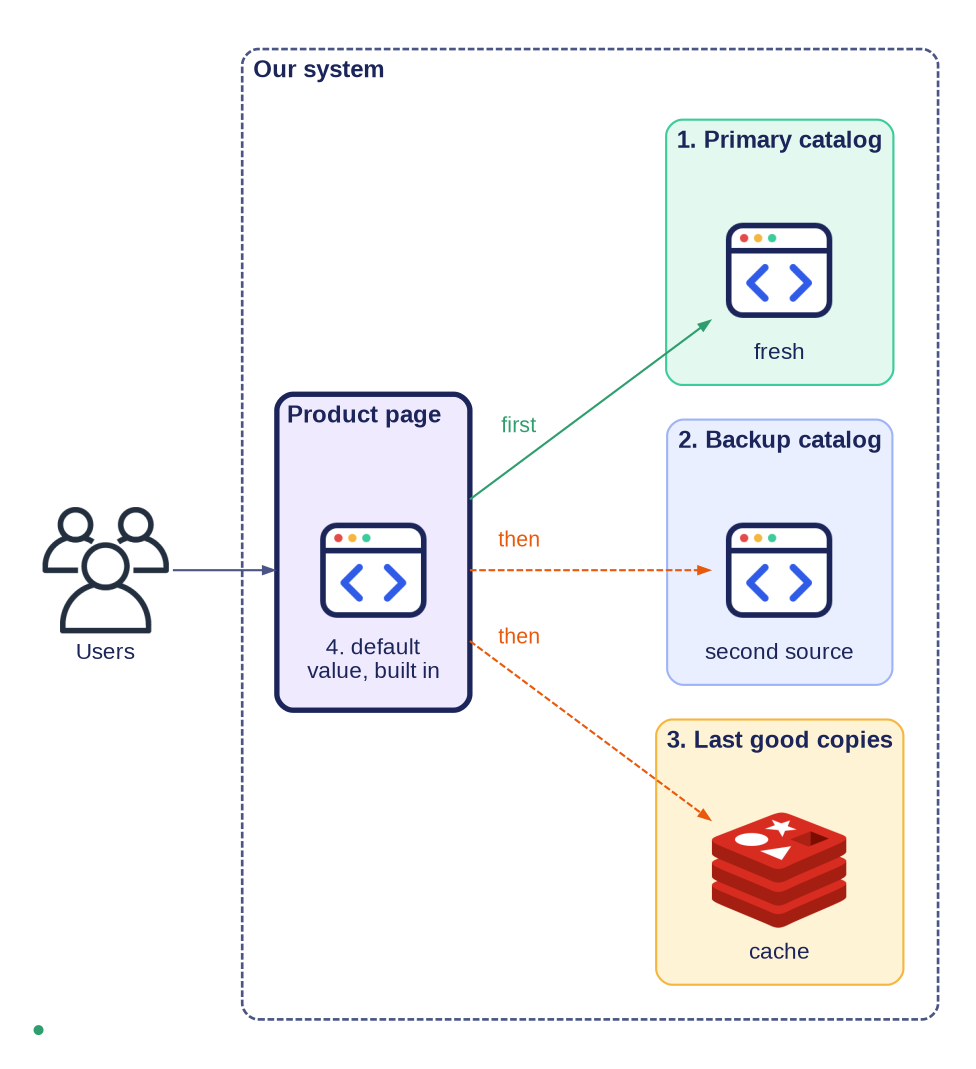
The same chain in time
Stale
An old answer, on purpose
| Age of the copy | Normal times | When the source is down |
|---|---|---|
| Below the fresh limit, for example 1 minute | Use it | Use it |
| Between fresh and stale limits, 1 minute to 1 day | Fetch a new one | Use it, and say its age |
| Above the stale limit | Fetch | Next fallback |
Cache-Control: max-age=60, stale-if-error=86400Degrade
The core stays
A shop, all well
- Personal recommendations
- Stock in real time
- Dynamic prices
- Customer reviews
The same shop, degraded
- A list of popular items
- Last known stock, checked again at checkout
- Standard prices from the last valid list
- No reviews, and a line that says so
Browsing and checkout must work. Recommendations and reviews may go. Note the second half of each line: an old stock number may be shown, but the order must check the real one, or you sell what you do not have.
Which fallback is acceptable?
| Feature | Acceptable | Not acceptable | Because |
|---|---|---|---|
| Product catalogue | Cached data, old is fine | Price 0, "Unknown product" | The old code's default sold at price 0 |
| Recommendations | Popular items, or an empty place | An error page | Extra |
| Search results | Cached, partial or popular results | "0 results" without a reason | People believe it |
| Account balance | None. At most a dated last value, for reading only | A default, or 0 | Must be accurate |
| Permissions | Deny, or a short-lived cached yes for low risk | Allow all | Fail closed |
| Payment | Pending, queued, if the business agrees | Report success | Money |
| Feature flags | The last known set, then built-in defaults | A call on each request | Configuration should survive its server |
Choosing a fallback
Danger
A fallback that makes it worse
The cache fails, and the fallback is the database
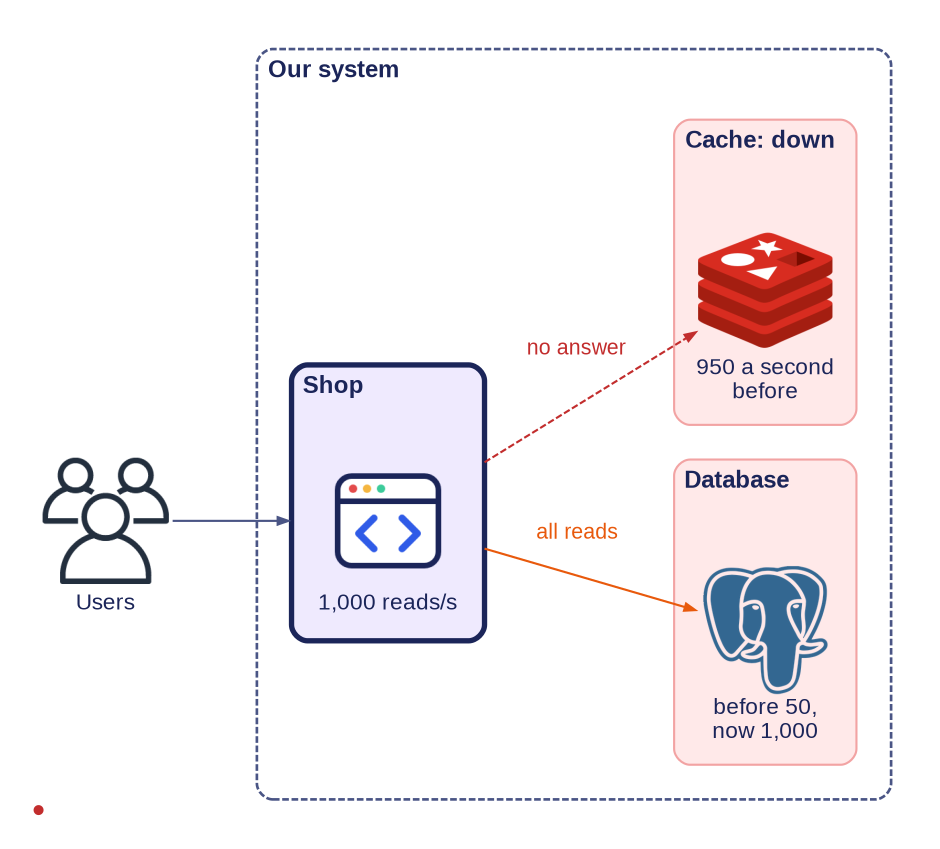
Do the multiplication
The AWS Builders' Library tells such a story from about 2001: when caches for shipping speeds failed, web servers asked the database directly. It locked up, the whole site went down, and fulfilment, which used the same database, as well. A missing line of text would have been the better fallback.
Four safer ways
- 1
Improve the primary
Two replicas that are both used beat one primary and one path that nobody uses. See achieving high availability.
- 2
Let the caller decide
Return a clear error. The caller knows better than you whether the part is optional.
- 3
Push data in advance
If the data is already on the machine, there is no remote call that can fail at request time.
- 4
Use the second path all the time
Send a share of normal traffic through it. Then it is tested, warm and sized.
Afterwards
Coming back
A fallback ends too, and the way back needs a plan: warm the cache before all readers return, work through what was queued as pending at a limited pace, and tell people that the full service is back.
Three modes of one feature
Best practice
Five rules
Clear order
Sort sources by freshness and by how likely they are to work. Different failures need different plans.
Track the use
Count answers by source. Users stop complaining when fallbacks work, so the count is your only alarm.
Test regularly
Force the failure in tests, in drills, and for a small share of real traffic.
Say it
"As of 10:40", "reviews are coming back". People forgive old, not wrong.
Keep it simple
Fewer dependencies than the primary. Best: none.
Where the fallback sits
| Place | Example | Good for |
|---|---|---|
| Browser or app | Show the last list from the device | Offline reading |
| CDN | A static copy of the page, stale-if-error | The whole site during an origin outage |
| Gateway | A fixed JSON answer when a route's breaker is open | Simple, shared rules |
| Calling service | Popular items instead of personal ones | It knows what the part means. Usually the best place |
What triggers a fallback is a failure, a timeout, or an open circuit breaker. Where the fallback stands among the other protections is in resilience: outermost, around the retries.
Summary
The whole topic in one minute.
For each dependency write down what the user gets without it. Optional parts get older data, popular items or nothing. Core parts get another copy of the same thing. Money, stock at the moment of sale, permissions and health data get an honest error.
Keep the fallback simpler than what it replaces, give it enough capacity, label its answers, count its use, and run it on purpose. A path that nobody has walked is not a way out.
- Decide per feature, before the failure, what the user gets.
- Primary, another copy, older data, simpler data, default, honest error.
- Never invent a balance, a price, a permission or a success.
- Two age limits: fresh and stale. Say the age.
- A fallback needs capacity, labels, counts and practice.