
Abstractions in system design
easy 22 minAn abstraction hides how something works behind a small, stable interface, so callers only need to know what it does.
Video lesson · Chapter 1 of 6
One call crosses a boundary
Abstraction in 80 seconds
1:20Reel coming soon
Theory
Read or listen first. About 2 min.
What it is
An abstraction is a simplified view of something complicated. It tells you what you can ask for and what you will get, and it leaves out how the work is done. A file is an abstraction over blocks on a disk. An API endpoint is an abstraction over the code and data behind it.
The visible part is called the interface. The hidden part is called the implementation. When the interface stays the same, the implementation can be fixed, sped up or replaced while callers carry on as before.
Why it exists
Nobody can hold a whole large system in their head. Abstractions cut it into parts that can be understood, built, tested and changed one at a time.
They also decide what a change costs. If forty places talk to the database directly, changing the database means changing forty places. If they all go through one interface, it means changing one. That is why drawing boundaries is a large part of designing systems.
A short history
1968
Edsger Dijkstra's THE operating system is built as a stack of layers, each using only the ones below it.
1972
David Parnas describes information hiding: split a program so that each module hides one design decision that is likely to change.
1974
Barbara Liskov and Stephen Zilles propose abstract data types: a type known by its operations, not by how it is stored.
1984
ISO publishes the OSI model, which describes network communication as seven layers.
2002
Joel Spolsky writes the Law of Leaky Abstractions: all non-trivial abstractions, to some degree, are leaky.
Words to know
- Interface
- The operations callers may use, with their promises. Also called a contract.
- Implementation
- The code and machines that keep those promises.
- Layer
- A set of parts with one job that offers services to the layer above.
- Encapsulation
- Keeping data together with the operations that protect it, and blocking direct access.
- Leaky abstraction
- One whose hidden details still reach the caller, for example as slowness or odd errors.
- Dependency injection
- Handing a part the things it needs, instead of letting it create them.
- Repository
- An interface for loading and saving business objects that hides the storage.
How it works
Step through the idea, or press Play.
Say what is needed. Write the few operations callers really use, in their words
Understand it
Start here
The light switch story
Think of a light switch. You press it and the lamp lights up. You do not know where the electricity comes from, and most days you do not need to.
The switch is the interface. The wires, the pole, the panel and the battery are the implementation.
The idea
What you gain
Five benefits
Less complexity
You can use a part without reading its code.
Easier maintenance
A fix stays inside one part.
Modularity
Teams and services can work on separate parts.
Reuse
Many callers share one implementation.
Freedom to change
Replace the inside while the outside stays the same.
You already use these
| Abstraction | What you see | What it hides |
|---|---|---|
| Car | Pedals | Engine control |
| Cash machine | Buttons | Banking systems |
| API | Endpoints | Server logic and data |
| File system | Paths | Disk blocks and caches |
| SQL | Tables and queries | Indexes, join order, pages |
Layers
Abstraction layers
Systems are built in layers. Each one hides complexity from the layer above it.
One request through the layers
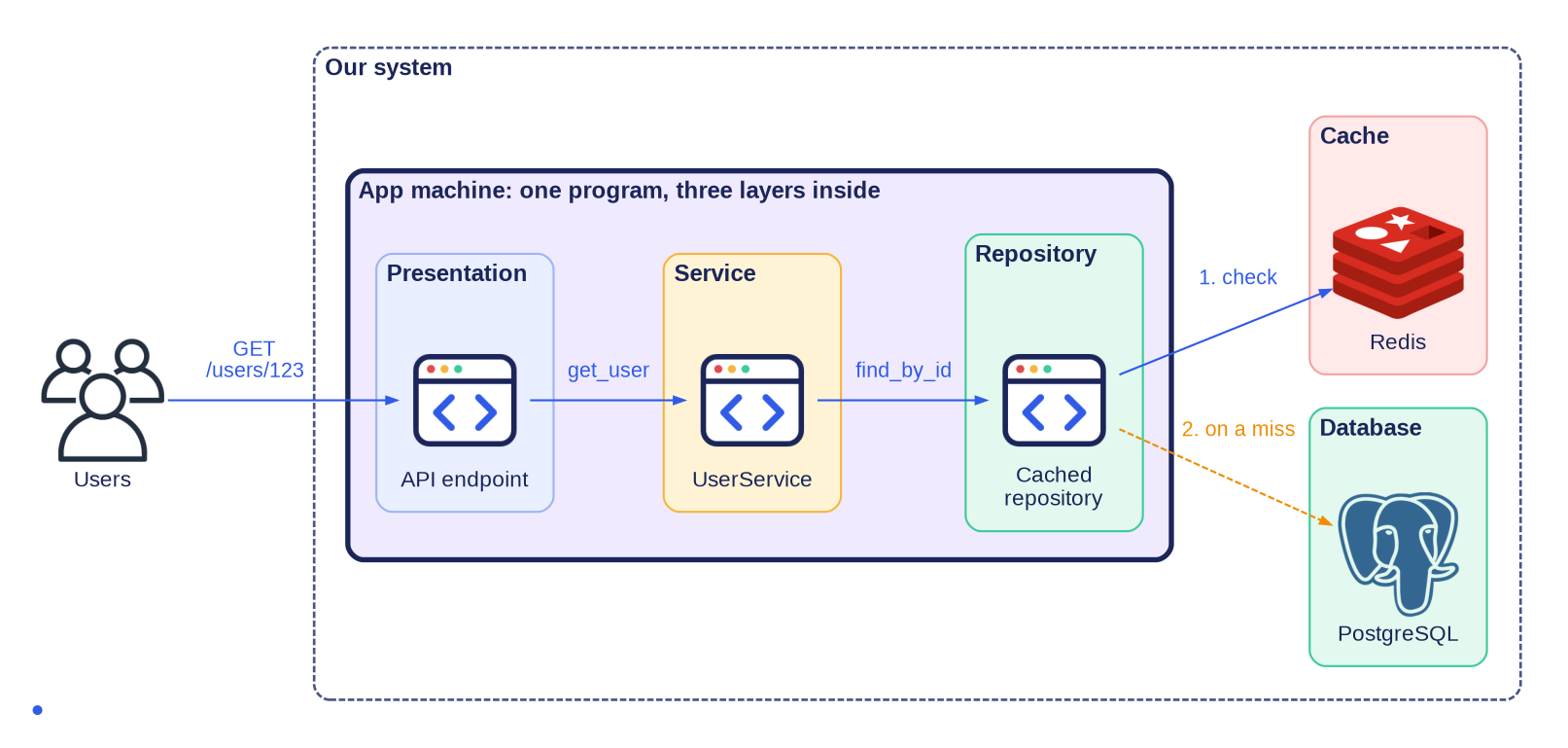
Who does what
| Layer | Job | Example |
|---|---|---|
| Presentation | UI, controllers, API endpoints | Read the request, return JSON |
| Service | Business logic, workflows, use cases | Check the email, create the user |
| Repository | Data access abstraction | find_by_id, save |
| Infrastructure | Database, cache, message queues, external services | PostgreSQL, Redis |
Each layer should
- Ask only the layer below, through its interface
- Hide its implementation
- Expose a clean interface
- Handle its own concerns
Each layer should not
- Know about the layers above
- Skip layers without a stated reason
- Leak implementation details
- Have circular dependencies
A read on a cache miss
Interfaces
Interfaces and APIs
An interface is a contract. It specifies what operations exist without dictating how they are implemented. One contract can have many implementations.
interface StorageInterface { get(key: string): Promise<string | null>; set(key: string, value: string, ttlSeconds?: number): Promise<void>; delete(key: string): Promise<boolean>;}// Several implementations, one interfaceclass InMemoryStorage implements StorageInterface { /* ... */ }class RedisStorage implements StorageInterface { /* ... */ }class S3Storage implements StorageInterface { /* ... */ }Good interface
- Small and focused
- Stable over time
- Free of implementation words
- Documented, including errors and limits
Bad interface
- Too large: a god interface
- Leaks the implementation
- Changes often
- Hard to implement
Why one interface saves work
Protect the inside
Encapsulation
Encapsulation bundles data with the operations that work on it and restricts direct access. It is what makes hiding real: clients do not need to know the inside, and they cannot come to rely on it.
The same account, open and closed
| Without encapsulation | With encapsulation |
|---|---|
user.balance = -1000 sets an invalid value | user.withdraw(100) checks the balance first |
user._cache.clear() breaks hidden state | user.clear_cache() is a safe operation |
Composition
Add a cache without touching anyone
CachedUserRepository has the same interface as the repository it wraps. It adds caching on reads and deletes the cached copy on writes. This is composition over inheritance, and it is called the decorator pattern.
Read path inside the wrapper
What the hidden cache does to average read time
Wiring
Dependency injection
Who decides which implementation is used? One place at start-up, often called the composition root. Every other part receives what it needs.
Same interface, two worlds
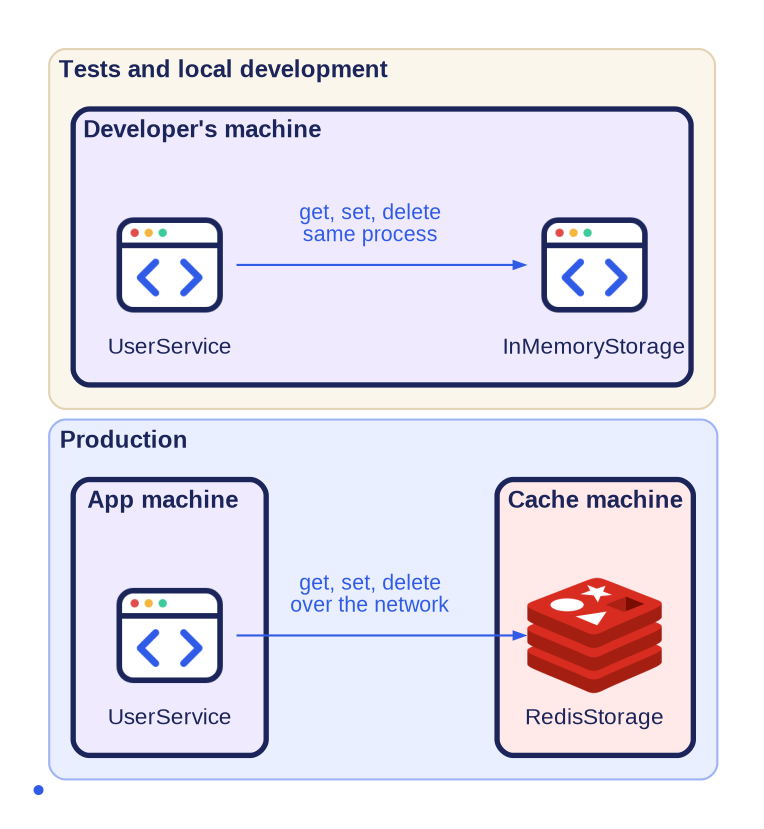
Choosing at start-up
Honesty
Leaky abstractions
It is tempting to say that swapping in-memory storage for Redis is a change of one line. The wiring changes by one line. The behaviour changes more, and good designers say so.
What leaks when memory becomes Redis
| Property | In memory | Redis | Put in the contract |
|---|---|---|---|
| Speed | Well under a microsecond | About a network round trip | Calls may take milliseconds |
| Failure | Cannot be unreachable | Can time out | Calls may fail: treat as a miss |
| Sharing | One copy per process | Shared by all processes | Values may be changed by others |
| Types | Any object | Bytes | Values must be serialised |
| Lifetime | Gone on restart | Survives an app restart | May vanish at any time |
What to do with a leak
Rules
Five best practices
- 1
Program to interfaces
Depend on abstractions, not on concrete implementations.
- 2
Keep interfaces small
Interface segregation: several small interfaces beat one large one.
- 3
Avoid leaky abstractions
Do not expose implementation details such as SQL strings or cursor objects.
- 4
Use dependency injection
Pass dependencies in rather than creating them inside.
- 5
Design for change
Find the decisions likely to change and put boundaries there. Do not wrap everything.
Cost
When an abstraction is too much
Every layer adds names to learn and another place to look while debugging. A layer that only forwards calls, or an interface that will never have a second implementation and is never replaced in tests, may not earn its place.
Add one when
- The decision behind it is likely to change
- Several callers repeat the same details
- Tests need a fake
- Two teams need a fixed contract
Wait when
- You have seen only one use and are guessing the second
- The layer would only forward calls
- Callers need the special feature you would hide
- The team cannot say what it hides
In system design
Boxes on the whiteboard are abstractions
When you draw a box called "queue" you promise what it does. The interviewer may open any box, so know one level below each: what it promises, what it hides and what leaks. Network calls behind boxes are the subject of RPC, and their public shape is the subject of API design.
Summary
The whole topic in one minute.
An abstraction shows what a part does and hides how. Systems are stacks of them: presentation, service, repository, infrastructure. Each layer asks the one below through an interface, so each can change alone.
Keep interfaces small, stable and free of storage words, inject the implementation, and check that every implementation behaves the same way. Then say honestly what leaks: latency, failure, limits and consistency do not disappear because they are hidden.
- Show what, hide how, and keep the interface stable.
- Presentation, service, repository, infrastructure: each layer asks the one below.
- A repository separates business logic from data access.
- Wrap to add behaviour, inject to choose the implementation.
- All useful abstractions leak: put time, failure, limits and consistency in the contract.