
The CAP theorem
medium 28 minWhen the network between copies of your data breaks, each copy must either refuse some requests or risk answers that disagree.
Video lesson · Chapter 1 of 5
The isolated desk cannot verify the price
CAP in 75 seconds
1:15Reel coming soon
Theory
Read or listen first. About 2 min.
What it is
A distributed data store keeps copies of the same data on several machines. The CAP theorem is about the moment when those machines cannot talk to each other. At that moment a machine that receives a request has only two options: answer from what it knows, or refuse until it can check.
The three letters are consistency (every read sees the latest completed write, as if there were one copy), availability (every request to a working node gets a real answer) and partition tolerance (the system goes on although messages between nodes are lost). During a partition you cannot keep both of the first two.
Why it exists
The theorem saves a team from chasing the impossible. If a product owner asks for data that is never stale, always answers and runs in two cities, you can show that one of the wishes must give way when the link fails, and ask which.
It is often told as "pick two of three". That misleads. Cables, switches and overloaded machines break whether you pick them or not, so partition tolerance is not optional for data on several machines. The real question is what each operation does while the network is split.
A short history
1999
Armando Fox and Eric Brewer publish the CAP principle in a paper about scalable internet services.
2000
Brewer presents it as a conjecture in a keynote at the PODC conference.
2002
Seth Gilbert and Nancy Lynch of MIT publish a formal proof, with consistency defined as linearizability.
2010
Daniel Abadi describes PACELC: else, when there is no partition, the trade-off is latency against consistency. The paper follows in 2012.
2012
Brewer writes "CAP Twelve Years Later" and says that the two-of-three wording was always misleading.
Words to know
- Replica
- One of several copies of the same data.
- Network partition
- Some nodes cannot exchange messages with others, although all of them run.
- Linearizability
- The system behaves like one copy on which every operation happens at one instant.
- Quorum
- The number of nodes that must answer. A majority of N is the whole part of N / 2, plus 1.
- CP
- During a partition, refuse rather than risk a wrong answer.
- AP
- During a partition, answer rather than refuse.
- Conflict
- Two sides accepted different writes to the same item.
- PACELC
- If Partition then A or C, Else Latency or Consistency.
How it works
Step through the idea, or press Play.
Keep several copies. So that one machine can fail
Understand it
Start here
Two islands and one guest book
Picture two small islands that share one guest book. Each island keeps a copy, and a raft pulled along a cable carries every new name to the other side. The keepers promise that both copies always say the same.
Joining lists of names is easy. If both islands had sold the same last boat ticket, no merge could please both guests.
Another small version: three friends write one story in three notebooks. You would like the same story in all of them (consistency), everybody able to write at any time (availability), and all that even when one friend cannot reach the others (partition tolerance). While that friend is out of reach, one of the first two wishes has to wait.
C
Consistency means one copy
In CAP, consistency is linearizability: once a write has finished, every later read, from any client and any node, returns that value or a newer one. It is not the C of ACID, which is about rules inside one database.
Consistent
- Client A: write x = 1, answer OK
- Client B: read x, gets 1
- Client C: read x, gets 1
Not consistent
- Client A: write x = 1, answer OK
- Client B: read x, gets 1
- Client C: read x, gets 0, which is stale
How a majority write works
Majority
A
Availability means every working node answers
A request that reaches a node that has not failed must get a real answer. It need not contain the latest write, but "try later" does not count. This is a yes or no property of the algorithm, not a percentage.
Available during the split
- Request 1: answered
- Request 2: answered, perhaps stale
- Request 3: answered, perhaps stale
Not available during the split
- Request 1: answered by the majority side
- Request 2: times out on the minority side
- Request 3: gets an error on the minority side
The other availability: percentages of a year
| Target | Downtime in a year of 365 days |
|---|---|
| 99% | 3.65 days |
| 99.9% | 8.76 hours |
| 99.99% | 52.6 minutes |
| 99.999% | 5.26 minutes |
P
Partitions are not optional
One network split
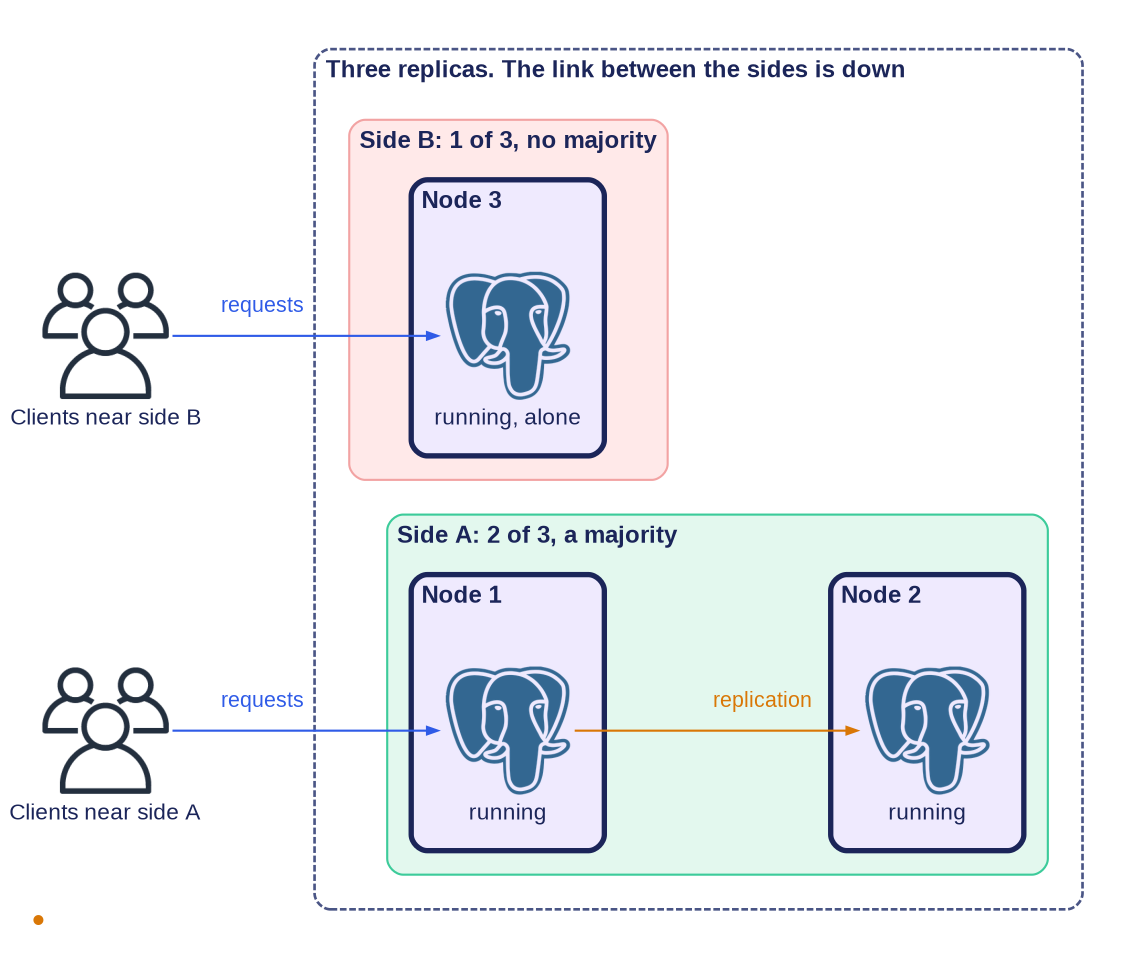
Networks fail
Switches break, cables are cut, a wrong rule blocks a port.
Pauses look the same
A node stopped for 20 seconds by garbage collection is silent, like a node behind a broken link.
Clouds have bad days
Zones and regions lose contact now and then. Your design should say what happens.
You cannot choose CA
With one machine there is nothing to split. With two, the split can happen whether you like it or not.
What does this node do?
Proof
Why both is impossible
- 1
Two nodes, one value
Both hold x = 0. The link between them is cut.
- 2
A write arrives on the left
To be available, the left node must accept x = 1 without telling the right.
- 3
A read arrives on the right
To be available, the right node must answer. It has heard nothing, so it says 0.
- 4
Contradiction
The write finished before the read began, so a consistent read must say 1. With both promises kept, the answer is both 0 and 1.
Notice what the proof uses: the right node sees exactly the same messages whether or not the left one accepted a write, namely none. No cleverness can help it.
CP
Refuse on the minority side
A CP system keeps working where a majority is and stops where it is not. With three nodes and node 3 cut off, writes through nodes 1 and 2 succeed with 2 of 3 votes. Clients that can only reach node 3 get errors until the link is back, and then node 3 catches up.
Which refusals are worth it?
| Use | Why wrong is worse than nothing |
|---|---|
| Moving money between accounts | Spending the same balance twice |
| Stock and seats | Selling the last one twice |
| Locks and coordination | Two holders at once |
| Leader election | Two leaders, called split brain |
AP
Answer everywhere, repair later
An AP system accepts reads and writes on every side. The price comes at healing time: both sides may have changed the same item, and something must decide. Common rules are last write wins (simple, but loses one write), keeping both versions for the application to merge, and data types built to merge (CRDTs).
Which disagreements can you live with?
| Use | Why an answer matters more | Repair |
|---|---|---|
| Social feed | A post a few seconds late is fine | Later sync |
| Shopping cart | A refused click loses a sale | Join both carts |
| Metrics and logs | Gaps are worse than duplicates | Deduplicate by id |
| Content delivery | An old picture beats an error page | Expiry time |
Both sides accept
Normal days
PACELC: the other half
Partitions are rare. On every other day the choice is latency or consistency: a fresh answer needs a round trip to other replicas, a local answer does not. Abadi's PACELC puts both halves in one line: if Partitioned, A or C; Else, L or C.
PACELC in one picture
What a fresh answer costs
PACELC labels, for a given configuration
| Label | In a partition | Otherwise | Typical shape |
|---|---|---|---|
| PC/EC | Refuse | Wait for agreement | Consensus stores such as etcd |
| PA/EL | Answer | Answer at once | Dynamo style with small quorums |
| PA/EC | Answer | Wait for agreement | Leader plus failover that may lose the last writes |
| PC/EL | Refuse | Answer at once | A fixed leader per item with local reads |
Real systems
Labels depend on settings
What the documents say
| System | Leans | Under which settings |
|---|---|---|
| etcd | CP | Linearizable by default; serializable reads are local and may be stale |
| ZooKeeper | CP | Linearizable writes; reads come from the connected server unless you sync first |
| HBase | CP | Its documents promise strongly consistent reads and writes |
| MongoDB | CP for majority operations | Default write concern is majority; linearizable reads must be asked for |
| Cassandra | AP, tunable | The level is chosen for each query: ONE to ALL |
| DynamoDB | Mixed | Eventually consistent reads by default, strong reads on request in one region |
| CouchDB | AP | Accepts writes on any node and replicates; conflicts are kept |
| Riak KV | AP | Keeps answering; offers mergeable data types |
| DNS | AP | Cached answers may be old until they expire |
| Redis with WAIT | Not CP | Its own page says WAIT does not make Redis strongly consistent |
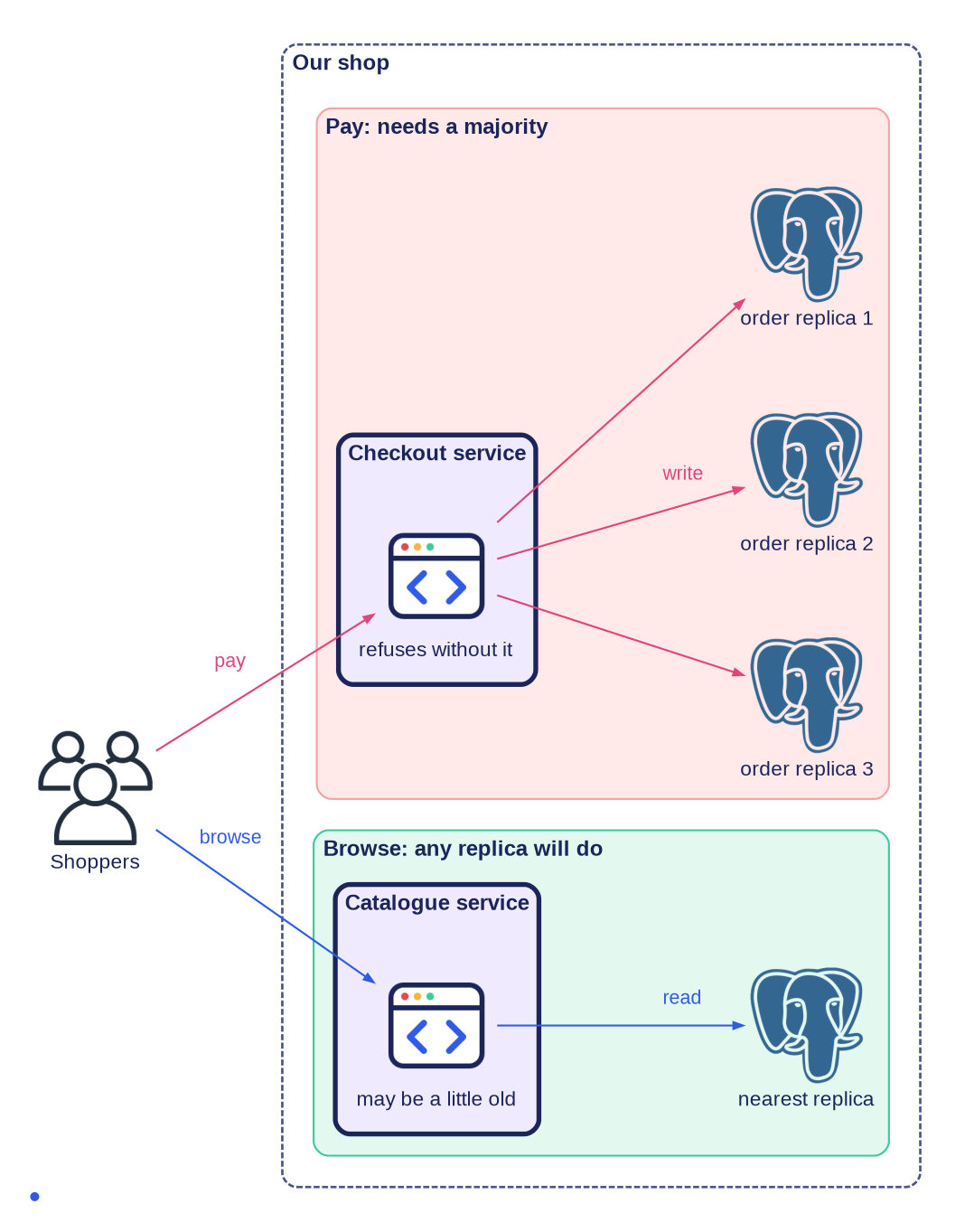
One shop, two choices
Do it well
Working rules
Do
- Choose from the business need
- Use majorities and consensus where wrong is expensive
- Design the merge before choosing AP
- Watch the replication lag
- Cut the network in tests
Do not
- Assume the network is reliable
- Ignore what users expect to see
- Mix both behaviours without saying which is where
- Forget the healing step
- Treat CAP as one switch for the whole product
Summary
The whole topic in one minute.
CAP is a statement about a broken network: a replica that cannot reach the others must either refuse or answer without knowing whether the answer is up to date. Consistency here means linearizability, and availability means that every working node answers every request.
Choose for each operation, not once for the whole company. Refuse where a wrong answer costs more than no answer, such as a lock or the last seat. Accept and merge later where an answer matters more, such as a shopping cart. In normal times, ask the other half of the question: how much latency is the fresh answer worth?
- CAP speaks about the time when replicas cannot talk.
- C is linearizability, A is an answer from every working node.
- P is not a choice, so decide between refusing and answering.
- A majority exists on at most one side of a split.
- AP needs a merge rule; CP needs a plan for the refused users.
- Without a partition the trade is latency against consistency.