
Design a Distributed Cache (Redis)
medium 45 minBuild a service like Redis: many machines that together behave as one fast key-value store in memory.
Video lesson · Chapter 1 of 5
One profile, three possible outcomes
Distributed cache in 90 seconds
1:30Reel coming soon
Theory
Read or listen first. About 2 min.
What it is
A distributed cache keeps copies of often-used data in the memory of several machines. Programs read and write it by key, and the machines share the keys between them.
It sits beside the database, not in place of it. The database holds the truth. The cache holds answers that would be slow or expensive to work out again, and it may forget any of them.
Why it exists
Memory answers a key lookup far faster than a query that plans, locks and reads a disk. When the same answers are wanted again and again, most requests never need the database.
One machine is not enough for long. It has a limited amount of memory, one network card and one command loop, and when it stops, every request falls on the database at once.
A short history
22 May 2003
Memcached is released. Brad Fitzpatrick wrote it for the website LiveJournal.
26 February 2009
Redis is released by Salvatore Sanfilippo, with lists, sets and other structures beside plain values.
April 2013
Facebook engineers describe their Memcached deployment at the NSDI conference: billions of requests a second and trillions of items.
March 2024
Redis moves to source-available licences. The Linux Foundation announces Valkey, a fork of the last BSD-licensed version.
Words to know
- Shard
- One part of the keys, and the machine that owns that part.
- Slot
- A small numbered bucket. A key always falls in the same slot; slots are assigned to shards.
- Hit rate
- The share of reads the cache can answer by itself.
- Eviction
- Throwing out an item because memory is full.
- TTL
- Time to live: the item is ignored after this time.
- Primary and replica
- The copy that takes writes, and a copy that follows it.
- Hot key
- One key with far more traffic than the others.
- Stampede
- Many requests rebuilding the same missing item at the same time.
Solve it like an interview
New to it? Start with Approach. Revising? Go straight to the mock.
- 1ApproachWhat this question tests, where it gets hard, and how to spend the time.
- 2ScopeAsk what changes the design, then commit to a short list.
- 3NumbersWork out a number when the answer changes what you build.
- 4API and dataThe contract first, then the data that serves it.
- 5DesignStart with the smallest system that works. Change it only when something breaks.
- 6Deep divesCompare the options before you open them, then say which you would pick.
- 7Explain your choicesAnswer first. Then compare your reasoning.
- 8By levelThe same question is judged differently for mid, senior and staff.
- 9MockAnswer against the clock, then score yourself.
Understand it
Picture it
Squirrels, trees and spare nuts
The rule spreads the nuts, the baskets survive a storm, and one famous nut still makes a queue.
Scope
What are we building?
A general-purpose cache, a service like Redis, for a large company: sessions, query results, counters, leaderboards, rate limits, messages and short locks. We design the cache itself, not only how to use one.
Find it
Any client reaches the right machine in one hop.
Fit it
Memory is limited, so something must be evicted.
Survive it
A machine dies; its keys come back in seconds.
Protect the database
Misses must never arrive all at once.
Without and with a cache (our assumptions)
| Without | With | |
|---|---|---|
| Who answers | The database, always | The cache for 90% of reads |
| Typical time | 20 ms | 1 ms on a hit |
| Load on the database | 100% | 10%, ten times less |
| To grow | Costly database replicas | Add cache shards |
Similar systems
| System | Known for |
|---|---|
| Redis, Valkey | Rich data types, one command loop |
| Memcached | Plain key-value, many threads |
| Hazelcast | In-memory data grid in Java |
| Apache Ignite | Data and compute grid |
| Aerospike | Key-value with data on flash |
| ElastiCache, Memorystore, Azure's Redis service | Managed by a cloud provider |
The finished system
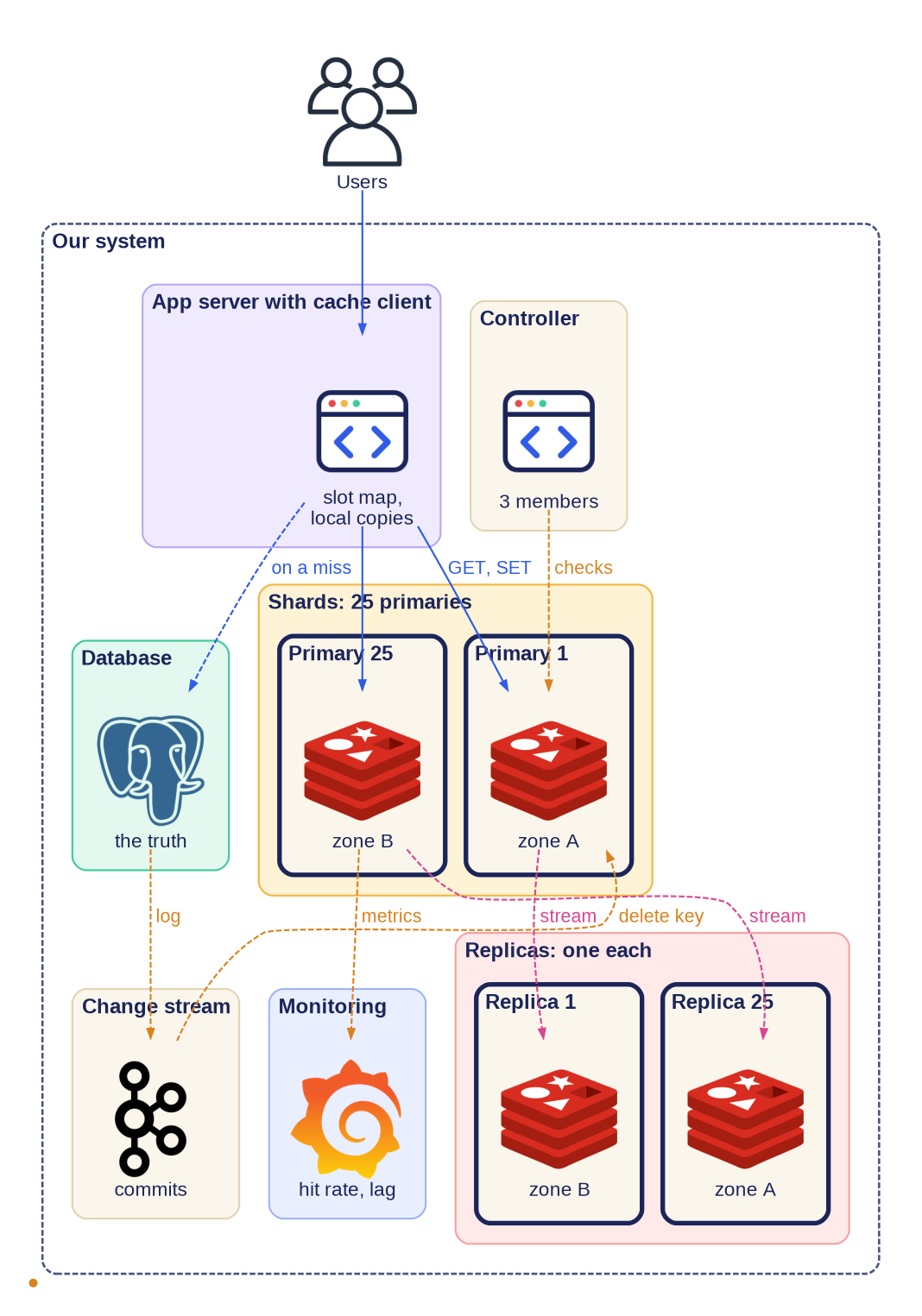
Where the design ends up
The whole system
Read next
Who owns which idea
| Idea | Its own page |
|---|---|
| Spreading keys, local and shared tiers | Distributed caching |
| Rings, virtual nodes, slots | Consistent hashing |
| Primary, replicas, failover, split brain | Cache replication |
| LRU, LFU and friends | Cache eviction |
| Stampedes | Thundering herd |
| Cache and database agreement | Cache consistency |
| Read and write patterns | Cache-aside, write-through, write-back |
| Which product | Memcached vs Redis |
For the interview go to Approach, then Scope, Numbers, API, Design and Deep dives. If you are revising, start with the Mock.
Summary
The whole topic in one minute.
A distributed cache is a hash table spread over machines. Clients work out a slot from the key, look the slot up in a small map and talk straight to the owner. Each owner has a replica, and a controller changes the map when one fails.
The design stays simple because the data can be lost. That decides most questions: copies are sent without waiting, full memory means eviction, and a missing item is read from the database again. The care goes into protecting the database at those moments.
- 1.74M requests a second at peak decides the number of shards; memory does not.
- Keys map to 16,384 fixed slots; slots map to shards. Only the second map ever changes.
- Replicate without waiting: a crash may lose a few milliseconds of writes.
- A hot key is not solved by more shards. Copy it closer to the readers.
- Delete on write, expire on time, rebuild once.