
etcd
medium 30 minetcd is a small, strongly consistent key-value store.
Video lesson · Chapter 1 of 5
A ferry terminal saves berth seven
etcd in 80 seconds
1:20Reel coming soon
Theory
Read or listen first. About 2 min.
What it is
etcd stores a small amount of data that must never be wrong: settings, the state of a cluster, who is the leader. Several servers, called members, hold identical copies. Every change goes through the Raft agreement algorithm and is committed when a majority has written it to disk.
Every change raises one global number, the revision. Old versions stay readable until they are compacted. This turns the store into an ordered ledger: a client can say "tell me everything after revision 6" and miss nothing.
Why it exists
Distributed programs need one place they can trust for a decision. etcd offers strict consistency, change streams, expiring keys and conditional transactions in one server written in Go, with a gRPC interface and an Apache 2.0 licence.
It gives that by refusing two things: large data and writes without a majority. If your data may be slightly old, or is large, another store is cheaper and faster.
A short history
2013, July
The etcd source repository is created on GitHub. The project comes from CoreOS, which needed to coordinate reboots and settings of its Linux machines.
2014
Diego Ongaro and John Ousterhout publish "In Search of an Understandable Consensus Algorithm", the Raft paper, at the USENIX Annual Technical Conference.
2016, June
Version 3.0.0 is released on 30 June with the gRPC interface, leases and transactions used today.
2018 and 2020
The Cloud Native Computing Foundation accepts etcd on 11 December 2018. It reaches the graduated level on 24 November 2020.
2023, November
etcd becomes a special interest group of the Kubernetes project.
2025 and 2026
Version 3.6.0 arrives on 15 May 2025 with at least 50% less memory on average and full downgrade support. Version 3.7.0 arrives on 8 July 2026 and starts entirely without the old v2 store.
Words to know
- Member
- One etcd server of a cluster.
- Quorum
- A majority of the voting members.
- Term
- Raft's number for a period with at most one leader.
- Revision
- The store's global change counter.
- Lease
- A time limit that keys can hang on. If nobody renews it, the keys are deleted.
- Watch
- A stream of changes for keys, from a chosen revision.
- Compaction
- Forgetting history before a revision.
- Linearizable
- Every read sees the latest completed write.
How it works
Step through the idea, or press Play.
Propose. A client sends a change; the leader puts it in the log
Understand it
Start here
Five scribes, one ledger
Imagine five scribes who each keep the same numbered ledger. A line counts once three of them have signed it.
The numbers are the whole trick. With a number you can always ask for the rest.
The idea
What it is, and what it is not
etcd is
- A strictly consistent key-value store (CP in CAP terms)
- An ordered history with numbers
- Leases, watches, conditional transactions
- Lock and election services
- One binary with TLS and role-based access
etcd is not
- A general database: 2 GiB by default, 8 GiB suggested maximum
- A cache, queue or log store
- A name server or health checker
- A store for distant regions: every write waits for a majority
- Writable on the smaller side of a split
What people use it for
Cluster state
Kubernetes keeps pods, services, secrets and settings in it.
Configuration and flags
One value everywhere, pushed by a watch.
Service registration
Addresses under a prefix, each on a lease.
Leader election and locks
One holder at a time, released when the lease ends.
Data model
Keys, revisions, versions
Keys are bytes in one flat, sorted space. /config/db is just a name; folders do not exist, but a range read of a prefix feels like one. Each key carries three numbers.
| Number | Meaning | Use |
|---|---|---|
| Create revision | Store revision when the key was created | Order in locks and elections; 0 means it does not exist |
| Mod revision | Store revision of its last change | Compare-and-swap, fencing |
| Version | Changes since creation, restarts after deletion | Counting changes of one key |
Inside one member
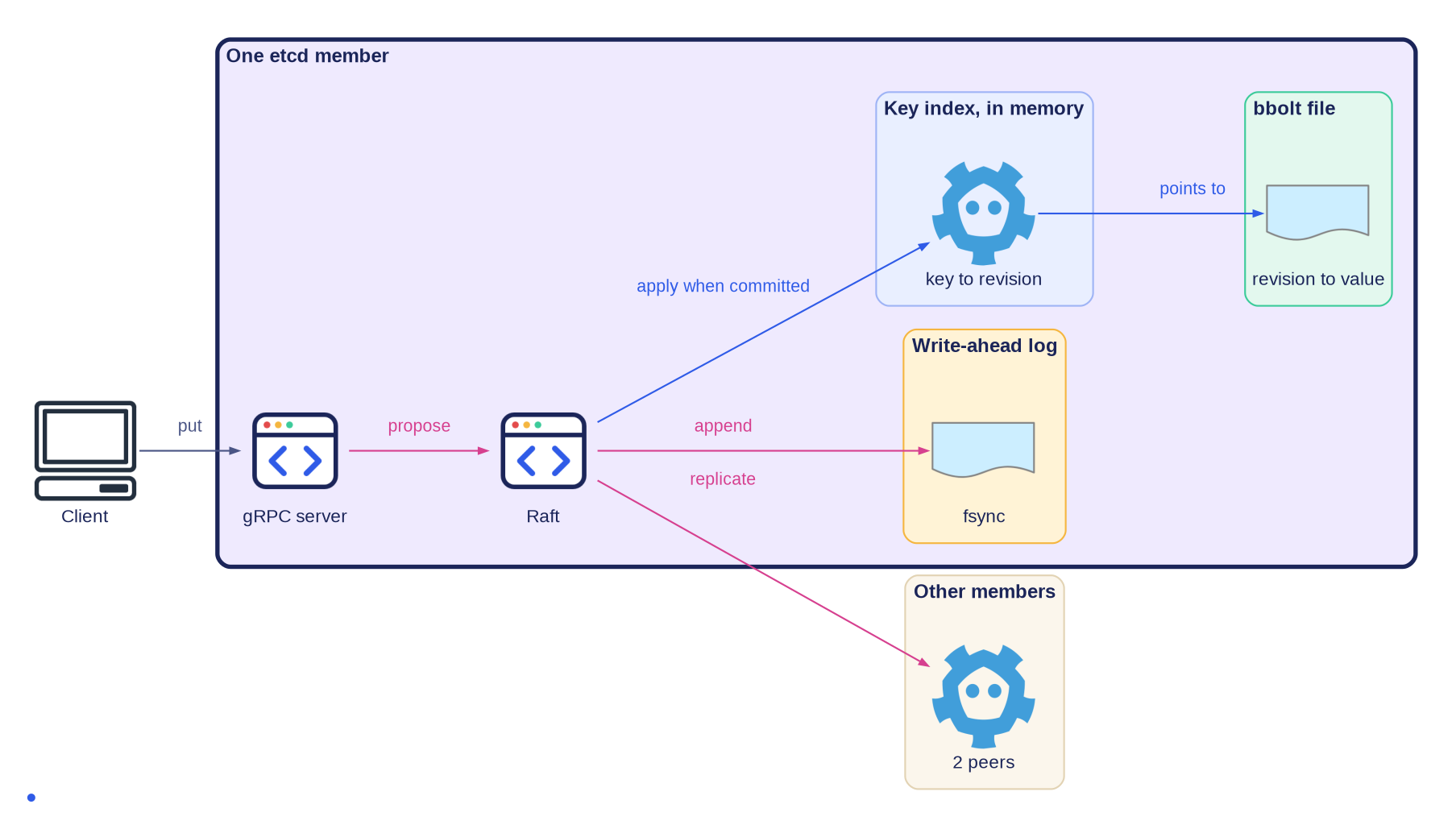
Architecture
Members and majority
Three members in three zones
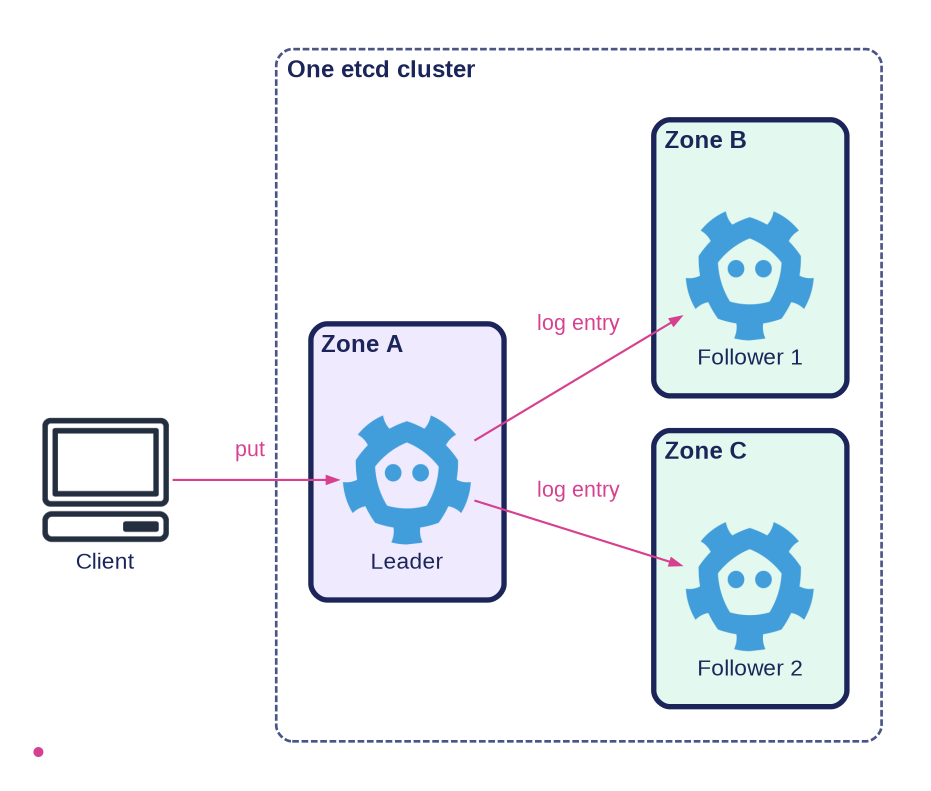
Majority and failures
Writes
The path of a put
One write
Why a write takes as long as it does
etcd's own benchmark, with 256-byte values: one client got 583 writes a second at 1.6 ms each; 1,000 clients over all members got about 50,000 a second at 20 ms, because many entries share one fsync. Your hardware will differ.
Leaders
Elections
When the leader is silent
Defaults: a heartbeat every 100 ms, an election timeout of 1,000 ms. The timeout should be at least ten times the round trip between members, and at most 50 s. During an election writes wait. Committed entries are never lost; uncommitted ones may be, so a client that times out must check or retry safely. The new leader extends all leases.
Reads
Linearizable or serializable
| Read | Who answers | May be old? | Without a majority |
|---|---|---|---|
| Linearizable (default) | The contacted member, after confirming the commit point with a majority | No | Fails |
| Serializable | The contacted member alone | Yes | Works |
Changes
Watches
A watch is a stream on a key or prefix, optionally from an old revision. Events are ordered, unique, and none is dropped as long as the history is still there. After a break, continue from the last revision seen plus one.
List, then watch
Expiry
Leases
Create a lease with a time to live, attach keys, and keep it alive. If the renewals stop, the lease ends and all its keys are deleted, as normal events that watchers see. A lease is not tied to a connection, so a reconnect does not end it. Expiry can be late, for example after a leader change, but not early.
Registering a service
- 1
Grant
Ask for a lease of 10 s.
- 2
Put
Write
/services/web/i-1with the address, on that lease. - 3
Keep alive
Renew every few seconds; client libraries do it.
- 4
Leave
Revoke the lease for an instant goodbye, or crash and vanish after at most about 10 s.
Conditions
Transactions, locks and elections
A transaction is *if* comparisons hold, *then* these operations, *else* those, all in one revision. Comparisons can look at value, version, create revision, mod revision or lease. Up to 128 operations by default.
# The shape of compare-and-swap on the mod revisionstore = {"/counter": ("5", 41)} # value, mod revisiondef txn(key, expected_rev, new, rev): value, mod = store[key] if mod != expected_rev: return False, value # somebody was faster: read again store[key] = (new, rev) return True, newprint(txn("/counter", 41, "6", 42))print(txn("/counter", 41, "6", 43))The lock service creates a key under the lock's name on your lease and waits until no older key exists, judged by create revision. Each waiter watches only the one before. The election service works the same way.
Operate
Limits and settings
Defaults in v3.7
| What | Value |
|---|---|
| Storage quota | 2 GiB; 8 GiB suggested maximum, a higher value logs a warning |
| Request size | 1.5 MiB |
| Operations per transaction | 128 |
| Heartbeat and election | 100 ms and 1,000 ms |
| Ports | 2379 clients, 2380 peers; use TLS on both |
| Raft snapshot | Every 10,000 entries (100,000 before 3.6) |
| Auto compaction | Off unless you set a retention |
| Pre-vote | On |
How fast does history grow?
Out of space, and back
Hardware and signals
| Area | Advice |
|---|---|
| Disk | SSD on its own; 50 sequential IOPS at least, 500 for heavy clusters |
| CPU and memory | 2 to 4 cores and 8 GB for typical clusters; far more with thousands of watchers |
| Network | Members close together, one per zone |
| Watch | fsync and commit times, leader changes, failed proposals, database size against the quota |
| Neighbours | Nothing else busy on the machine: a late heartbeat means an election |
Change safely
Members, backups and access
Replace a dead member of three
- 1
Remove it first
Two members remain, majority 2, and both are up.
- 2
Add the new one as a learner
It receives data without a vote, so a mistake cannot break the quorum.
- 3
Promote
When it has caught up it becomes a voter: three again.
Adding first would make four members with majority 3. With one dead, every other member would have to be perfect, and a mistyped address would block all further changes. etcd rejects such additions by default.
Backups that work
etcdctl snapshot savefrom a live member, on a schedule- Check with
etcdutl snapshot status - Restore with
etcdutl snapshot restore, on every member from the same file - For Kubernetes add a revision bump and mark it compacted, so no cache sees time go back
- Rehearse it
Not backups
- Three members: they copy a mistaken delete at once
- Copying files of a running member
etcdctl snapshot restore: removed in 3.6- A snapshot stored on the same machines
- Forcing a new cluster while old members still run
Turn on TLS for clients and peers, role-based access with key prefixes, and encryption of sensitive values before they reach etcd. Whoever can read a Kubernetes cluster's etcd can read its secrets unless encryption at rest is set.
Decide
When to choose it, and when not
Choose etcd
- Critical metadata that must never differ
- Watching every change in order
- Locks, elections, leases
- Flags and settings with instant push
- A few gigabytes at most
- Building a control plane, as Kubernetes does
Choose something else
- Large data or heavy writes
- Slightly old data is fine: an eventually consistent store
- Members on several continents
- Discovery with DNS and health checks: Consul
- Logs and time series
- Your own app on Kubernetes: use its API, not its etcd
Alternatives
| etcd | ZooKeeper | Consul | Redis | |
|---|---|---|---|---|
| Agreement | Raft | ZAB | Raft | Asynchronous replication |
| Data | Flat keys with history | Tree, current state only | Key-value and services | Structures, large data |
| Interface | gRPC, JSON gateway | Own TCP protocol | HTTP and DNS | Own TCP protocol |
| Notices | Stream, resumable | Once, or persistent | Blocking queries | Pub/sub, lost if away |
| Access | Roles on key ranges | List per znode | Tokens and policies | Users and command lists |
| Choose it for | Control planes, Kubernetes | Hadoop family | Discovery and mesh | Cache, speed |
Summary
The whole topic in one minute.
etcd is a replicated ledger with a key-value view. Raft elects one leader, a majority commits each entry, and the revision numbers the result. Reads are linearizable unless you ask for a cheaper one, watches replay from a revision, leases remove what is no longer renewed, and transactions compare before they write.
Keep it small, on fast disks, with 3 or 5 members close together. Compact, defragment and back it up. Use a fencing number when a lock protects something outside etcd.
- A majority commits; the revision numbers everything.
- Reads are linearizable by default; serializable reads are cheaper and may be old.
- List, then watch from the next revision. If compacted, list again.
- 2 GiB by default, 8 GiB suggested maximum: compact, defragment, back up.
- Remove a dead member before adding its replacement.