
Container and Kubernetes load balancing
medium 30 minContainers come and go and their addresses change.
Video lesson · Chapter 1 of 5
Find the entrance to an otherwise ordinary pod
Theory
Read or listen first. About 2 min.
What it is
In Kubernetes your program runs in pods. A pod is one or a few containers that share an address. Pods are replaced all the time: on a new version, when a machine fails, when traffic grows or falls. Every new pod gets a new address.
A Service is a steady name and a steady address for a group of pods. Callers use the name. Kubernetes keeps the list of pods behind it and spreads connections over those that are ready.
A Service works with connections (layer 4). For web requests, with host names and paths, there is Ingress and its newer replacement, the Gateway API. A service mesh goes further and balances each request between services.
Why it exists
A classic load balancer has a list of servers that changes a few times a year. Here the list changes many times an hour. Nobody can edit it by hand, so the list must follow the pods by itself.
Container traffic also has two directions: from outside into the cluster, and between services inside it. Most of the traffic is inside. That part needs a balancer that costs almost nothing, so Kubernetes puts it into the network rules of every machine instead of into a separate box.
A short history
6 June 2014
The first commit of Kubernetes is published.
August 2020
Kubernetes 1.19 makes the Ingress API stable (networking.k8s.io/v1).
31 October 2023
Gateway API 1.0: the successor of Ingress becomes generally available.
April 2025
Kubernetes 1.33: the nftables mode of kube-proxy is stable and the old Endpoints API is deprecated in favour of EndpointSlices.
December 2025
Kubernetes 1.35 deprecates the IPVS mode of kube-proxy.
March 2026
Maintenance of the Ingress NGINX project ends. The Kubernetes project recommends Gateway.
Words to know
- Pod
- The smallest thing Kubernetes runs: containers that share one address.
- Node
- A machine of the cluster that runs pods.
- Service
- A steady name and virtual address for a set of pods.
- Selector
- The labels that say which pods belong to a Service.
- EndpointSlice
- The list of addresses behind a Service, in pieces of at most 100 by default.
- kube-proxy
- A program on each node that turns Services into network rules of the kernel.
- Readiness probe
- The check that decides if a pod may receive traffic.
- Ingress, Gateway
- Rules for traffic that enters the cluster by host and path. A controller must carry them out.
- Sidecar
- A proxy container next to the program in the same pod.
Understand it
Start here
The hive keeps its name
Nobody asks for bee number two. They ask for the hive.
| In the garden | In Kubernetes |
|---|---|
| Bee | Pod |
| Hive with its name | Service |
| Bees that can fly today | Ready endpoints |
| Young bee on the board | Pod that is not ready |
| Signpost | Ingress or Gateway |
The idea
A Service is a name, a list and some rules
- 1
Name
The cluster's DNS answers
my-service.productionwith one virtual address, for example 10.96.0.20. - 2
List
A controller watches pods whose labels match the selector and writes the addresses, with a ready flag, into EndpointSlices.
- 3
Rules
On every node kube-proxy reads the list and writes rules into the kernel: traffic to 10.96.0.20 port 80 goes to one of these pods.
A Service inside the cluster
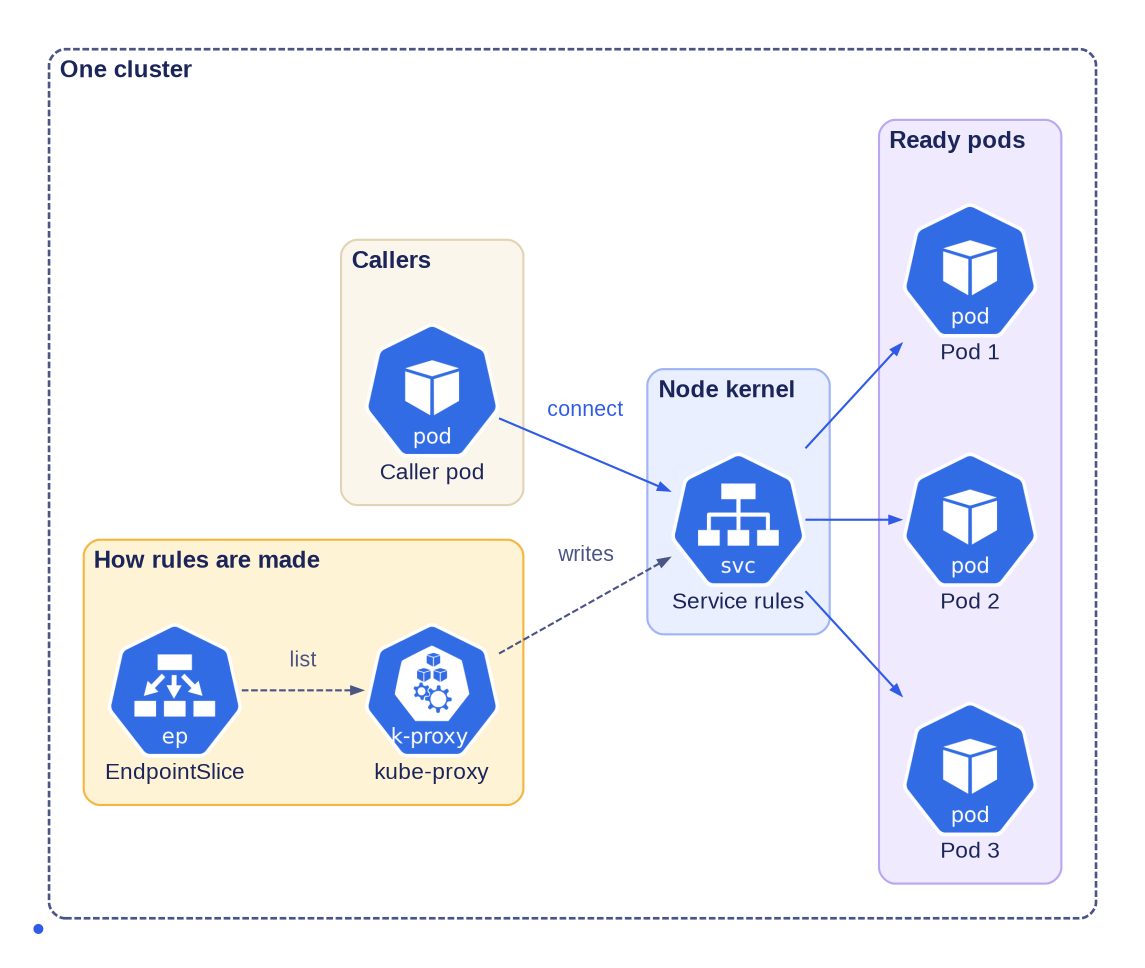
From a pod to a pod
Finding services by name is a subject of its own: service discovery. Kubernetes does server-side discovery with Services and client-side discovery with headless Services.
How it chooses
At random, not in turn
It is often said that Services use round robin. In the default iptables mode the kernel picks an endpoint at random for each new connection. The rules are a list, and each rule has a chance.
Why the chances differ but the shares are equal
Modes of kube-proxy on Linux
| Mode | Choice | Remember |
|---|---|---|
| iptables | Random | Default as of 1.37. The time to find a Service grows with their number |
| nftables | Random | Stable since 1.33. One lookup whatever the number of Services |
| ipvs | Round robin, least connections and more | Deprecated since 1.35 |
The choice is made per connection. All requests on one open connection go to the same pod. That matters below for gRPC.
Types
Four types, each on top of the last
Service types
ClusterIP
The default. A virtual address inside the cluster only. Address 10.96.0.20 port 80 to the pods.
NodePort
The same port on every node, 30000 to 32767 by default. Node address port 30080 to the Service.
LoadBalancer
Asks the cloud for an external balancer, which sends to the node ports or straight to pods.
ExternalName
Only a DNS alias (CNAME) to a name outside. No proxy, no balancing.
Ingress is not a Service type. It is a separate kind of object that uses Services. ExternalName can surprise you with HTTP and TLS, because the caller's host name differs from the real one.
The way in
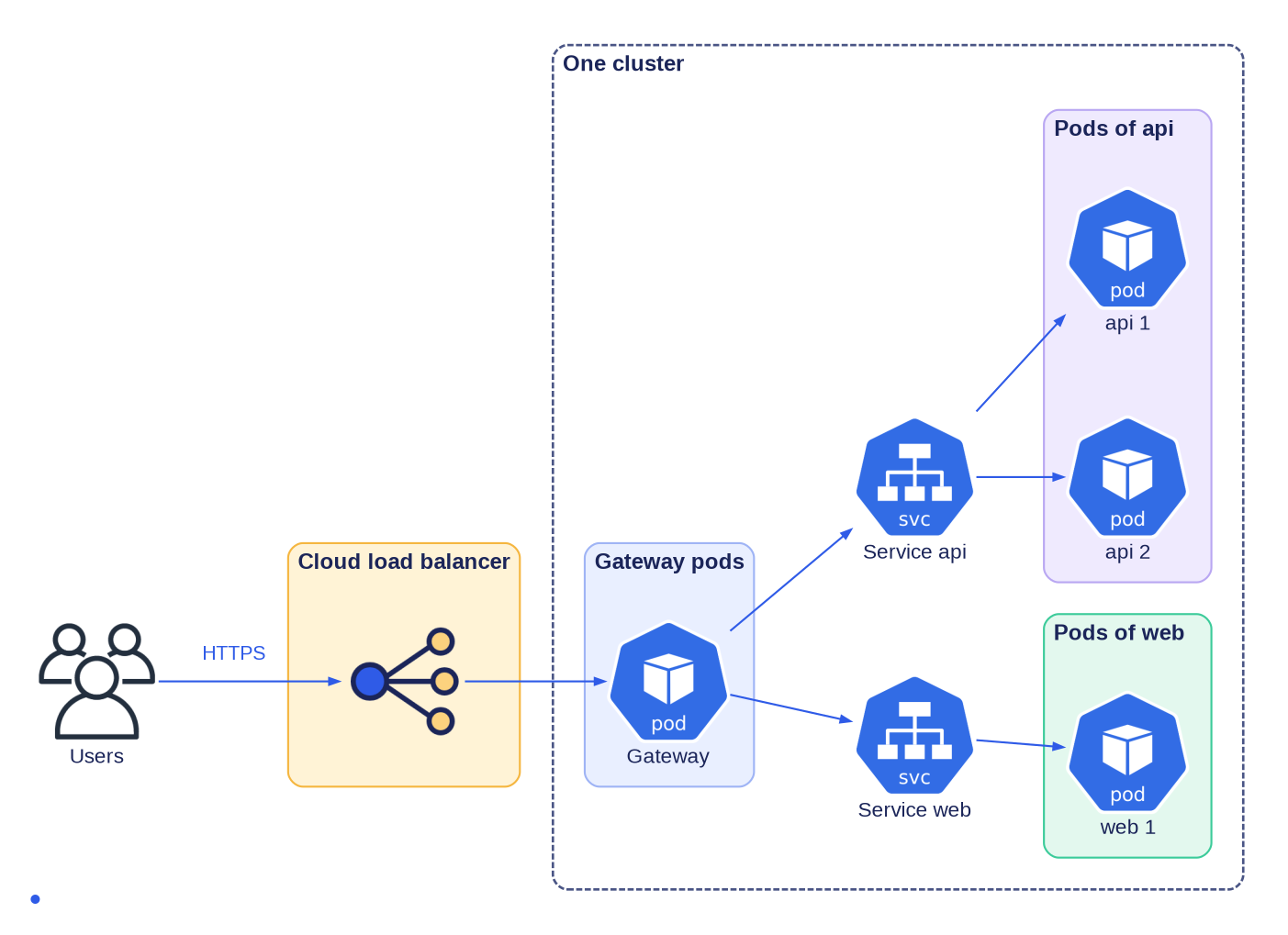
Which type?
External traffic
An extra hop and a lost address
An external balancer sends a connection to some node. The pod may be on another node, so the packet travels once more, and the sender's address is usually replaced on the way. The setting externalTrafficPolicy: Local keeps traffic on the node where it arrives. The address survives and the hop goes away, but the load can become unequal.
| Setting | Extra hop | Client address | Balance |
|---|---|---|---|
| Cluster (default) | Possible | Usually replaced | Even over pods |
| Local | No | Kept | Even over nodes, not over pods |
If the external balancer can send straight to pod addresses, both problems disappear. Then you may switch off node ports with allocateLoadBalancerNodePorts: false.
Ready
Readiness decides who gets traffic
| Probe | Question | If it fails |
|---|---|---|
| Startup | Has it started? | Wait, other probes are off, then restart |
| Readiness | May it get traffic now? | Taken off the list, not restarted |
| Liveness | Is it stuck? | Restarted |
Removing a pod is the dangerous half. Two things start at the same time: the pod is told to stop, and its address is removed from lists on all nodes. Rules on some nodes can be late, so a pod that exits at once refuses connections that are still on their way.
A shutdown without errors
Choose the grace period
Web traffic
Ingress, and Gateway after it
An Ingress holds rules: this host and path go to that Service. It does nothing by itself. A controller must run in the cluster and carry the rules out.
Routing example
| Request | Service |
|---|---|
| api.example.com/v1/... | api-v1 |
| api.example.com/v2/... | api-v2 |
| web.example.com/... | web |
Part of the Ingress API: host rules, path rules and TLS. Offered by controllers through annotations: URL rewriting, rate limits, cookies and more. Annotations differ between controllers, so they tie you to one.
- Known controllers: Traefik, HAProxy Ingress, Kong, and the AWS Load Balancer Controller (once called the ALB Ingress Controller).
- Ingress NGINX, long the most familiar one, is retired since March 2026. Do not choose it for something new.
- The Ingress API is stable but frozen: no new features. The Kubernetes project recommends Gateway.
Gateway API
- Roles: platform team owns the Gateway, app teams own routes.
- Weights, header matches and gRPC routes are in the API.
- The same file works with many controllers.
Ingress
- One object for everybody.
- Anything beyond host, path and TLS needs annotations.
- Frozen.
apiVersion: gateway.networking.k8s.io/v1kind: HTTPRoutemetadata: name: apispec: parentRefs: - name: public-gateway hostnames: ["api.example.com"] rules: - matches: - path: { type: PathPrefix, value: /v1 } backendRefs: - { name: api-stable, port: 80, weight: 90 } - { name: api-canary, port: 80, weight: 10 }Every request
Service mesh
A Service balances connections. A mesh balances requests. It puts a proxy next to each program, which picks a pod for every request, retries, breaks circuits, encrypts and measures. The program itself does not change.
| Mesh | Proxy | Known for |
|---|---|---|
| Istio | Envoy sidecars, or ambient mode without sidecars | Many features; by default picks the less busy of two random pods |
| Linkerd | Its own small proxy in Rust | Simplicity; sends to the fastest pods by a moving average |
| Consul | Envoy usually | Works with HashiCorp tools, inside and outside Kubernetes |
A mesh costs memory and some delay for each pod, and knowledge to run it. Two services that need a circuit breaker do not need a mesh: see circuit breaker. Forty services in five languages may.
Patterns
Four patterns worth knowing
- 1
Even spread (default)
New connections go to all ready pods, at random in the default mode, so the spread is even over time.
- 2
Session affinity
sessionAffinity: ClientIPsends one client address to one pod, for up to 10,800 seconds (3 hours) by default. Cookies need layer 7. See sticky sessions. - 3
Weighted routing
90% to version 1 and 10% to version 2, with a Gateway or a mesh. Without one, only the number of pods can set the share. More in load balancing patterns.
- 4
Headless Service
clusterIP: None. DNS returns all pod addresses and the client balances itself. Databases and gRPC clients use this.
A canary by counting pods
A trap
gRPC and HTTP/2 stick to one pod
HTTP/2 sends many requests through one long connection. The Service chose a pod when the connection opened. So one busy caller sends everything to one pod, and new pods from the autoscaler stay idle.
How uneven a few connections are
| Remedy | How | Cost |
|---|---|---|
| Client balancing | Headless Service and round robin in the client | Client support, DNS refresh |
| Mesh or layer 7 proxy | Balances each request | A proxy to run |
| Limit connection age | Server closes connections after some minutes | Only eases it |
Debugging
The Service does not answer
Follow the chain
The most frequent cause is dull: labels of the pods and selector of the Service do not match, or targetPort is not the port the program listens on.
Summary
The whole topic in one minute.
Pods change, the Service stays. Labels choose the pods, readiness decides which of them get traffic, and rules on every node spread the connections, by default at random.
Use ClusterIP inside, LoadBalancer or a Gateway for the way in, headless when the client wants to choose, and a mesh when you must balance single requests. Readiness and a careful shutdown decide whether a deployment drops requests.
- A Service is a steady name and address over changing pods.
- kube-proxy writes rules; the kernel balances connections, at random by default.
- ClusterIP inside, NodePort 30000 to 32767, LoadBalancer for outside, ExternalName is only DNS. Ingress is not a type.
- Readiness puts pods on and off the list. A pause before stopping saves requests.
- Ingress is frozen, Ingress NGINX is retired, Gateway is the recommendation.
- gRPC needs request balancing: headless client, proxy or mesh.