
Lambda architecture
medium 27 minLambda architecture sends every event down two roads.
Video lesson · Chapter 1 of 5
Two scorekeepers at the stadium
Lambda architecture in 75 seconds
1:15Reel coming soon
Theory
Read or listen first. About 2 min.
What it is
Lambda architecture is a way to give answers that are both complete and fresh. The same events go into two pipelines. The batch layer stores every raw event and regularly computes its results again from all of them. The speed layer computes results for the events that came after the last batch run. The serving layer answers a question by adding both.
It has nothing to do with AWS Lambda, which runs functions, or with lambda expressions in a programming language. Only the Greek letter is the same.
Why it exists
Around 2011 the choice was hard. Batch systems gave exact results hours later. Streaming systems were quick, but could lose or double events. Using both, and letting the exact one correct the quick one, gave the advantages of each.
The second reason is people. Programs have bugs. If raw events are never changed, any wrong result can be computed again. Nathan Marz, who described the design, called this human fault-tolerance.
A short history
October 2011
Nathan Marz publishes the article How to beat the CAP theorem. It describes a batch layer on immutable data and a realtime layer that covers the last hours and is overridden by the batch layer.
July 2014
Jay Kreps publishes Questioning the Lambda Architecture. The article argues that keeping the same logic working in two complex systems is very hard, and proposes to use only the stream.
2014
The Summingbird paper from Twitter at VLDB presents a framework for integrating batch and online MapReduce computations, so that one program can serve both layers.
2015
The Dataflow Model paper at VLDB describes one model for bounded and unbounded data, which weakens the reason to keep two pipelines.
Words to know
- Master data set
- All raw events, appended and never changed.
- Batch view
- Results computed from the master data, ready to be read.
- Live view
- The speed layer's results for the newest events. Also called real-time view.
- Cutoff
- The moment up to which the batch view covers the data.
- Recomputation
- Building a view again from the start.
- Human fault-tolerance
- Being able to recover from mistakes that people make.
- Mergeable
- Two partial results can be combined into the right total.
How it works
Step through the idea, or press Play.
Batch layer. All raw events, exact results, hours old
Understand it
Start here
The bake sale
Asha sells cupcakes at a school bake sale. Parents keep asking how many were sold so far. A quick answer is wanted now, and an exact one for the school's books.
If the board still showed Saturday's sales on Sunday, they would be counted twice. Wiping it at the right moment is the delicate part.
The idea
Three layers
Two roads, one answer
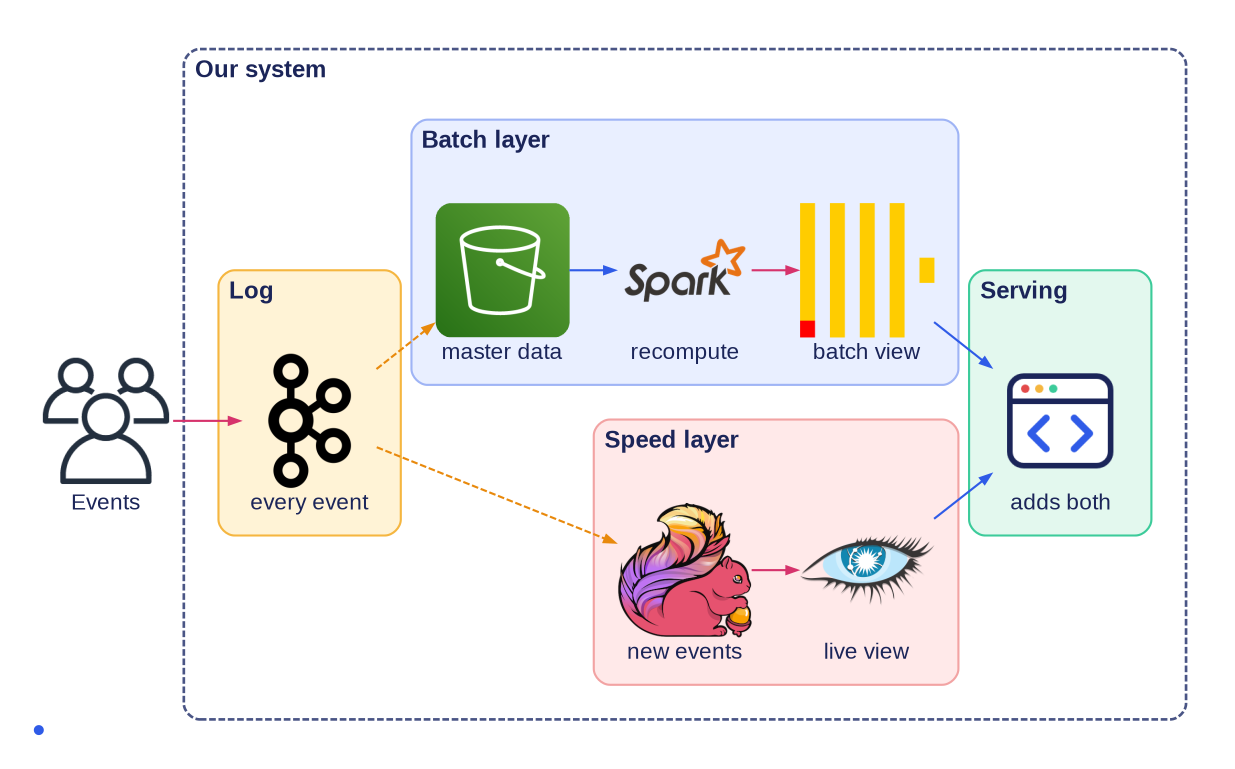
Batch layer
Complete and exact views from all the data. Slow: nightly or hourly.
Speed layer
Views of the newest events within seconds. Temporary, and may be approximate.
Immutable data
The master data is only appended to. A correction is a new event.
Recomputation
Views are thrown away and built again from the start.
Batch layer
All the data, again and again
| Part | What it does | Properties |
|---|---|---|
| Master data | Stores all raw events ever received, on HDFS or object storage | Append only, the source of truth |
| Batch job | Reads it with MapReduce or a dataflow engine | Same code each time, can be repeated |
| Batch view | Holds totals and indexes ready to be read | Replaced as a whole by each run |
One batch run
- 1
Read
All events before the cutoff from the master data.
- 2
Compute
Filter, group and count in parallel.
- 3
Write
The new view next to the old one.
- 4
Swap
The view and its cutoff together, in one step.
What a full run costs
Speed layer
Only the gap
The speed layer covers the time from the last cutoff to now. It uses stream processing with windows and gives results within seconds. It may use approximate algorithms, because the batch layer overrides its results later. Marz calls this property eventual accuracy.
Who covers which time
How long is the gap?
Serving layer
Adding the two
def query(day_totals, cutoff, live_events): """Batch before the cutoff, live from the cutoff on.""" return sum(day_totals.values()) + sum(n for t, n in live_events if t >= cutoff)print(query({"Mon": 800}, cutoff=24, live_events=[(23, 5), (25, 50), (30, 230)]))| Question | Read from |
|---|---|
| Last month | Batch view only |
| The last hour | Live view only |
| All time until now | Both, added |
The batch run and the swap
Mistakes
Repair by computing again
A wrong number was reported
Late events are handled in the same spirit. An event that arrives two days late is appended to the master data. If the job selects by event time and recomputes old days, it lands in the right place without special code.
Trade-offs
Strengths and weaknesses
Advantages
- Accurate and fresh together
- Raw data that cannot be damaged by a bug
- Can recompute when an error is found
- Late data is included by the next run
- The speed layer may fail and be repaired
Challenges
- The same logic in batch and in stream
- Two systems to operate
- A bug can be in either, or in the merge
- The boundary must be exact
- More machines and storage
The duplication problem
| Step | Batch code | Stream code |
|---|---|---|
| Read | files of a day | a topic, for ever |
| Filter | a filter on rows | a filter on events |
| Count | map to 1, reduce by key | key by, window, sum |
| Late data | not special | watermark, corrections |
| Finish | replace the view | update rows |
Practice
Good habits
Do
- Keep the master data unchanged
- Design views so that they can be rebuilt
- Be careful with expiry
- Make operations idempotent
- Monitor both pipelines
Do not
- Let the two codes drift apart
- Ignore late events
- Leave merged queries untested
- Assume the stream counts exactly once
- Run it without alerts
Alternatives
Do you need two roads?
Today a stream processor with checkpoints and event time can be exact by itself. Then the second road has less to add. Kappa architecture drops the batch layer and replays the log when something must be recomputed.
| Choice | Idea | Fits when |
|---|---|---|
| Lambda | Batch and stream, merged | The stream is approximate, or history is far too big to replay |
| Kappa | Stream only, replay the log | One exact stream job, and the log is long enough |
| One engine, two modes | The same program over files and topics | Beam or Flink fits your logic |
| Micro-batch only | A small batch every few minutes | Minutes are fresh enough |
Is Lambda worth it?
Numbers
A first estimate
100 million events a day, 200 bytes each (assumed)
| Question | Arithmetic | Answer |
|---|---|---|
| Average and peak rate | 100,000,000 / 100,000, then x 3 | 1,000 and 3,000 a second |
| Master data a day | 100,000,000 x 200 bytes | 20 GB |
| Master data in 3 years | 20 GB x 1,095 | 21.9 TB |
| Live view, 3 days of minutes, 10,000 keys | 4,320 x 10,000 x 50 bytes | 2.16 GB |
| Batch view, 3 years of days, 10,000 keys | 1,095 x 10,000 x 50 bytes | about 550 MB |
Summary
The whole topic in one minute.
Lambda sends every event to a batch layer and a speed layer. The batch layer is slow and exact, because it starts from all raw events each time. The speed layer fills the gap since the last batch run. A query adds the batch view and the live view at a stored cutoff.
Its strength is that mistakes are repaired by computing again. Its weakness is two implementations of the same rules. Modern stream processors and engines that handle both modes often make one pipeline enough, but the immutable raw data remains a good idea everywhere.
- Batch layer: all raw events, exact, late.
- Speed layer: only since the cutoff, quick, temporary.
- Serving layer: batch view plus live view.
- The cutoff is the last time the batch run read, not when it ended.
- Immutable raw data makes mistakes repairable.
- The price is two codes and two systems.