
The Facebook outage of 2021
medium 26 minOn 4 October 2021 a maintenance command took down every link of Facebook's backbone.
Video lesson · Chapter 1 of 5
The name that disappeared
The Facebook outage in 75 seconds
1:15Reel coming soon
Theory
Read or listen first. About 2 min.
What it is
On 4 October 2021 Facebook, Instagram, WhatsApp and the company's other products disappeared from the internet for hours. Nothing had been attacked and no data was lost. A command given during routine maintenance disconnected the company's backbone, the private network that joins its data centers.
Two more things turned that into a long outage. The company's name servers noticed that they could not reach a data center and stopped announcing their own addresses, so nobody could look up facebook.com. And the tools, and the out-of-band network, that engineers needed for the repair were down as well, so people had to travel to the buildings.
This page uses Facebook's two reports for what happened inside. Clock times come from Cloudflare, which watched from outside, because Facebook's reports give none.
Why it exists
It is one of the clearest public examples of a hidden shared dependency. Many copies of a service were running in many places, and all of them relied on one thing: the backbone.
It also shows that a sensible local rule can be harmful when every copy applies it at the same moment, and that a recovery plan must not need the thing that is broken. Those three ideas come up in almost every design discussion about availability.
A short history
November 1983
RFC 882 describes domain names: a distributed address book for the internet.
June 1989
RFC 1105 describes the Border Gateway Protocol, which networks use to tell each other what they can reach.
July 1997
RFC 2182 advises that the name servers of a zone should not all share the same location and the same path.
December 2006
RFC 4786 records good practice for anycast: one address announced from many places, with the announcement withdrawn when a place is unhealthy.
4 October 2021
Facebook's backbone goes down. The company publishes a first report the same day and a detailed one on 5 October.
Words to know
- Backbone
- A company's own long-distance network between its buildings.
- BGP
- Border Gateway Protocol: how networks announce which addresses can be reached through them.
- Prefix
- A block of addresses that is announced or withdrawn as one.
- Authoritative name server
- The server that holds the real answer for a domain name.
- SERVFAIL
- The DNS reply a resolver gives when it could not get an answer.
- Out-of-band network
- A separate path to equipment, for when the normal network is down.
- Blast radius
- How much breaks when one thing breaks.
How it works
Step through the idea, or press Play.
A command cuts the backbone. The audit tool that should stop it has a bug
Understand it
Start here
The lighthouse keeper
A keeper looks after a lighthouse on an island. One bridge leads there, and the board with the keys hangs on that same bridge. It is convenient every day, until the day the bridge is gone.
The lighthouse was never damaged. Everything that led to it was.
Background
How a request normally arrives
A normal day
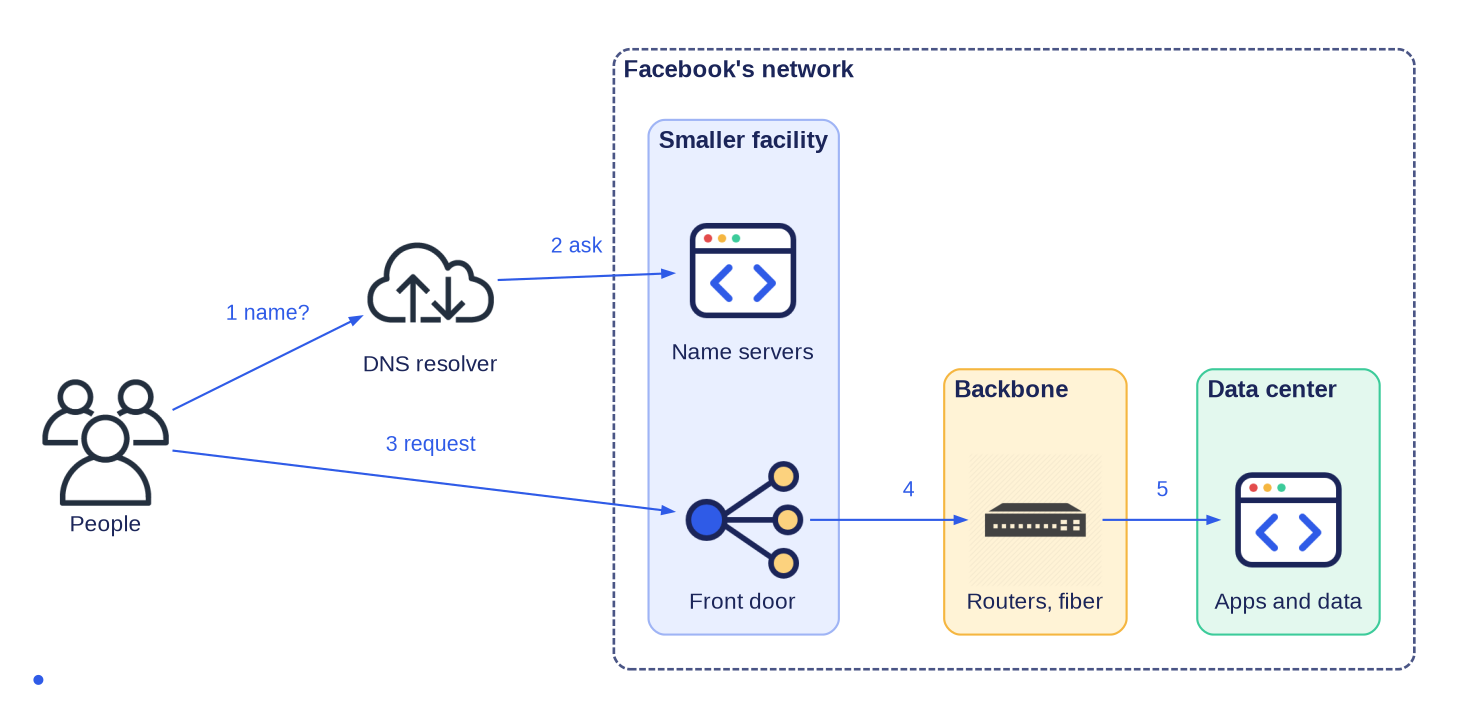
The report describes two kinds of building. Data centers hold millions of machines that store data and do the heavy work. Smaller facilities connect the backbone to the internet, and one of their jobs is to answer DNS questions. The backbone between them is tens of thousands of miles of fiber.
DNS finds the address
A resolver asks Facebook's name servers which address belongs to a name. See how DNS works.
BGP finds the way
Networks tell each other which addresses can be reached through them. If nobody announces an address, no packet can get there.
The backbone does the rest
The smaller facility passes the request to a data center over private links, and the answer comes back the same way.
Health decides
A name server that cannot talk to a data center stops announcing itself, so that healthy ones take over.
Opening the app on a normal day
What happened
The timeline
4 October 2021, UTC, seen from outside
| Time | Event | Reported by |
|---|---|---|
| no time given | A command during routine maintenance takes down all backbone connections | |
| about 15:40 | A peak of routing changes from Facebook: routes are withdrawn | Cloudflare |
| about 15:50 | facebook.com stops resolving on 1.1.1.1 | Cloudflare |
| 15:51 | Cloudflare opens an internal incident for SERVFAIL replies | Cloudflare |
| 15:58 | Cloudflare notices that routes to the name servers are gone | Cloudflare |
| no times given | Engineers travel to data centers, gain access, confirm the cause and restore the backbone | |
| about 21:00 | New routing activity from Facebook's network | Cloudflare |
| 21:17 | That activity peaks | Cloudflare |
| about 21:20 | facebook.com resolves again on 1.1.1.1 | Cloudflare |
| 21:28 | Facebook appears reconnected. Services take longer to return fully | Cloudflare |
How long the name was gone, and what that does to a yearly target
Cause 1
The command and the guard
Engineers often take part of the backbone offline to repair a fiber, add capacity or update a router. During one such job, a command was issued to assess the availability of global backbone capacity. It unintentionally took down all the connections. The company has a tool that audits such commands and stops dangerous ones. A bug in that tool let this one pass.
Two layers, and both gave way
A safer way to run the same job
| Guard | Question it answers | Would it have helped here? |
|---|---|---|
| Model the result first | Is every building still connected after this? | Yes, if it does not share code with the audit tool |
| Limit the reach | Can one command touch more than one region? | Yes: the damage stops at one region |
| Go in waves | Is the first wave healthy after ten minutes? | Yes, if waves are really separate |
| Automatic undo | If nobody confirms in time, put it back? | Yes: it works even when the operator has lost access |
| Test the guard | Does it still refuse known bad commands? | Yes: this finds the bug on a quiet day |
Cause 2
Why the names vanished
Everything is running, nothing can be reached
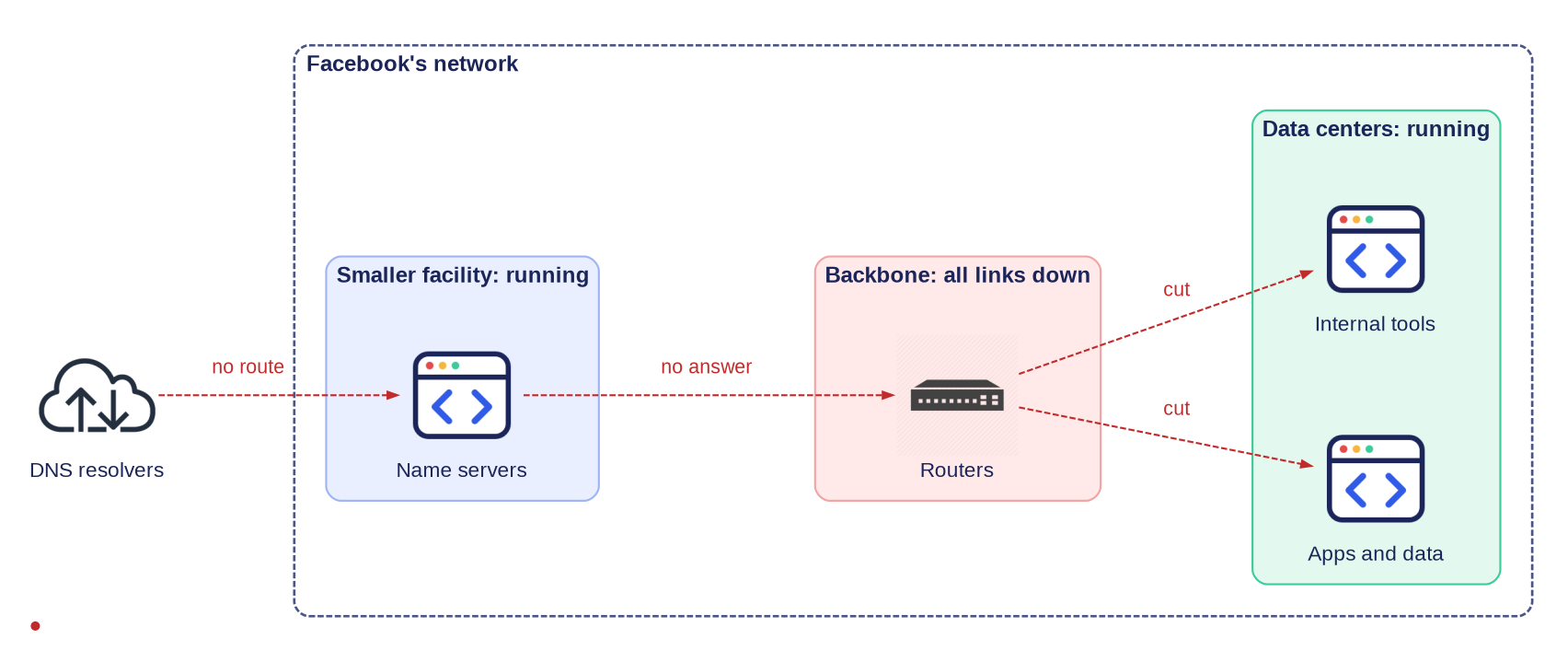
Name servers in the smaller facilities withdraw their BGP announcements when they cannot speak to the data centers, because that is a sign of an unhealthy network connection. When one facility is cut off, this rule is right: other facilities answer instead. This time the backbone was gone for all of them, so all of them withdrew.
One rule, every facility, the same minute
Why many copies did not help
The rule is right when
- One facility loses its links
- Other facilities still reach a data center
- Moving users away makes things better
The rule hurts when
- Every facility fails its check at once
- There is nobody left to take over
- Withdrawing also removes the error page and the repair path
Cause 3
Why it took hours
- 1
Normal access was down
The networks of the data centers were down, so nobody could log in the usual way.
- 2
Out-of-band access was down
The second path, meant for this situation, did not work either.
- 3
Internal tools were broken
Losing DNS broke many of the tools used to investigate and resolve outages.
- 4
Buildings are hard to enter
They are designed with high physical and system security, so it took time to activate the secure access protocols.
- 5
Routers are hard to change
Even with physical access, hardware and routers are designed to be difficult to modify.
- 6
Everything could not return at once
Data centers reported power dips of tens of megawatts each. A sudden return could harm anything from electrical systems to caches.
The report says this trade is worth it: strong day-to-day protection in exchange for slower recovery from a rare event. That is a fair choice to make on purpose. The design question is whether the rescue path can be both secure and independent.
The tools need what is broken
Effects
What others felt
| Who | What | Source |
|---|---|---|
| People and businesses | Facebook's products unreachable; the company apologised to everyone who depends on them | |
| User data | No evidence that data was compromised; no malicious activity | |
| Staff | Many internal tools and systems affected | |
| DNS resolvers | Resolvers were handling 30 times more queries than usual | Cloudflare |
| Other platforms | More DNS queries for Twitter, Signal and other services | Cloudflare |
The query flood is a thundering herd. Apps that do not accept an error keep asking, and people reload. A failed lookup costs the resolver more than a cached answer. Clients should back off and add jitter for DNS errors too.
Recovery
Coming back without falling over
Once the backbone was connected again, everything came back up with it, but services were not switched on all at once. The company had practised for years with storm drills: exercises that take a service, a data center or a whole region offline. No drill had ever removed the global backbone, and the report says they will look for ways to simulate that.
A staged return
Repair
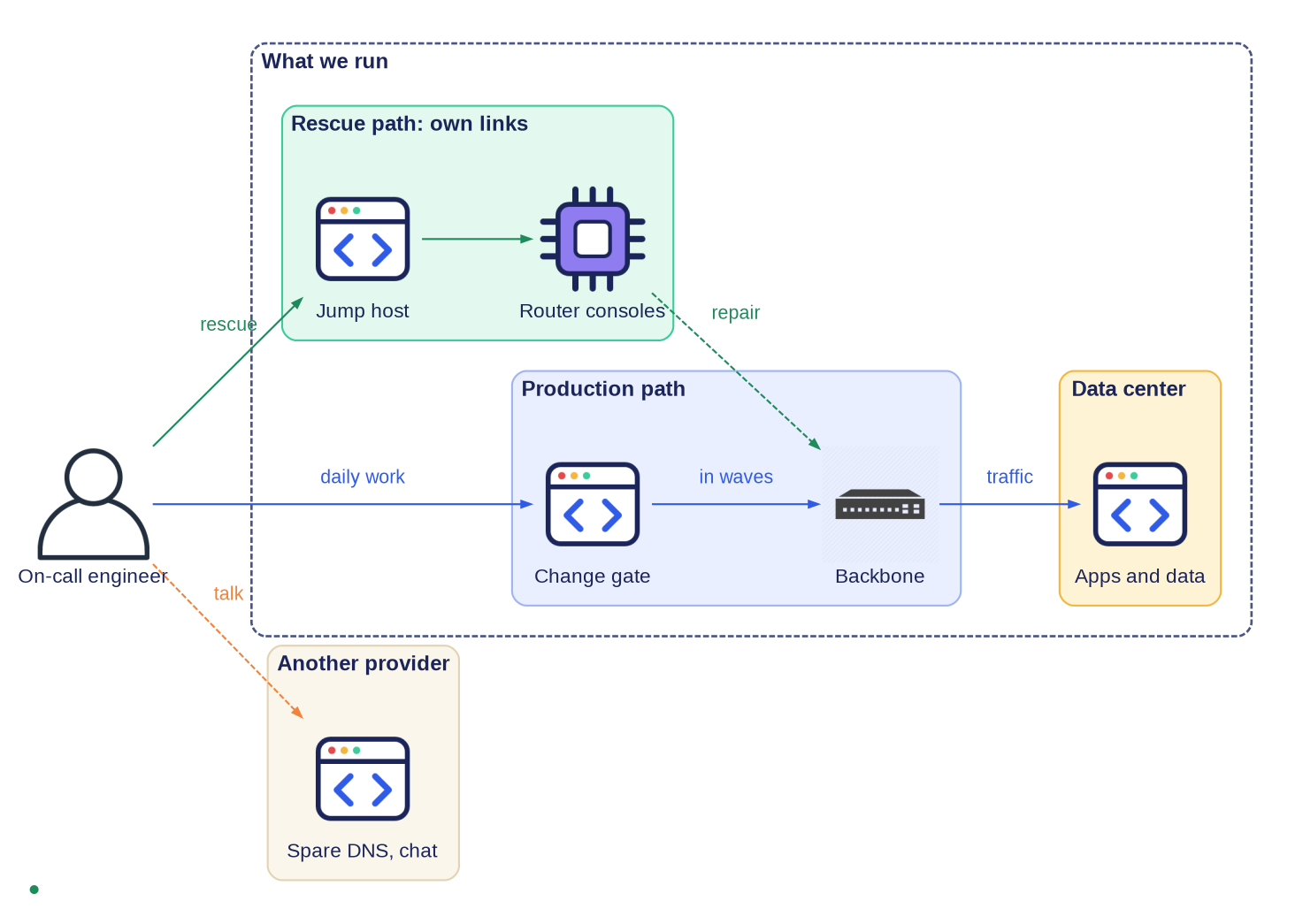
The design we would draw next
A second way in
Six lessons and what to change
| Lesson | Change | How to check it |
|---|---|---|
| Rescue access must be independent | Separate links, power, names and sign-in for management | Pull the main network in a drill and log in |
| One command must not reach everything | Regions as separate change domains, waves, automatic undo | Try a bad change in a lab copy; see how far it goes |
| Doors must open without the network | Local fallback for access to buildings and consoles | Run the procedure with the network unplugged |
| Names need an independent copy | Some name servers on other networks, as RFC 2182 advises | Resolve your domain with your own network filtered out |
| Talk on something else | A chat and phone bridge outside production, with printed numbers | Use it once a month |
| Degrade instead of vanishing | Fail open when every copy fails its check; serve a static page | Fail all health checks in a test and watch |
Prefer
- Management network with its own links
- Several routes with safeguards
- Name servers on more than one network
- Dry run, waves, undo timer
Avoid
- All tools on the network they repair
- One change system for the whole world
- All name servers behind one backbone
- A guard that is never tested
Use it
Ask these about your own system
- 1
If the network is gone, how do I log in?
Write the steps. If any step needs DNS, single sign-on or chat from production, it fails.
- 2
What do all copies share?
Network, names, configuration, clock, sign-in, deployment. Shared things decide your real availability.
- 3
What does each copy do when its check fails?
Then ask what happens if every copy does that in the same second.
- 4
How far can one command reach?
If the answer is everywhere, split it.
- 5
When did we last see the guard refuse something?
A guard that never says no is untested.
- 6
How do we turn everything back on?
Know your step size for power, caches and connections.
Summary
The whole topic in one minute.
A maintenance command meant to assess backbone capacity took down all backbone links. An audit tool should have stopped it, but a bug let it through. Every smaller facility then lost contact with the data centers, judged itself unhealthy and withdrew the routes to its name servers. The servers were running, and nobody could find them.
Repair was slow because normal access, out-of-band access and many internal tools were down, and because buildings and routers are deliberately hard to get into. Power and traffic were then brought back in steps. The lessons: test the guard, limit how much one command can reach, beware of rules that every copy obeys at once, and keep a way in that shares nothing with production.
- A maintenance command took down all backbone links; a bug in the audit tool let it through.
- Name servers withdrew their routes as designed, all at once, so the names vanished while the servers ran.
- Normal access, out-of-band access and many tools were down, so people went to the buildings.
- Copies do not help against a cause they share.
- Keep a tested rescue path that shares nothing, limit the reach of changes, and return in steps.