
Design a podcast hosting platform
medium 45 minCreators upload episodes; thousands of apps we do not control find and download them through one public file, the feed.
Video lesson · Chapter 1 of 5
A podcast upload stalls inside a train tunnel
Theory
Read or listen first. About 2 min.
What it is
A podcast hosting platform stores the episodes of a show and publishes a feed: an XML file in RSS format that lists them. Podcast apps check the feed, see a new episode and download its audio file.
The platform does not own the player. The feed is the product: if it is correct, the episode appears in many apps; if it is broken, it appears in none. And because others play the audio, the platform counts downloads, not listening.
This page is an exercise, inspired by services such as Buzzsprout, Libsyn and Spotify for Creators. It does not describe any company's system.
Why it exists
A creator wants to upload once and be found everywhere, without agreements with each app. An open file that everybody may check makes that possible.
The work behind it is hard to do alone: large uploads on weak networks, equal loudness, petabytes of traffic, and numbers that sponsors believe.
A short history
December 2000
RSS 0.92 adds the enclosure element, which lets a feed point at a media file.
August 2002
RSS 2.0, the version that podcast feeds still use.
February 2004
Ben Hammersley suggests the word podcasting in The Guardian.
June 2005
Apple adds podcasts and a directory to iTunes 4.9.
December 2017
IAB Tech Lab publishes version 2.0 of its podcast measurement guidelines. Version 2.3 followed in September 2026.
2024
Google Podcasts closes. Feeds keep working in other apps, because nobody owns the list.
Words to know
- RSS feed
- An XML file with facts about a show and an item for each episode.
- Enclosure
- The part of an item that gives the audio's URL, length in bytes and type.
- GUID
- An episode's permanent name. If it changes, apps see a new episode.
- Byte range
- A request for part of a file, such as bytes 0 to 999,999.
- Conditional request
- Give me the file only if it changed: ETag and 304.
- LUFS
- A unit of perceived loudness over a whole recording.
- Download
- A counted event: enough bytes for one minute of content, once in a time window.
- Dynamic ad insertion
- Choosing ads when the file is requested.
Solve it like an interview
New to it? Start with Approach. Revising? Go straight to the mock.
- 1ApproachWhat this question tests, where it gets hard, and how to spend the time.
- 2ScopeAsk what changes the design, then commit to a short list.
- 3NumbersWork out a number when the answer changes what you build.
- 4API and dataThe contract first, then the data that serves it.
- 5DesignStart with the smallest system that works. Change it only when something breaks.
- 6Deep divesCompare the options before you open them, then say which you would pick.
- 7Explain your choicesAnswer first. Then compare your reasoning.
- 8By levelThe same question is judged differently for mid, senior and staff.
- 9MockAnswer against the clock, then score yourself.
Understand it
One list on a door, many players that check it, and a clerk who counts fairly.
Scope
What are we building?
Upload and process episodes, publish feeds, deliver audio, schedule releases, and count downloads. An embedded player and several shows for each account are small additions. Video, live shows, discovery and comments are out.
Upload
Large files that continue after a break.
Feed
One correct file that many apps read.
Deliver
28.8 PB a month, from the edge.
Count
Downloads that a sponsor can trust.
The finished system
Where the design ends up
The whole system
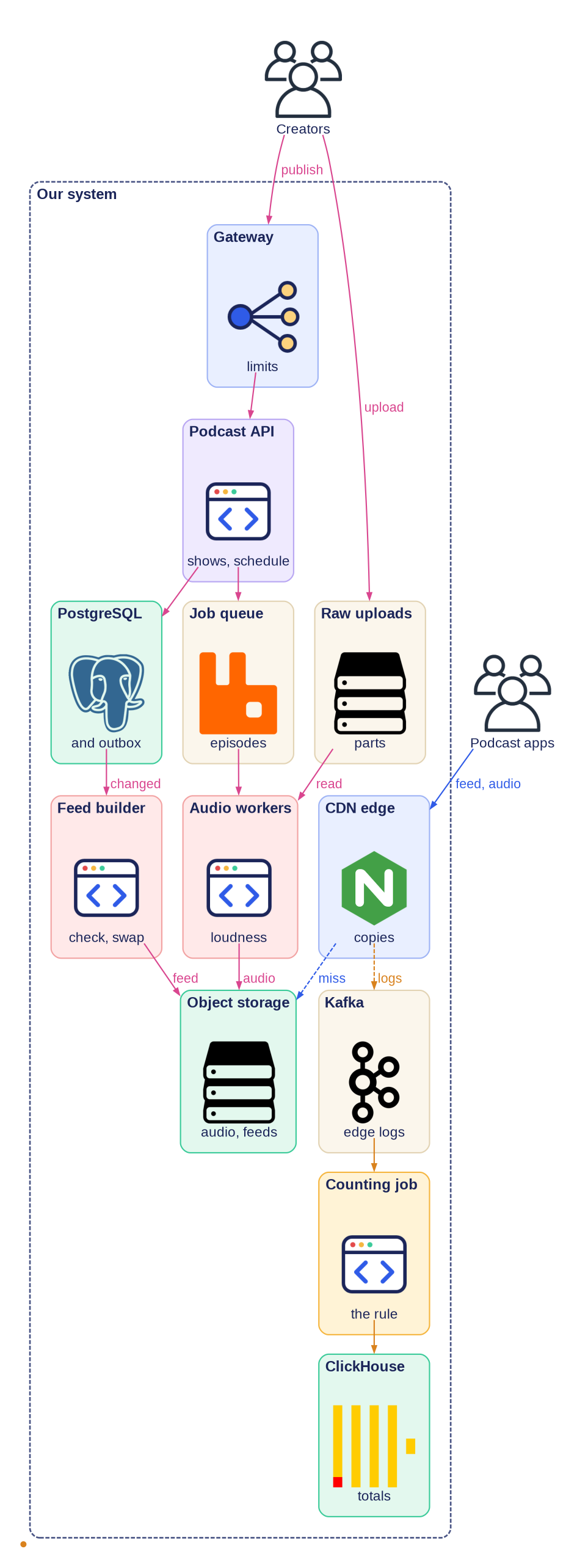
Podcasts next to music streaming
| Question | Podcast host | Music service |
|---|---|---|
| Who owns the player? | Others | We do |
| How is audio fetched? | One file, often ahead of time | Small pieces, several qualities |
| What can be counted? | Downloads | Plays, skips, seconds |
| What lasts? | URLs and GUIDs in other people's apps | Our own manifest, changed any time |
| Who pays? | Creators | Listeners |
Ideas and where they are explained
| Idea here | Concept page |
|---|---|
| Uploads in parts | File upload APIs |
| Audio at the edge | CDN and invalidation |
| Where files live | Object storage |
| Jobs that may run twice | Queues and idempotency |
| Events after a commit | Change data capture |
| Counting a stream | Stream processing |
| One service or many | Microservices and monolith |
Continue in the Interviews tabs: Approach, Scope, Numbers, API and data, Design, Deep dives, Explain your choices, By level and Mock.
Summary
The whole topic in one minute.
Uploads go straight to storage in parts. A queue gives each episode to a worker, which checks it, evens out the loudness and writes one file to serve. A database transaction publishes the episode, and a builder writes, checks and swaps the feed.
Apps read feeds and audio from a CDN. Its logs become counts: enough bytes for a minute, once for each address, app and episode in 24 hours, without robots. Private feeds and changing ads are the hard additions, because they break caching.
- The feed is the product: check it, then swap it.
- GUIDs and enclosure URLs never change.
- Bytes go from storage to edge to app; services carry text.
- A download is a rule, not a request.
- Ads chosen per request must stay the same for every range of that download.
Sources
- RSS Advisory Board: RSS 2.0 specification
- Apple Podcasts: RSS feed requirements
- Apple Podcasts: audio requirements
- Apple Podcasts: change the RSS feed URL
- IAB Tech Lab: podcast measurement guidelines
- Podcast namespace
- W3C: WebSub
- RFC 5005: feed paging and archiving
- tus resumable upload protocol
- Amazon S3: multipart upload limits
- Wikipedia: History of podcasting (dates)