
Neo4j
medium 25 minNeo4j is a graph database.
Video lesson · Chapter 1 of 5
Who is Ana's grandchild?
Neo4j in 75 seconds
1:15Reel coming soon
Theory
Read or listen first. About 2 min.
What it is
Neo4j stores a property graph. A node is a thing, such as a person or an account. A relationship joins two nodes, has exactly one type and one direction, and may hold properties of its own. A label groups nodes of one kind.
The links are part of the stored data. From one node, the database can step to its neighbours without searching the rest of the graph. You describe the pattern you want in a language called Cypher, and the planner decides how to find it.
Why it exists
In a relational database a link is a matching value, found again by a join each time you ask. One or two joins are fine. A question such as "which accounts are within five steps of this one, through any shared phone or address" needs a join per step and gets hard to write and slow to run.
A graph database makes such questions short, and their cost depends on the part of the graph you touch rather than on the size of all tables. The price is that work without a starting point, such as a total over every node, gains nothing, and that a connected graph is hard to split over machines.
A short history
2007
Neo Technology is founded in Sweden and the database, which began inside a content management product, becomes an open source project.
2010
Neo4j 1.0 is released.
2011
Neo4j engineers create Cypher, a language that draws the pattern to find, as an SQL-like language for graphs.
2018
From version 3.5, Enterprise Edition becomes commercial only and its source is no longer published. Community Edition stays under GPLv3.
2024
GQL, the graph query language standard ISO/IEC 39075, is published. Cypher accommodates most of its mandatory features.
2025
Version numbers follow the calendar from 2025.01. Cypher 25 arrives with 2025.06. Property sharding, part of Infinigraph, is introduced in 2025.12.
Words to know
- Node
- A thing in the graph. It has an identity, labels and properties.
- Relationship
- A stored link between two nodes, with one type and one direction.
- Property graph
- A graph whose nodes and relationships both carry named values.
- Traversal
- Walking from node to node along relationships.
- Anchor
- The node or nodes where a query starts, usually found with an index.
- Cardinality
- How many rows a step of the plan produces. Growth here is what makes a graph query slow.
- Dense node
- A node with very many relationships, such as a country or a celebrity.
- Bookmark
- A token for a committed state. A later read that carries it waits until the server has caught up.
How it works
Step through the idea, or press Play.
Anchor. An index finds the starting node by a key
Understand it
Start here
The embroidered family tree
Imagine a cloth where every person in a family is a sewn patch, and coloured threads join the patches. To find Ana's grandchildren you do not read a book of names again and again. You put a finger on Ana and follow the thread.
The cloth can hold thousands of patches. Ana's question still touches three.
The product
What you get, and under which licence
Ways to run it, checked November 2026
| Community Edition | Enterprise Edition | Aura | |
|---|---|---|---|
| Licence | GPLv3, open source | Commercial, closed parts | Managed service |
| Servers | One instance | Cluster with failover | Run for you |
| Backup | Offline dump and load | Online backup too | Run for you |
| Default store format | aligned | block | Not your choice |
| Constraints | Uniqueness | Also existence, key and type | Check your tier |
Two ports matter. Drivers speak the Bolt protocol on port 7687. The HTTP interface and browser listen on 7474. The query language has versions too: databases created on 2026.02 or later get Cypher 25 by default, while older ones stay on Cypher 5 unless you change the setting.
Model
Nodes, relationships and what becomes which
A small fraud graph
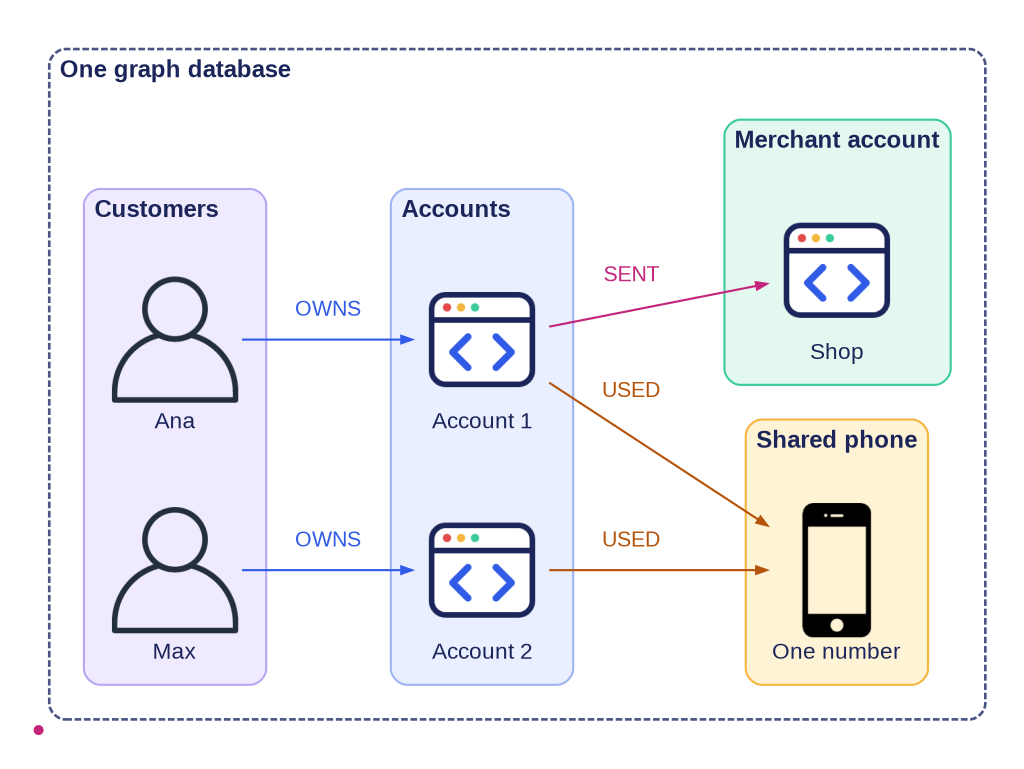
Turning a whiteboard into a model
| You have | Make it | Because |
|---|---|---|
| A thing you look up or arrive at | A node with a label | You can anchor on it and walk through it |
| A verb between two things | A relationship | It becomes one step |
| A fact about the verb, such as an amount or a date | A relationship property | It can be filtered during the walk |
| A value many things share, such as a phone | A node | Shared values are the links fraud teams look for |
| A value nobody else shares, such as a birth date | A property | A node would add a hop and say nothing |
| A verb with many parties or its own history | A node in the middle | A relationship has exactly two ends |
Inside
Why a step does not need an index
The idea is often called index-free adjacency: a node's record leads to its relationships, and each relationship leads to the node at the other end. An index is needed once, to find the anchor. After that, the next node is found from the current one.
One query, two kinds of access
Store formats
| Format | Where | How it stores | Node limit |
|---|---|---|---|
aligned | Default in Community | Records linked like lists on disk | 2^35, about 34 billion |
block | Enterprise, default for new databases since 5.22 | Properties in blocks with their nodes, so fewer pages are read | 2^48 |
standard, high_limit | Deprecated since 5.23 | Older record formats | Migrate away |
How far does a walk spread?
Language
Cypher in ten minutes
Cypher draws the pattern. Round brackets are nodes and arrows with square brackets are relationships. Always pass values as parameters, with a dollar sign, so that plans are reused and input cannot become code.
// 1. Keys first: a constraint also creates the index that backs itCREATE CONSTRAINT person_id IF NOT EXISTSFOR (p:Person) REQUIRE p.id IS UNIQUE;// 2. Write once, even if the request is repeatedMERGE (a:Person {id: $from})MERGE (b:Person {id: $to})MERGE (a)-[r:FOLLOWS]->(b)ON CREATE SET r.since = datetime();// 3. People followed by those I follow, whom I do not follow yetMATCH (me:Person {id: $id})-[:FOLLOWS]->(:Person)-[:FOLLOWS]->(other:Person)WHERE other <> me AND NOT (me)-[:FOLLOWS]->(other)RETURN other.id, count(*) AS pathsORDER BY paths DESC LIMIT 10;// 4. A bounded path: one to four stepsMATCH (a:Person {id: $id})-[:FOLLOWS]->{1,4}(b:Person)RETURN DISTINCT b.id LIMIT 100;// 5. The shortest connectionMATCH p = SHORTEST 1 (a:Person {id: $a})-[:FOLLOWS]-+(b:Person {id: $b})RETURN length(p);MERGE matches the whole pattern or creates the whole pattern, which is why each node is merged on its key before the relationship is.How to read a slow query
- 1
PROFILE it
EXPLAINshows the plan.PROFILEruns it and shows the rows and the database hits of every step. - 2
Check the anchor
A
NodeIndexSeekor unique seek is good.AllNodesScanor a label scan means a missing index or a missing label. - 3
Find the growth
Look for the step where rows jump. That expansion needs a type, a direction, a filter or a lower depth.
- 4
Cut duplicates early
WITH DISTINCTbefore the next expansion, andLIMITbefore collecting.
Speed
Indexes and constraints
Range
Equality, ranges, prefixes and ordering. The everyday index for keys and dates.
Text and point
Text for string predicates such as contains and ends with. Point for places and distances.
Token lookup
Finds nodes by label and relationships by type. Two exist when a database is created: keep them.
Full-text and vector
Search indexes backed by Apache Lucene. Vector search is approximate, for meaning and similarity.
A uniqueness constraint does two jobs: it protects the data, and it makes MERGE on that key fast and safe when two requests arrive together. The vector index lets a retrieval system find similar text and then walk to related facts, which people call GraphRAG. Word search itself belongs to full-text search.
Transactions
ACID, locks and lost updates
All access runs in ACID transactions. The default is read committed: a reader does not block a writer. Writers lock the nodes and relationships they change. Creating or deleting a relationship also involves the nodes at its ends, so many writers attaching links to one popular node queue up behind each other. What the levels allow is explained in isolation levels.
Safe
SET n.count = n.count + 1in one statement: the write lock is taken first- Take a lock on one agreed node before a read-then-decide
- Driver transaction functions, which retry transient errors
- Work that is safe to repeat
Risky
- Read the value, compute in the application, write it back
- Updating the same two nodes in different orders: deadlock
- Loading ten million rows in one transaction: changes are held in memory
- Calling a payment service inside a retried function
A deadlock and its retry
Growth
Clusters: primaries, secondaries and bookmarks
One database in a cluster
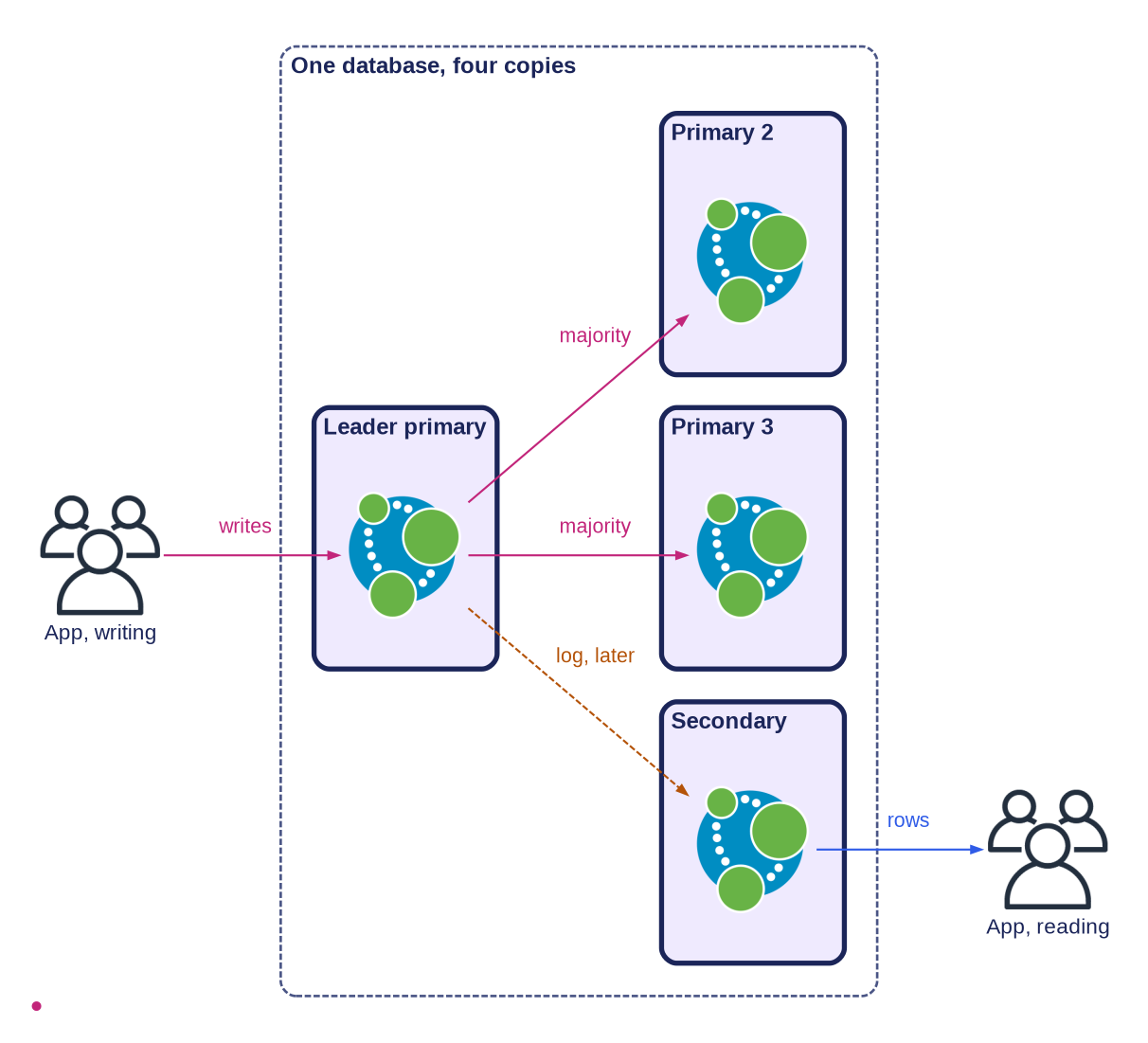
How many primaries?
Reading your own write
Ways to grow
| Need | Move | Limit |
|---|---|---|
| More memory for the hot part | Scale up | The largest machine |
| More reads | Secondaries | They lag; each holds a full copy |
| Separate tenants or regions | One database each, queried together as a composite database | Relationships cannot cross databases |
| Huge property volume | Property sharding (Infinigraph) | Separate subscription; the graph shard holds all nodes and relationships |
| More writes | Smaller transactions, fewer hot nodes, split databases | One leader per database |
Operations
Memory, loading, backup and monitoring
- 1
Set memory explicitly
The page cache holds graph data, the heap runs queries and holds transaction state. Defaults are guesses made at startup; the manual recommends setting both, and leaving room for the operating system. Vector indexes use memory outside the page cache.
- 2
Load in the right tool
First load of billions: the offline
neo4j-admin database import. Regular loads: batches withUNWIND $rows, orCALL { ... } IN TRANSACTIONS. - 3
Back up and restore
Enterprise has online backup. Community stops the database and dumps it. A secondary is not a backup: a wrong delete is copied to it.
- 4
Watch
Page cache hit ratio, heap and garbage collection pauses, slow query log, checkpoint time, secondary lag and the number of open transactions.
Keeping the graph in step with the system of record
Decide
When to choose it, and when not
Choose it when
- Questions walk three or more steps, or an unknown number
- The path itself is the answer: fraud rings, access rights, dependencies
- Relationships change often and have facts of their own
- Anchored queries touch a small neighbourhood
Do not when
- Queries are lists, filters and one join
- You total a billion rows: use a column store such as ClickHouse
- Writes far exceed one leader
- A graph library in memory, run once a night, is enough
Alternatives
| Choice | Better when | Weaker when |
|---|---|---|
| PostgreSQL with recursive queries | One or two hops, data already there | Deep patterns and path conditions |
| Adjacency lists in a key-value store | Only "who are the neighbours", at enormous scale | Anything past two hops is your own code |
| Another graph database | You need a managed cloud service or another licence | Cypher dialects and features differ |
| A graph algorithm library | Batch ranking and communities | Live transactional queries |
Cost has three parts: memory for the hot graph, the licence if you need failover or online backup, and a second data model your team must feed and operate. For a first version, recursive SQL on the database you already run is often the honest answer.
Summary
The whole topic in one minute.
Neo4j keeps links as data. A query finds one or a few anchor nodes through an index and then follows relationships, so the cost is the number of steps it takes and not the size of the database.
Model the links you will walk as relationships with clear types, put a uniqueness constraint on every lookup key, bound the depth of paths and beware of dense nodes. Writes go to one leader per database and need a majority of primaries. Reads scale with secondaries and stay causally consistent with bookmarks.
- Links are stored, so a step follows data and needs no join.
- Find the anchor with a constraint or index, then expand by type and direction.
- Bound every path. Work grows as degree to the power of hops.
- Dense nodes hurt reads through fan-out and writes through locks.
- Community is one GPLv3 instance. Clusters and online backup are Enterprise.
- One leader per database: 2F + 1 primaries, secondaries for reads, bookmarks for your own writes.