
Envoy
medium 28 minEnvoy is an open source network proxy that runs at the edge or beside every service.
Video lesson · Chapter 1 of 5
One request chooses a cluster
Envoy in 90 seconds
1:30Reel coming soon
Theory
Read or listen first. About 2 min.
What it is
Envoy is a proxy written in C++. It accepts connections, runs them through a chain of filters, picks one server out of a group, and passes the request on. At its core it works on bytes and connections (layers 3 and 4); an HTTP layer on top understands requests, headers and gRPC.
It is built to be told what to do by another program. Addresses, routes, listeners and certificates can all arrive through streaming APIs called xDS, so a change needs no file edit and no restart.
It is a building block. Service meshes such as Istio and gateways such as Envoy Gateway are control planes that write Envoy configuration for you.
Why it exists
A company with many small services has the same network problems in every one of them: find the other service, balance, time out, retry, encrypt, measure. Solving these in a library means one library per programming language and a new release of every service for each upgrade.
Envoy moves that work into a separate process next to the service. The program calls its local proxy in plain HTTP, and the proxy does the hard part the same way for Java, Go, Python and PHP.
A short history
2015
Work starts at Lyft in the summer. By late autumn it carries all of Lyft's edge traffic, as its author later described.
September 2016
Version 1.0.0: Lyft publishes Envoy as open source.
September 2017
Envoy joins the Cloud Native Computing Foundation as an incubating project.
November 2018
It becomes a graduated CNCF project.
October 2026
Version 1.40.0. Releases come once a quarter and are maintained for about a year.
Words to know
- Downstream and upstream
- Downstream is who called Envoy; upstream is whom Envoy calls.
- Listener
- An address and port that Envoy accepts connections on.
- Filter
- A small step in a chain that can read, change, answer or stop traffic.
- Cluster
- A named group of servers that can do the same job.
- Endpoint
- One server of a cluster.
- Sidecar
- A proxy that runs next to one copy of one service.
- Data plane and control plane
- The proxies that carry traffic, and the program that tells them how.
- xDS
- The family of discovery APIs through which configuration arrives.
How it works
Step through the idea, or press Play.
Accept. A listener takes the connection and picks a filter chain
Understand it
Start here
The personal interpreter
Imagine a market where the traders speak many languages. You could learn all of them. Or somebody who already knows them could walk beside you all day.
The traveller stays simple. The interpreter is the same for every traveller.
The idea
A proxy beside every service
Two sidecars and a control plane
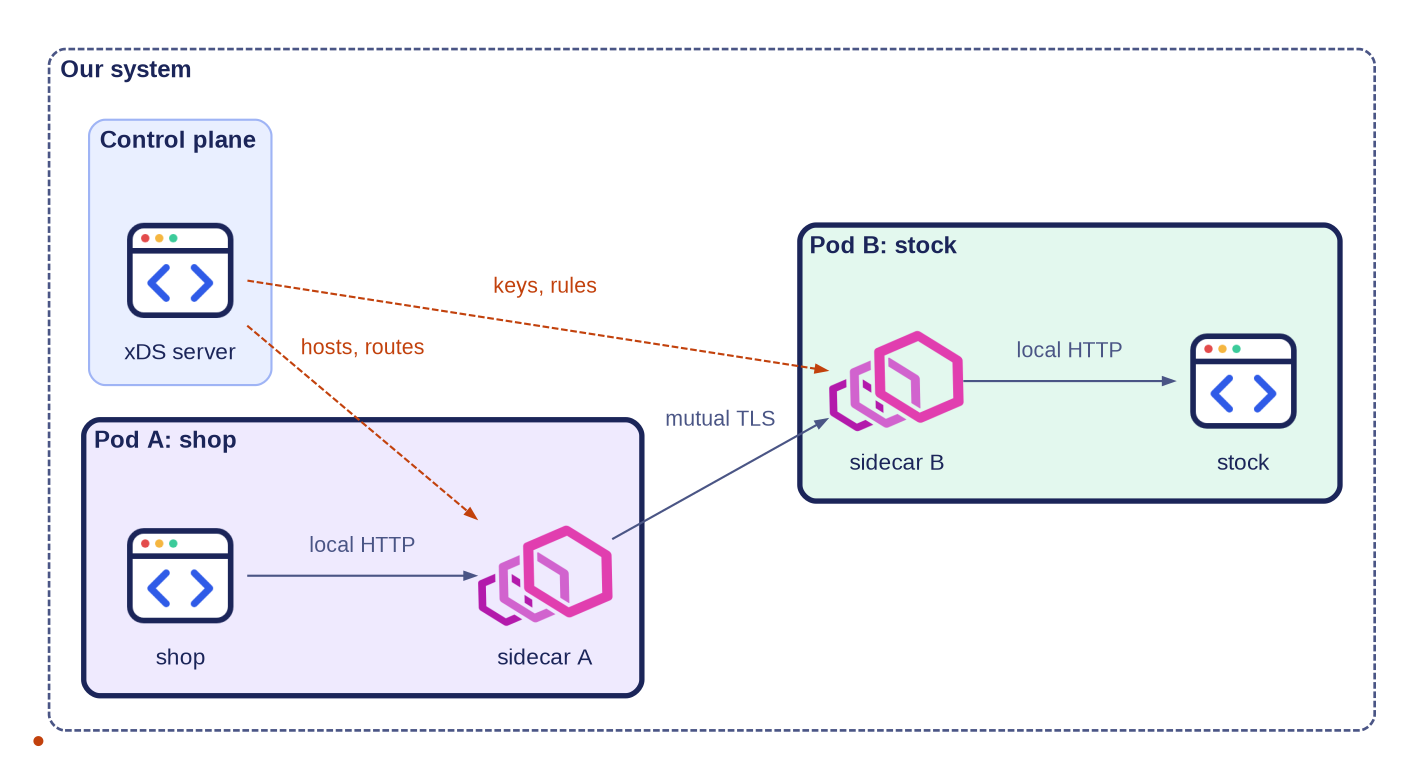
Any language
The program makes a local call. Network rules live in the proxy.
Dynamic
Endpoints, routes, listeners and secrets change over a stream, without a restart.
Resilient
Timeouts, retries, circuit limits, health checks and ejection in one place.
HTTP/2 and gRPC
Both sides, in any mix with HTTP/1.1. HTTP/3 is supported too.
Observable
Counters and timings for every cluster, access logs and traces.
Extensible
Filters in C++, Lua, WebAssembly, dynamic modules or an outside service.
The ideas have their own pages: service discovery, L4 and L7 balancers, circuit breaker, retries and microservice communication. This page is about how the product does them.
Placement
Where it stands
Three places for the same program
Do you need it, and where?
Linkerd is a mesh that does not use Envoy but its own small proxy. That is a fair comparison point: less general, less to learn.
Inside
One main thread, many workers
Inside one process
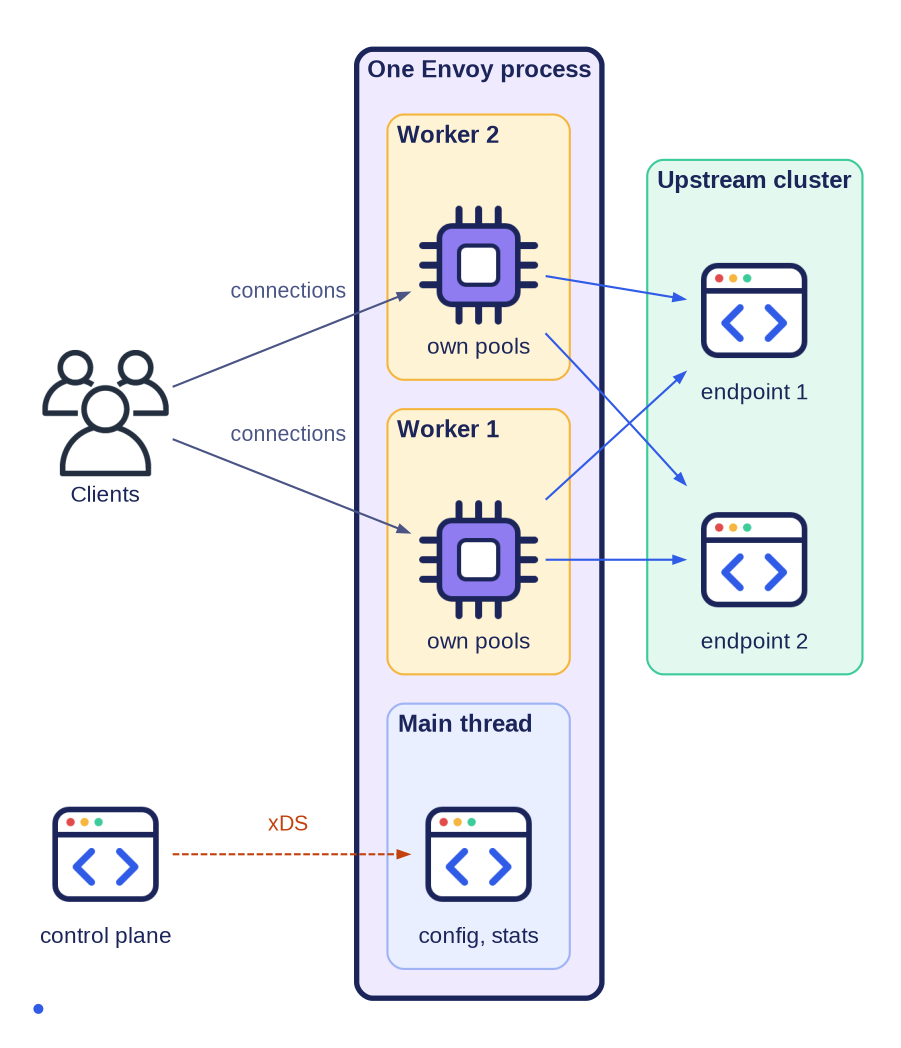
The main thread loads configuration, gathers statistics and serves the admin page. Workers carry traffic, rarely share state, and take no locks for it. The number is set with --concurrency; by default, on Linux, it is the smallest of the hardware threads, the CPU affinity and the CPU limit of the container, so a two-core pod on a 64-core machine starts two workers. Without a CPU limit it would start 64.
Connections add up per worker
Objects
Listener, filter, route, cluster, endpoint
How the objects point at each other
static_resources: listeners: - name: web address: { socket_address: { address: 0.0.0.0, port_value: 8080 } } filter_chains: - filters: - name: envoy.filters.network.http_connection_manager typed_config: "@type": type.googleapis.com/envoy.extensions.filters.network.http_connection_manager.v3.HttpConnectionManager stat_prefix: web route_config: name: main virtual_hosts: - name: all domains: ["*"] routes: - match: { prefix: "/stock/" } route: cluster: stock timeout: 2s retry_policy: retry_on: connect-failure,refused-stream,unavailable num_retries: 1 http_filters: - name: envoy.filters.http.router typed_config: "@type": type.googleapis.com/envoy.extensions.filters.http.router.v3.Router clusters: - name: stock type: STRICT_DNS connect_timeout: 1s lb_policy: LEAST_REQUEST load_assignment: cluster_name: stock endpoints: - lb_endpoints: - endpoint: address: { socket_address: { address: stock, port_value: 9000 } }admin: address: { socket_address: { address: 127.0.0.1, port_value: 9901 } }envoy --mode validate -c envoy.yaml.Ways to find the endpoints of a cluster
| Type | Where addresses come from | Use it when |
|---|---|---|
STATIC | Written in the configuration | Tests, fixed machines |
STRICT_DNS | Every address of a DNS answer is an endpoint | Headless services, small setups |
LOGICAL_DNS | Only the first address, used when a new connection is needed | A large web service behind DNS |
EDS | A control plane streams them, with weights and zones | The preferred way in a mesh |
Request
The life of one request
Shop calls stock through two sidecars
- 1
Accept
A worker accepts. Listener filters may look at the first bytes, for example for the server name in the TLS hello, to choose a filter chain.
- 2
Decode
The HTTP connection manager turns bytes into requests, for HTTP/1.1, HTTP/2 or HTTP/3 alike.
- 3
Filter
Each HTTP filter sees the request in order: login check, rate limit, rewriting. Any of them may answer and stop the chain.
- 4
Route and balance
The router finds the cluster, the balancer an endpoint, the pool a connection.
- 5
Answer
The response passes the filters in reverse order. Statistics and the access log are written.
Control
xDS: configuration as a stream
The main discovery services
| API | Delivers | Changes how often |
|---|---|---|
| LDS | Listeners | Rarely |
| RDS | Route tables | With each rollout |
| CDS | Clusters | When services come and go |
| EDS | Endpoints of a cluster | All the time |
| SDS | Certificates and keys | At every rotation |
| ADS | All of them on one stream | Used to control the order |
Envoy answers each update with an ACK, or with a NACK that carries the error. After a NACK it goes on with what it had. The incremental form sends only differences. Separate streams are only eventually consistent with each other, so the protocol describes a safe order.
Make before break
Discovery says one thing, health checks another
| Discovery | Health check passes | Health check fails |
|---|---|---|
| Host is listed | Send traffic | Do not send |
| Host is missing | Send traffic | Do not send, then delete it |
Balancing
Choosing an endpoint
| Policy | Rule | Use it when |
|---|---|---|
| Round robin (default) | In turn, by weight | Hosts and requests are alike |
| Least request | Two random hosts, the one with fewer active requests | Request times differ. A good default |
| Ring hash | Consistent hashing on a ring | Cache servers; fewest keys move |
| Maglev | Consistent hashing with a fixed table of 65,537 places | As above, with faster lookups; about twice as many keys move |
| Random | Any host | Better than round robin when there are no health checks |
Around the policy: priorities (use level 1 only as level 0 gets weak), zone-aware routing (prefer the same zone) and subsets (only hosts with a label, such as a canary version). gRPC needs this kind of balancer, because a connection balancer would pin all calls of a long connection to one host.
Failure
Health checks, outliers and panic
- 1
Active checks
Envoy asks each endpoint on a timer, over HTTP, gRPC or TCP.
- 2
Outlier detection
Envoy watches real answers. By default five 5xx in a row eject a host for 30 seconds, then 60, then 90, up to 300.
- 3
A limit on ejection
max_ejection_percentis 10 by default, so a bad answer from a shared database cannot eject everybody. With 3 hosts, one host is already 33 percent, so nothing is ejected until you raise it. - 4
Panic
If fewer than 50 percent of hosts are healthy, Envoy sends to all of them again, healthy or not.
How long is a host out?
The state of one endpoint
Protection
Timeouts, retries and circuit limits
Defaults worth knowing
| Setting | Default | Note |
|---|---|---|
| Route timeout | 15 s | For the whole answer. Set 0 for streams |
| Stream idle timeout | 5 min | No bytes in either direction |
| Connect timeout | 5 s | Per cluster; too long inside one network |
| Retries | None | Must be configured; then 1 by default, with jittered back-off from 25 ms to 250 ms |
| Connections, pending, requests | 1,024 each | Per cluster, shared by the workers |
| Retries in flight | 3 | Per cluster; a retry budget replaces it |
Envoy's circuit breaking limits how much may be in flight. When the limit is reached it refuses at once, with 503 and the header x-envoy-overloaded. That protects a slow service from a queue. The classic open, half-open and closed states are closer to its outlier detection; see circuit breaker.
Why one layer retries
# part of a clustercircuit_breakers: thresholds: - max_connections: 2000 max_pending_requests: 200 max_requests: 2000 retry_budget: budget_percent: { value: 20 } min_retry_concurrency: 3outlier_detection: consecutive_5xx: 5 interval: 10s base_ejection_time: 30s max_ejection_percent: 34Rules
Rate limits, identity and the admin port
Local rate limit
A token bucket in this process; refusals are 429. Ten proxies allow ten times the rate, unless the bucket is shared out over the cluster.
Global rate limit
Envoy asks a separate rate limit service before passing on. One exact number, one more hop.
Mutual TLS
Both sides show certificates. SDS delivers and rotates them without a restart.
JWT and external checks
Filters verify tokens or ask your own service.
failure_mode_allowdecides what happens when it is down.
Operations
Running it
| Task | How | Watch |
|---|---|---|
| See what is wrong | Response flags in the access log: UH no healthy host, UO overflow, UT upstream timeout, NR no route | Share of requests with a flag |
| Check configuration | /config_dump, /clusters and /stats on the admin port | update_rejected counters |
| Change configuration | xDS; for files, a validated rollout | Old listeners drain their connections |
| Upgrade the binary | Rolling restart, or hot restart on one machine: the new process takes over the listening sockets | Existing connections are not moved, they drain |
| Stay supported | A release every quarter, fixes for about 12 months | Security releases in between |
What it costs. A sidecar per copy means memory, some CPU, and two proxy passes on every call. Measure both in your own system before and after; the number depends on request size, filters and TLS. Every copy also holds configuration, so limit what each one is sent: a sidecar that knows 2,000 clusters it never calls wastes memory 2,000 times over.
Decide
Envoy or something else
| Product | Strong at | Choose it instead when |
|---|---|---|
| NGINX | Files, cache, a small configuration | One front door, rare changes |
| HAProxy | Balancing TCP and HTTP with fine control | You want a balancer, not a platform |
| Traefik | Finds containers by itself, certificates included | A small team on Docker or Kubernetes |
| Kong | API products: keys, consumers, plugins | You publish APIs to customers |
| Istio | A mesh on top of Envoy | You want mesh features without writing xDS |
| A library such as gRPC | No extra process; gRPC itself can read xDS | One language, hard latency limits |
Strengths
- Same rules for every language
- Everything can change while it runs
- Deep statistics for every call
- HTTP/2 and gRPC on both sides
Costs
- Verbose configuration, hard to write by hand
- A control plane to run and protect
- One more process and hop per call
- No response cache for general use out of the box
Summary
The whole topic in one minute.
Envoy is a proxy made of filters. A listener accepts, filters inspect, the router picks a cluster, and a balancer picks an endpoint. A main thread handles configuration while worker threads, each with its own event loop, carry the traffic.
Its strength is that everything can change at run time through xDS, and that every service gets the same timeouts, retries, limits, encryption and numbers. Its price is a second process per service and a control plane to run. Know the defaults, keep retries in one layer with a budget, and keep the admin port private.
- Listener, filters, route, cluster, endpoint. The router is the last HTTP filter.
- Main thread for configuration, workers for traffic; a connection stays with one worker.
- xDS streams configuration. Add clusters first, move routes, remove last.
- Outlier detection ejects, circuit limits refuse, panic below 50 percent sends to all.
- Retries in one layer, with a budget. Route timeout is 15 seconds. Admin on localhost.
Sources
- Envoy: what is Envoy
- Envoy: life of a request
- Envoy: xDS protocol
- Envoy: service discovery and eventual consistency
- Envoy: outlier detection
- Envoy: circuit breaking
- Envoy: timeouts
- Envoy: configuring Envoy as an edge proxy
- Envoy: release process and support
- Matt Klein: 5 years of Envoy open source
- CNCF: Envoy
- Istio: architecture
- Dropbox: from Nginx to Envoy