
Traefik
easy 25 minTraefik (say "traffic") is a reverse proxy that configures itself.
Video lesson · Chapter 1 of 5
A shop appears without editing each proxy
Traefik in 90 seconds
1:30Reel coming soon
Theory
Read or listen first. About 2 min.
What it is
Traefik Proxy is a reverse proxy and load balancer written in Go, under the MIT licence. It stands at the edge, ends TLS, and passes each request to one of your services.
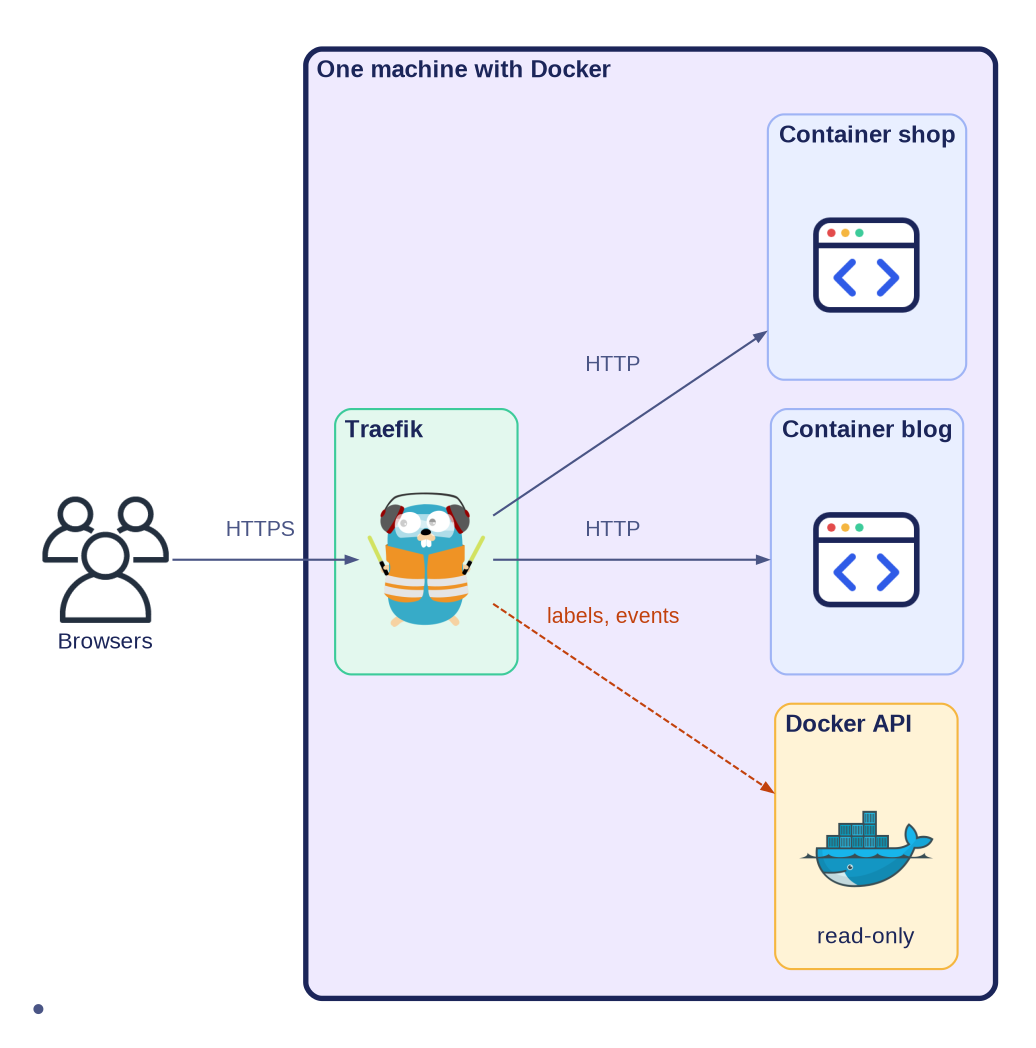
What makes it different is where its routes come from. It connects to providers such as Docker, Kubernetes, Consul or a file, reads what is running there, and updates its routes whenever that changes.
It separates two kinds of settings. The install configuration (which ports, which providers) is read at start. The routing configuration (which request goes where) arrives from the providers and changes without a restart or a lost connection.
Why it exists
In a container platform, addresses are short-lived. A copy starts, moves and stops many times a day. A proxy whose list of servers sits in a hand-written file is wrong most of the time, or somebody builds a script that rewrites the file and reloads it.
The platform already knows which containers run and where. So the proxy can ask it. A team then describes a route next to its own service, as a label or a resource, and nobody else has to act.
A short history
September 2015
The repository appears on GitHub.
July 2016
Version 1.0.0.
September 2019
Version 2.0.0 brings routers, middlewares and services, and TCP.
April 2024
Version 3.0.0.
November 2025
From 3.6 on, each minor version is supported for six months.
November 2026
Version 3.8.0. The 3.7 line from May 2026 also still gets releases.
Words to know
- Provider
- A source of routes: Docker, Kubernetes, Consul, a file and others.
- Entry point
- A named port, such as websecure on 443.
- Router
- A rule plus the middlewares and the service it leads to.
- Middleware
- A step between router and service: a limit, a login, a rewrite.
- Service
- A group of servers and how to balance over them.
- Label
- A key and value on a container. Traefik reads those that start with traefik.
- ACME
- The protocol by which certificates are issued automatically, for example by Let's Encrypt.
- Certificate resolver
- Traefik's setting for one way to get certificates.
How it works
Step through the idea, or press Play.
Watch. A provider reports what runs
Understand it
Start here
The signpost that repaints itself
Imagine a village with one signpost at the gate. Shops open and close every week. Who keeps the signpost right?
The shops look after their own signs. The post only copies them.
The idea
Ask the platform
One machine with Docker
Discovery
Docker, Swarm, Kubernetes, Nomad, ECS, Consul, etcd, Redis, files, HTTP and more.
Routing
By host, path, method, header, query and client address, combined with and, or, not.
Certificates
ACME with three kinds of proof, and automatic renewal.
Middlewares
Limits, retries, circuit breaker, login, headers, compression, redirects.
Protocols
HTTP/1.1, HTTP/2, HTTP/3, gRPC, WebSocket, plain TCP and UDP.
Sight
Dashboard, access logs, metrics and traces.
The general ideas have their own pages: service discovery, load balancing, Kubernetes load balancing and API gateway.
Model
Entry point, router, middleware, service
The path of a request
Two kinds of configuration
| Install configuration | Routing configuration | |
|---|---|---|
| Once called | Static | Dynamic |
| Contains | Entry points, providers, certificate resolvers, logs | Routers, middlewares, services, TLS options |
| Comes from | One of: a file, arguments, environment variables | The providers |
| Change it by | Restart | Nothing: it is watched |
services: traefik: image: traefik:v3.8 command: - --entrypoints.web.address=:80 - --entrypoints.web.http.redirections.entrypoint.to=websecure - --entrypoints.web.http.redirections.entrypoint.scheme=https - --entrypoints.websecure.address=:443 - --providers.docker=true - --providers.docker.endpoint=tcp://socket-proxy:2375 - --providers.docker.exposedbydefault=false - --certificatesresolvers.le.acme.email=ops@shop.example - --certificatesresolvers.le.acme.storage=/data/acme.json - --certificatesresolvers.le.acme.httpchallenge.entrypoint=web ports: ["80:80", "443:443"] volumes: ["le-data:/data"] networks: [edge, docker-api] shop: image: registry.example/shop:1 labels: - traefik.enable=true - traefik.http.routers.shop.rule=Host(`shop.example`) - traefik.http.routers.shop.entrypoints=websecure - traefik.http.routers.shop.tls.certresolver=le - traefik.http.services.shop.loadbalancer.server.port=8080 - traefik.http.services.shop.loadbalancer.healthcheck.path=/health networks: [edge]# socket-proxy: a small program that only lets Traefik read containers.# Add it as a service, and declare the networks edge and docker-api and the volume le-data.Discovery
From event to route
A container starts
Some providers
| Provider | Reads | Where a team writes its route |
|---|---|---|
docker, swarm | Containers or services and their labels | Compose file |
kubernetescrd | IngressRoute and other custom resources | Manifest of the service |
kubernetesgateway | Gateway API (standard channel) | HTTPRoute |
kubernetesIngressNGINX | Ingresses with ingress-nginx annotations | Nothing changes: a way to migrate |
consulcatalog, nomad, ecs | Services and their tags or labels | Service definition |
file | YAML or TOML, watched | A shared file |
How late can a route be?
Rules
Which router wins
Rules are combined with &&, || and !. Routers are tried from the highest priority down and the first match wins. Without a number, the priority is the length of the rule in characters. Long rules are usually more specific, so this often works, but not always.
Length decides, until you decide
| Rule | Characters | Tried |
|---|---|---|
| The exact host a.test | 14 | Third |
| A short HostRegexp for any name in .test | 28 | Second |
| The host and a path prefix /api | 36 | First |
What the status code tells you
Middlewares
Steps on the way
| Middleware | Does | Know this |
|---|---|---|
| rateLimit | Token bucket per source | average 0 means off, burst 1 by default; per instance unless you use Redis |
| retry | Tries again on failure | POST and PATCH only if you allow it |
| circuitBreaker | Opens on an expression | Checked every 100 ms, 10 s open, 10 s recovery; state per router |
| forwardAuth | Asks another service about each request | One more call per request |
| inFlightReq | Limits requests at the same time | Protects slow services |
| headers, stripPrefix, compress | Change the request or answer | Order in the list counts |
| ipAllowList | Lets only some addresses in | Mind the proxies in front |
# labels of a container: a limit, then a circuit breakerlabels: - traefik.http.middlewares.slow.ratelimit.average=20 - traefik.http.middlewares.slow.ratelimit.burst=40 - traefik.http.middlewares.cut.circuitbreaker.expression=ResponseCodeRatio(500, 600, 0, 600) > 0.25 - traefik.http.routers.shop.middlewares=slow,cutToken bucket on two instances
More than the built-in steps: plugins in Go run inside an interpreter (Yaegi), others as WebAssembly. The documentation lists them under experimental features and asks for care in production.
TLS
Certificates without hands
Three ways to prove that the name is yours
| Challenge | The authority checks | Use it when |
|---|---|---|
| HTTP-01 | A token on port 80 | One public instance, port 80 open |
| TLS-ALPN-01 | A special TLS handshake on port 443 | Port 80 is closed |
| DNS-01 | A DNS record | Wildcard names, or nothing is reachable from outside |
Certificates are stored in one file. Traefik assumes 90 days and renews 30 days before the end (certificatesDuration, 2160 hours). Let's Encrypt has announced shorter lifetimes: 64 days by default from February 2027 and 45 by 2028, so keep Traefik current and watch expiry in your metrics.
Who should own the certificates?
Balancing
Servers, health and draining
| Strategy | Rule | Use it when |
|---|---|---|
wrr (default) | In turn, by weight | Servers are alike |
p2c | Two random servers, the one with fewer connections | Requests differ in length |
leasttime | Lowest response time and fewest connections | Servers differ in speed |
hrw | Hash of the client address (consistent hashing) | Same client, same server |
| Sticky cookie | A cookie names the server | Sticky sessions you cannot avoid |
- 1
Active checks
Off until you set a path; then every 30 seconds with a timeout of 5 seconds by default. 2xx and 3xx are healthy.
- 2
Passive checks
One failed try within 10 seconds takes a server out for 10 seconds, by default, once switched on.
- 3
Service of services
Weights for a canary, mirroring of a share, and failover to a second service.
- 4
Stopping Traefik
Active requests get 10 seconds (graceTimeOut). Set requestAcceptGraceTimeout so that the balancer in front notices first.
Clusters
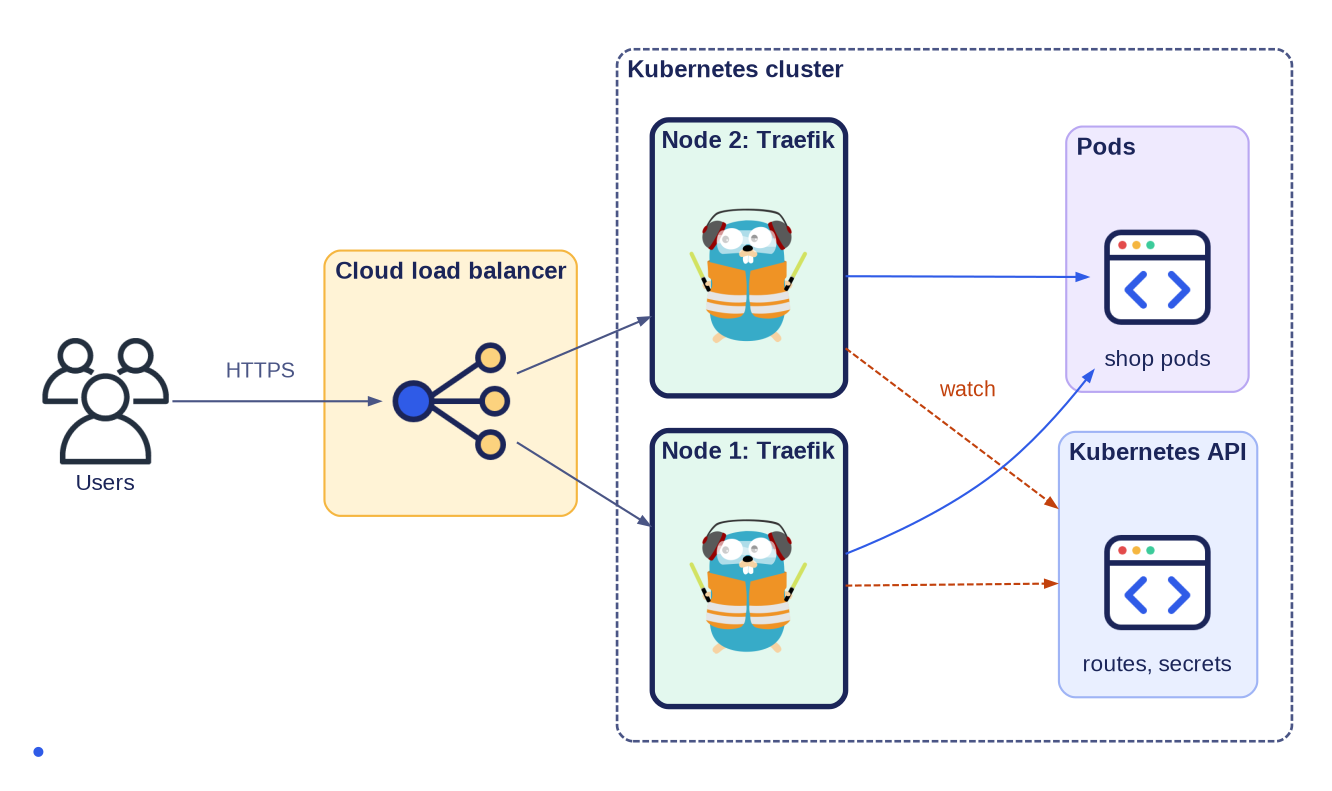
Traefik in Kubernetes
Two instances, shared knowledge
apiVersion: gateway.networking.k8s.io/v1kind: HTTPRoutemetadata: { name: shop, namespace: shop }spec: parentRefs: [{ name: public, namespace: edge }] hostnames: ["shop.example"] rules: - matches: [{ path: { type: PathPrefix, value: / } }] backendRefs: - { name: shop-v1, port: 80, weight: 95 } - { name: shop-v2, port: 80, weight: 5 }Traefik is also the ingress controller that K3s, a small Kubernetes distribution, deploys by default. After the retirement of ingress-nginx (see NGINX), its provider for ingress-nginx annotations is one path away from it. It supports many annotations, not all: test each one you use.
Safety
Four doors to close
The platform's API
Full access to the Docker API means control of the machine. Put a filtering proxy in between; in Kubernetes give only the rights in the documentation.
The dashboard
Not recommended in production without a login.
api.insecureserves it without one: never outside a test.Forwarded headers
Trust
X-Forwarded-*only from the addresses intrustedIPs.Labels are power
Who can set labels can claim any host name. Use constraints, namespaces and reviews.
Operations
Running it
| Question | Answer |
|---|---|
| How big? | Measure with your TLS and middlewares. It is one Go process that uses all cores given to it |
| Timeouts? | Reading a request 60 s, idle connections 180 s, writing an answer unlimited by default |
| High availability? | Two or more instances behind a balancer or a virtual IP; certificates from outside; limits in Redis |
| If the platform's API is down? | Known routes stay in memory and go on. A restarted instance learns nothing until it is back |
| What to watch? | Requests and errors per router and service, configuration reload time and failures, certificate expiry |
| How to upgrade? | Minor versions are supported for six months. Read the migration notes: v1 configuration does not work on v2, and v3 changed rule syntax |
Decide
Traefik or something else
| Product | Strong at | Choose it instead when |
|---|---|---|
| NGINX | Files, response cache, fine tuning | Servers rarely change, or you need a cache |
| HAProxy | Balancing with deep control | Load balancing itself is the hard part |
| Envoy | Dynamic by API, base of meshes | A platform team builds on it |
| Kong | Consumers, keys, plugins | You publish APIs to partners |
| Cloud balancer | Nothing to run | One cloud, few routes |
Strengths
- Routes live next to the service
- No reload, no script
- Certificates included
- Small to start, one program
Costs
- No response cache in the open source proxy
- Built-in ACME is for one instance
- Needs access to the platform's API
- Labels in many places are hard to review
Summary
The whole topic in one minute.
Traefik asks the platform what is running and turns the answer into routers, middlewares and services. Labels on containers or resources in Kubernetes are the configuration, and changes take effect within seconds without a restart.
That convenience needs three decisions: which containers may be public (exposedByDefault false), how Traefik reaches the platform's API safely, and who owns certificates once there are two instances. Set priorities by hand when rules overlap, and add health checks, limits and a graceful shutdown as with any proxy.
- Providers report, Traefik builds routes, nobody reloads.
- Entry point, router, middlewares in order, service, server.
- The longest rule wins unless you set a priority.
- exposedByDefault false, no raw Docker socket, a login on the dashboard.
- With two instances, certificates and exact limits come from outside.
Sources
- Traefik: configuration overview (install and routing)
- Traefik: providers
- Traefik: Docker provider
- Traefik: rules and priority
- Traefik: services and load balancing
- Traefik: ACME
- Traefik: rate limit
- Traefik: circuit breaker
- Traefik: FAQ on status codes
- Traefik: supported releases
- Traefik: ingress-nginx provider
- K3s: networking services
- Let's Encrypt: certificate lifetimes